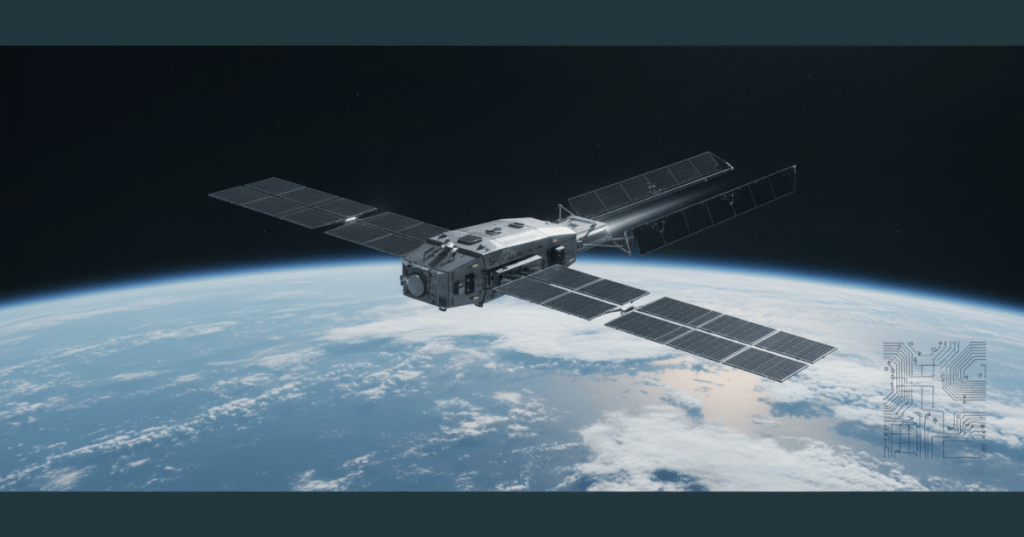
SpaceX chief executive Elon Musk said at Baron Capital’s 33rd Annual Investment Conference on November 6, 2026, that the first StarMind orbital AI computers, co-designed with NVIDIA, might launch in the third quarter of 2027. In a virtual interview with Ron Baron, Musk anticipated higher deployment volumes in 2028 and 2029 and forecast a SpaceX annualized revenue rate above $500 billion by December 2027. Both schedules represent expectations, not operational achievements or booked revenue.
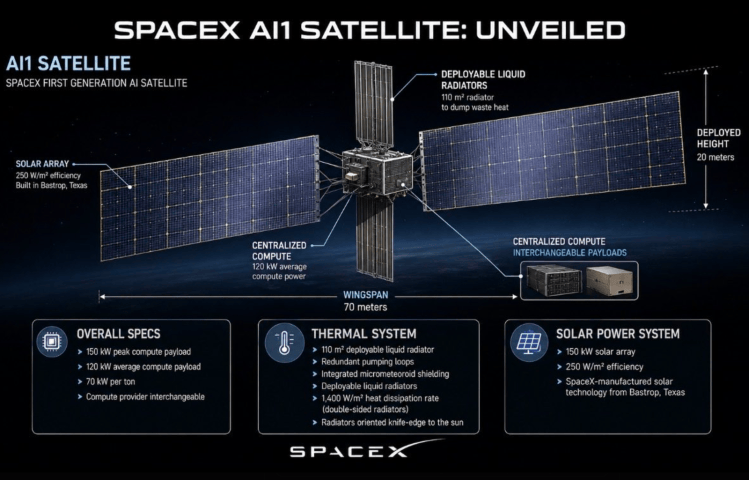
The proposed orbital system would combine AI accelerators with solar panels, satellite network connections and radiator surfaces to reject heat. Reusable rockets and vertically integrated hardware are central to SpaceX’s thesis that computing above Earth could compete with land-based data centers.
StarMind receives a tentative launch schedule
A contemporaneous machine-transcribed account of the conference stream quotes Musk qualifying the first-launch window with “I’m just guessing here.” He projected an initial slow rollout, potentially significant deployment in 2028, and larger volumes during 2029. Actual launch dates, spacecraft count and sustained computing capacity remain unverified future milestones.
The orbital case is constrained by thermal engineering. Spacecraft reject heat through radiation rather than conventional air cooling; sunlight, equipment temperature, radiator orientation and external heating influence the result. Previous BitcoinVersus.Tech radiator analysis examined the size of cooling hardware required. Space weather, communication delays and component replacement introduce additional costs.
SpaceX revenue would need to accelerate dramatically
SpaceX’s third-quarter SEC filing reports approximately $14.575 billion in quarterly revenue, compared with $7.814 billion in the preceding quarter, an increase of about 86.5%. The conference’s machine-transcribed account records Musk projecting fourth-quarter growth of “something like 70%”. Applied to the latest reported base, that would produce about $24.8 billion for the fourth quarter. The calculation is illustrative, not an announced financial result.
Musk predicted an annualized revenue rate exceeding $500 billion in December 2027, while cautioning “Now, this is not a promise.” A $500 billion annualized pace corresponds to $125 billion per quarter, about 8.6 times third-quarter 2026 revenue. An annualized exit rate must not be confused with $500 billion recognized during the full 2027 fiscal year. Musk reportedly assigned only approximately 2% likelihood to a $1 trillion annualized rate.
TeraFab’s terawatt target concerns chips
Musk reiterated his proposed one-terawatt-per-year TeraFab goal. The metric concerns the aggregate rated electrical load of AI chips produced annually. It does not mean TeraFab currently generates a terawatt of electricity or consumes that level of power. Musk estimated 2027 global AI-chip output at 35–45 gigawatts, making the target approximately 22–29 times his estimated baseline. Those industry estimates have not been independently verified.
Existing BitcoinVersus.Tech reporting on TeraFab details the 2028 manufacturing ambition. Equipment lead times, semiconductor yields, energy requirements and financing create substantial uncertainty around the terawatt production vision.
Starship, Starlink and the next evidence
Starship’s reusable launch architecture is pivotal to the projected cost per kilogram of orbital hardware. Musk also discussed Starlink expansion and traffic generated by AI agents, yet satellite network aspirations are not equivalent to approved or operational spacecraft numbers. Recent reporting on SpaceX’s mobile-network plans with Qualcomm and Starcloud’s GPU spacecraft manufacturing provides related communications and computing context.
Baron Capital is a major investor in Musk-led companies. A separate BitcoinVersus.Tech story on Ron Baron’s CNBC interview described the investor’s 2028 orbital-compute outlook. Musk’s afternoon conference remarks add a tentative StarMind deployment sequence and quantified business forecast. Verification now depends on launches, measured orbital computing output, fab production milestones and subsequent reported revenue.
We volunteer daily to ensure the credibility of the information on this platform is Verifiably True. If you would like to support our work and help further secure the integrity of our research initiatives, please scan the QR code below to donate 5,000 sats.

To scan on mobile, open the article on another display and scan the original QR code with a compatible Bitcoin wallet. Verify the destination 3C9o19EH5HSiwEPyCTmEKzxhNCbo2X6TTb before sending 5,000 sats.
Editor’s Note: The Baron conference agenda, reader-supplied event recording, independent machine-transcribed excerpts, and SpaceX’s SEC filing informed the analysis. A complete official transcript could not be independently obtained; direct quotes were checked against the attributed machine-transcribed reporting rather than independently transcribed from YouTube. Dates, revenue figures and production volumes are forecasts unless identified as reported results. The feature is original conceptual artwork and the SpaceX technical diagram is a historical concept, not a deployed system. BitcoinVersus.tech is not a financial advisor. This media platform reports on financial subjects purely for informational purposes.


Leave a Reply