
Serve Robotics launched Physical AI Services on November 5, 2026, turning the connectivity and training-data technology behind its delivery robots into products for other robotics developers. The company identified Bedrock Robotics, which develops autonomy for heavy construction machinery, as a launch customer. The expansion moves Serve beyond operating its own robots toward supplying infrastructure for outside machine fleets.
The technology addresses a growing problem in physical artificial intelligence: deploying a robot is different from keeping thousands of robots connected, monitoring failures and collecting useful examples for retraining. Serve says its systems already support thousands of vehicles across industries, including construction, mining and autonomous trucking. Those scale figures are company assertions, not independently audited product-usage measurements.
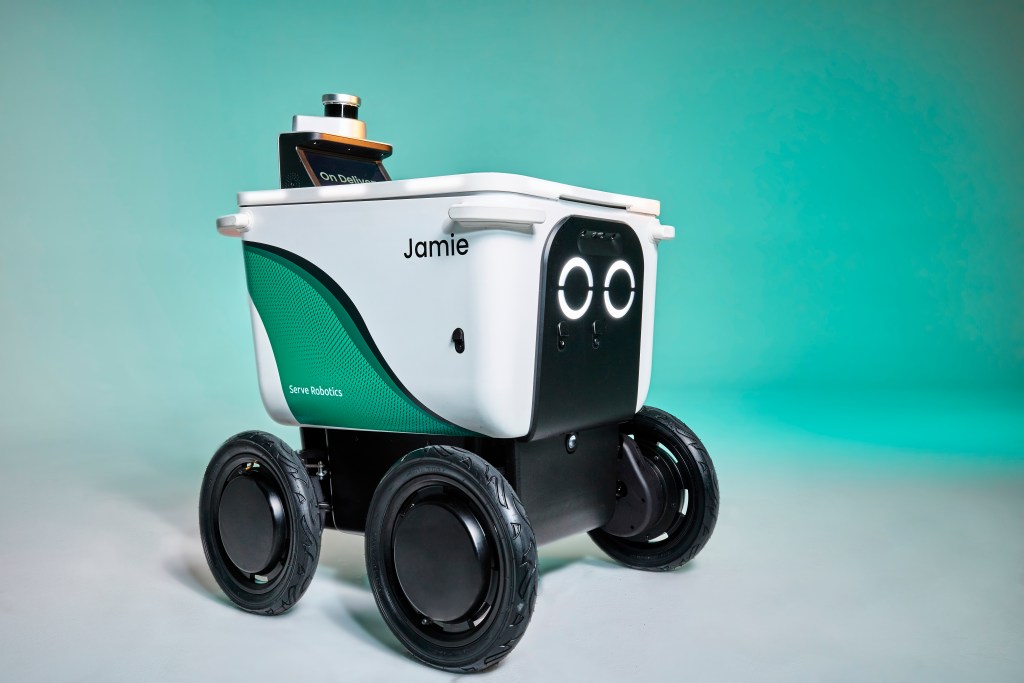
Three products support off-board intelligence
The newly launched portfolio consists of Serve Link, Serve Data Curator and a real-world training-data catalog. Serve Link connects mobile machines to monitoring, inference and training systems outside the robot, including data centers. Bedrock plans to use its connectivity across Wi-Fi, LTE, 5G and satellite networks, according to Serve’s announcement.
Keeping a robot connected does not make every safety-critical decision suitable for cloud execution. Wireless latency, coverage gaps, authentication and emergency-stop design still require local controls. The company has not published independent latency benchmarks, service-level guarantees or fleet-wide availability statistics for Serve Link. BitcoinVersus.Tech’s examination of Boston Dynamics’ agent-directed factory inspections demonstrates the separate role of remote orchestration in working robots.

Fleet data becomes a product
Serve Data Curator is designed to identify rare, useful events in the large volumes of sensor data captured by robots. Such events might include unfamiliar obstacles, changing sidewalks or near-miss scenarios. Selecting informative examples for review can reduce the workload of manually sorting every recorded frame, although Serve supplied no public validation metrics quantifying improvement.
A separate catalog packages data from Serve’s sidewalk deployments, including terrain and infrastructure information, for foundation-model training. Prior BitcoinVersus.Tech coverage of robot training-data facilities explains why diverse physical experience matters, while a recent report on MIT’s robot-memory correction research illustrates the challenge of interpreting observations accurately.
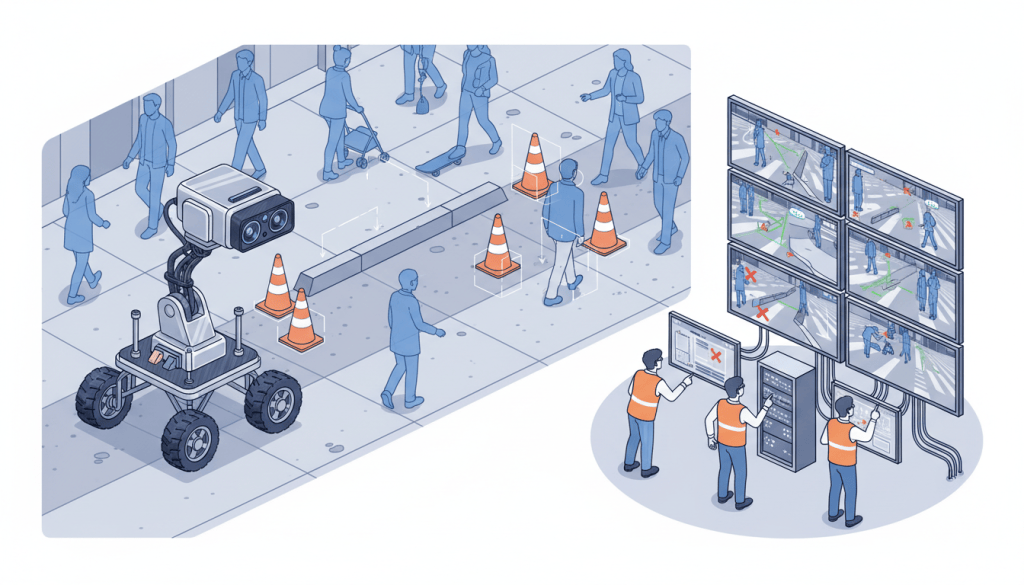
Commercial opportunity meets operating losses
Serve’s November 5 quarterly results give useful scale context. Revenue rose 313% year over year to $2.835 million for the September quarter, but fell from $3.238 million in the preceding quarter. The company recorded a $7.555 million gross loss and reported an average of 917 daily active robots. Its claim of more than 2,000 deployed robots must not be confused with robots active on an average day.
Serve raised its 2026 revenue guidance to $12 million and reported $198 million in cash and marketable securities at quarter-end. Neither the earnings release nor the new product announcement breaks out future Physical AI Services contract revenue, per-robot pricing, dataset licensing terms or guaranteed delivery performance. The new business could diversify revenue, but commercial profitability remains unproven.
Scaling across customer-owned machinery will also introduce cybersecurity, privacy and data-ownership questions. Different robots produce different sensor formats and may have vastly different safety consequences when connectivity fails. The distinction matters for equipment operating near pedestrians, construction crews and heavy industrial machinery. Related BitcoinVersus.Tech reporting on robotics lidar commercialization highlights another hardware layer developers must integrate with reliable autonomy software.
The next meaningful evidence will be disclosed customer contracts, independently reported service reliability, quantifiable training improvements and identifiable external-service revenue. For now, Serve has confirmed a product launch and named customer, not demonstrated that every robot maker can profitably outsource its intelligence infrastructure.
We volunteer daily to ensure the information on this platform is Verifiably True. If you would like to support the research, please scan QR code.

To donate 5,000 sats, scan the original QR code with a compatible Bitcoin wallet. On mobile, display the code on a separate screen. Check the destination 3C9o19EH5HSiwEPyCTmEKzxhNCbo2X6TTb before sending funds.
Editor’s Note: Verified sources include Serve Robotics’ November 5 product announcement, its official product overview, third-quarter earnings disclosure and SEC Form 8-K. Reporting was also cross-checked with TechCrunch. The 2024 manufacturer photograph is archival; both technical graphics are illustrations, not product screenshots. Video playback and live desktop/mobile rendering were not independently tested. BitcoinVersus.Tech is not a financial advisor; the publication covers financial information for educational purposes only.


Leave a Reply