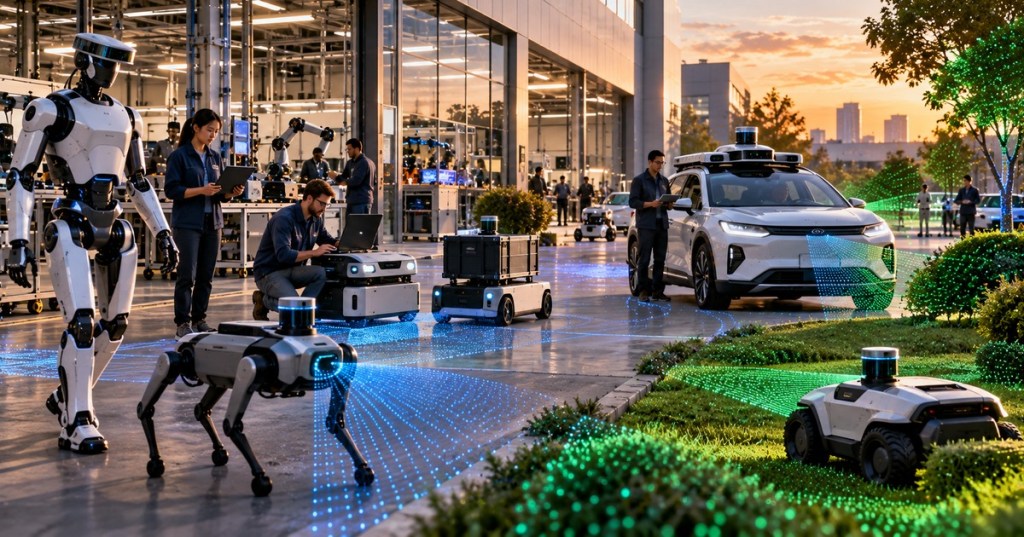
RoboSense says it sold a record 595,600 LiDAR units in the third quarter of 2026, up 220.9% from a year earlier. Robotics and other non-ADAS applications reached 145,200 units, up 309.0%, while advanced driver-assistance systems accounted for 450,400 units, up 200.1%.
Key Takeaways
- RoboSense reported 595,600 total LiDAR units in Q3 2026, a quarterly record.
- Robotics LiDAR reached 145,200 units, up 309.0% year over year.
- ADAS LiDAR reached 450,400 units, up 200.1% year over year.
- First-nine-month LiDAR volume reached 1,314,800 units.
- The figures are preliminary and unaudited operating data, not a full Q3 financial report.
The primary source is RoboSense’s October 9 operating update. Independent coverage from Momenta Media and other outlets reported the same figures from the company’s Hong Kong market disclosure.
Robotics Is Growing Faster Than Cars
ADAS still represented the majority of RoboSense’s Q3 unit volume, but robotics is growing faster. The company reported 145,200 robotics LiDAR units in the quarter, compared with 450,400 for ADAS.
For the first nine months of 2026, RoboSense reported 1,314,800 total LiDAR units, including 427,800 units for robotics and other applications and 887,000 for ADAS.
The company’s first-half results already showed the same shift. RoboSense reported H1 revenue of roughly RMB 1.02 billion, up 30.2% year over year, while robotics LiDAR volume rose 510.4% to 282,600 units. That suggests unit growth in robotics has been much faster than overall company revenue growth, an important reminder that shipment volume alone does not tell investors what is happening to selling prices, product mix or margins.
Why Robotics Needs More Sensors
Robots need reliable real-world perception to avoid obstacles, localize themselves, map environments and interact safely with people and objects. LiDAR provides depth information by measuring the travel time of laser pulses and turning those measurements into a three-dimensional point cloud.
That same perception layer is becoming more important as physical AI systems move beyond controlled demonstrations. BitcoinVersus.Tech recently covered XDOF approaching a $1.2 billion valuation around robot-training data. Better sensors and larger real-world datasets reinforce each other: higher-quality perception produces better training data, and better models make more effective use of sensor input.
BitcoinVersus.Tech also covered Flexiv using NVIDIA Isaac to train a robot to perform precise DisplayPort insertion. Tasks like that require accurate sensing, localization and control at close range, exactly the type of environment RoboSense is targeting with its robotics sensor portfolio.
RoboSense Is Moving Beyond LiDAR Alone
RoboSense is increasingly positioning itself as a broader robotics-platform supplier rather than only a LiDAR vendor. In its first-half update, the company described a strategy built around robotic “eyes,” “skin” and “muscles,” including Space Camera products, tactile sensors and joint modules.
The company’s AC1 active camera is an example of that expansion. It combines LiDAR, an RGB camera and an inertial measurement unit into one perception module for obstacle avoidance, mapping and localization.
Its New E2 Uses an In-House SPAD Chip
RoboSense says the latest E2 fully solid-state LiDAR is built around its in-house Peacock SPAD-SoC and a 2D VCSEL architecture. The company lists a 180° × 135° field of view and point-cloud output of up to 1.5 million points per second.
RoboSense also recently integrated its E2 and EM4 LiDAR products with NVIDIA Holoscan Sensor Bridge, allowing point-cloud data to move over Ethernet into NVIDIA edge-AI pipelines. That link between sensors and local compute is becoming increasingly important for robotics, where latency can matter as much as model intelligence.
The same trend is visible in autonomous transportation. BitcoinVersus.Tech recently argued that robotaxis may be one of the clearest paths to a standalone robotics business. Large-scale autonomy requires a stack that includes perception hardware, compute, models, fleet operations and continuous real-world data collection.
What the Numbers Do Not Tell Us Yet
The October update is an operating-volume disclosure, not a complete earnings report. RoboSense explicitly describes the figures as unaudited and based on preliminary internal information.
That means the announcement does not yet tell us Q3 revenue, gross margin, average selling price, operating income or net profit. Unit sales can grow much faster than revenue if lower-priced products make up a larger share of volume, and profitability depends on manufacturing cost, pricing and product mix as well as units shipped.
It is therefore safest to interpret the update as evidence of rapid physical deployment rather than a complete financial verdict on the company.
Bottom Line
RoboSense’s Q3 update shows LiDAR moving deeper into mass-market deployment across both vehicles and robots. The company says total quarterly volume more than tripled from a year earlier, while robotics volume grew even faster at 309%.
The bigger question now is whether that scale translates into durable revenue growth and profitability. The next full financial report should provide the margin and pricing data needed to answer that.
Editor’s Note: The 595,600-unit Q3 total, 450,400 ADAS units, 145,200 robotics units and year-over-year growth rates are company-reported preliminary operating data announced October 9, 2026. They are unaudited and should not be treated as a substitute for RoboSense’s full financial results.
Support independent reporting: BitcoinVersus.Tech volunteers daily to help keep its research verifiably true. Bitcoin donation address: 3C9o19EH5HSiWEPyCTmEKzxhNCbo2X6TTb.
BitcoinVersus.Tech is not a financial advisor. This media platform reports on technology and financial subjects for informational purposes.


Leave a Reply