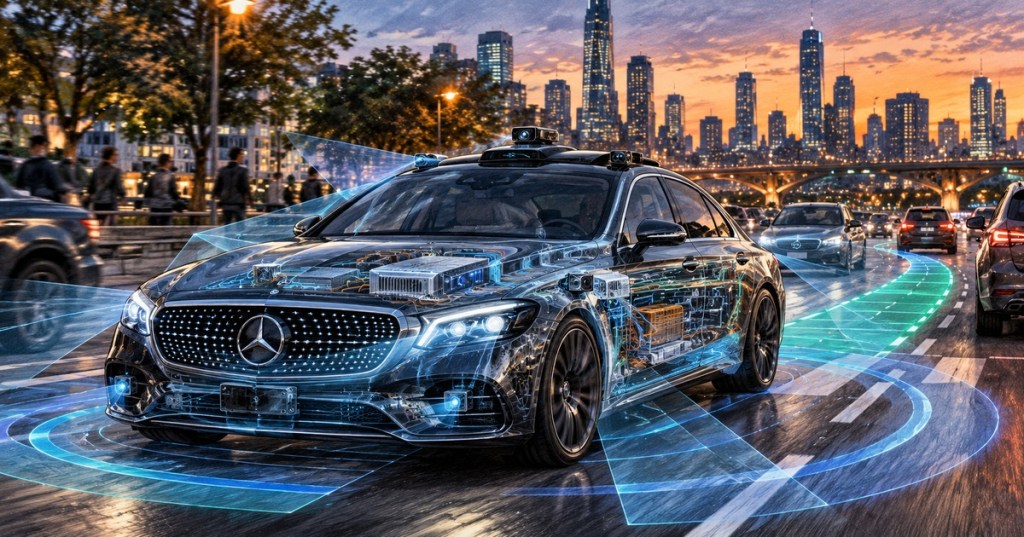
Mercedes-Benz and NVIDIA expanded their automated-driving partnership on October 16, 2026, adding a broader joint-development plan that ties Mercedes-Benz vehicle engineering and MB.OS to NVIDIA’s Hyperion compute-and-sensor architecture, Alpamayo driving software and Halos safety system.
According to Mercedes-Benz, the two companies will jointly develop the next generation of driver-assistance and automated-driving systems. The announcement goes beyond a single vehicle program: it describes a shared technical stack intended to support urban point-to-point assistance, active safety, automated parking and future higher-level automation.
The stack combines the car, sensors and AI software
Mercedes-Benz’s MB.OS remains the vehicle-side operating system, while NVIDIA Hyperion provides the in-vehicle compute and sensor architecture. Alpamayo adds full-stack driving software with AI reasoning capabilities, and Halos adds a safety layer that includes redundancy and guardrails. The companies say those pieces will be developed together rather than treated as separate bolt-on systems.
That architecture is important because automated driving increasingly depends on several layers working at once: cameras and other sensors have to perceive the environment, onboard processors have to interpret it in real time, planning software has to choose a maneuver, and a safety system has to monitor whether that decision stays inside acceptable limits.
BitcoinVersus.Tech recently covered RoboSense’s rapid LiDAR growth across robotics, one example of how sensing hardware is becoming a larger part of physical-AI systems. The same broader shift is visible in Mobileye’s physical-AI and robotaxi strategy, where the core business is increasingly about the entire perception-and-driving stack rather than one chip or camera.
Level 4 is part of the long-term target
The companies say the expanded work can support future SAE Level 4 applications, including what they describe as robolimousines. That does not mean today’s Mercedes vehicles suddenly become Level 4 autonomous cars. It means the joint platform is being developed with applications in that direction as a future target.
The competitive context is widening quickly. Reuters reported one day earlier that Volvo is also expanding its NVIDIA relationship for new driver-assistance and automated-driving technology. NVIDIA is therefore positioning Hyperion, Alpamayo and related safety tools as a reusable automotive platform rather than a system tied to only one automaker.
For Mercedes-Benz, the expanded agreement fits a larger move toward software-defined vehicles and over-the-air upgrades. For NVIDIA, it puts its accelerated-computing stack deeper into a market where the most valuable system may eventually be the combination of compute, sensing, reasoning software and safety validation.
That also connects directly to the economics of autonomous fleets. BitcoinVersus.Tech previously examined why robotaxis may be one of the clearest paths to an independent robotics business. Mercedes-Benz and NVIDIA are not announcing a commercial Level 4 fleet here, but the expanded partnership gives them more of the technical foundation required to compete if that market continues to scale.
BitcoinVersus.Tech Editor’s Note:
We volunteer daily to ensure the credibility of the information on this platform is Verifiably True. If you would like to support to help further secure the integrity of our research initiatives, please donate using the QR code provided

For best QR-code scanning results, please scan this donation code from a desktop or larger screen. Mobile screens may prevent camera recognition.


Leave a Reply