The easiest way to start a robotics company may not be building a robot at all. It may be operating somebody else’s robots.
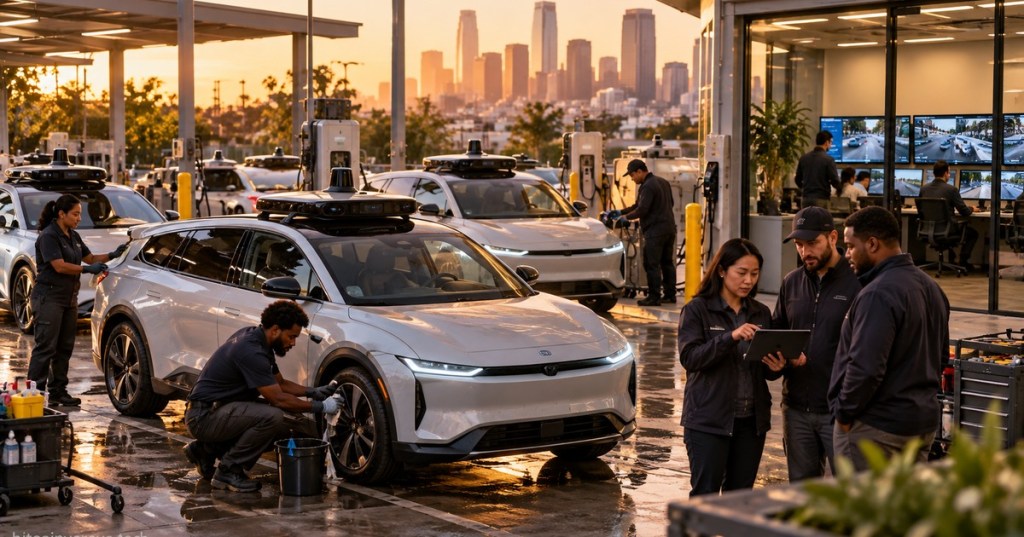
Robotaxis are beginning to reveal a business model that looks surprisingly familiar to the early Uber and Lyft economy: one company builds the platform, another supplies the vehicle or autonomy stack, another operates the fleet, and local businesses make money keeping the machines charged, clean, maintained, dispatched, recovered, and ready for service.
That could make autonomous transportation one of the most accessible pathways into an independent robotics business—not because robotaxis are easy, but because an entrepreneur may not need to invent the autonomous-driving system, manufacture the vehicle, or train the foundational AI model.
The Robot May Be the Hardest Part—and You May Not Need to Build It
Building a humanoid robot company from scratch means solving actuators, batteries, sensors, perception, manipulation, safety, manufacturing, software, controls, and a long list of physical-AI problems. BitcoinVersus recently covered how companies such as Mecka are raising major funding just to solve the data layer for physical AI.
A local robotaxi operator could attack a much narrower problem: keep autonomous vehicles productive.
That means vehicle acquisition or financing, charging, cleaning, tire and brake service, sensor cleaning, depot management, staging, software-update coordination, roadside recovery, parts inventory, inspection, insurance administration, utilization management, and local regulatory operations.
Lyft’s Nashville Depot Shows the Business Model Already Exists
On October 2, Lyft subsidiary Flexdrive opened a new 80,000-square-foot autonomous-vehicle depot in Nashville built to support Waymo vehicles. The facility includes fast chargers capable of supporting hundreds of AVs, high-voltage maintenance bays, secure parts storage, cleaning operations, and fleet staging.
That is important because Flexdrive does not build the Waymo Driver. It does not manufacture Waymo’s autonomous-driving sensors. Its value is the physical operating layer that keeps the fleet ready to earn revenue.
Flexdrive says it already manages roughly 15,000 vehicles across 24 North American locations. Nashville is the same fleet-management expertise applied to robotics. The company is effectively becoming an autonomous fleet operator.
Moove Makes the Thesis Even Clearer
Moove is building almost exactly the independent-operator model this article describes. Its current autonomous-vehicle business finances, owns, and operates AV fleets for mobility platforms. The company builds robotics-focused depots, manages charging, handles maintenance and readiness, and runs 24/7 command operations.
Moove raised $250 million in August at a $2.1 billion valuation to expand that infrastructure layer. The important part is what investors are funding: not a new self-driving foundation model, but the systems required to turn autonomous vehicles into a functioning transportation business.
This Is the Uber Driver Model Moved Up One Level
Uber and Lyft originally made independent transportation businesses unusually easy to start. A person did not need to build a dispatch network, payment system, mapping platform, or consumer marketplace. The platform supplied those pieces. The driver supplied the vehicle and labor.
Autonomy changes the unit of entrepreneurship.
Instead of one person owning one car and selling driving labor, the next independent operator may own or manage five, 20, 100, or 500 robotic vehicles and sell fleet availability.
The robot becomes the worker. The entrepreneur becomes the fleet manager.
The Business Could Look More Like a Franchise Than a Robotics Lab
Imagine a future autonomy platform approving qualified local fleet partners. The operator leases certified autonomous vehicles, secures a depot, installs charging, hires technicians, connects to Uber, Lyft, Waymo, or another marketplace, and gets paid based on vehicle availability and completed rides.
The operator would not modify the autonomy stack any more than a franchise owner rewrites the software in a point-of-sale terminal. The competitive advantage would be operations: lower downtime, faster cleaning, cheaper charging, better preventive maintenance, quicker recovery, smarter staging, and higher utilization.
That is why the current Waymo expansion matters beyond Waymo itself. More deployed robotaxis create demand for an entire service economy around those vehicles.
Uber Is Explicitly Planning for Third-Party Robotaxi Fleets
Uber’s expanding autonomous strategy points in the same direction. Its Nuro/Lucid robotaxi program separates the vehicle, autonomy technology, ride-hailing marketplace, and fleet operation into different layers. Uber has said the vehicles can be owned and operated by Uber alongside third-party fleet partners.
That modular structure matters. It suggests autonomous transportation does not have to become a world where five giant companies own every robot. The technology provider, marketplace, fleet owner, depot operator, charging company, repair business, and local logistics operator can all be different companies.
BitcoinVersus has tracked the same separation happening elsewhere in autonomy. Aurora’s autonomous trucking turns freight lanes into robotic transportation infrastructure, while Mobileye has expanded from autonomy technology toward operating its own robotaxi business.
Delivery May Be an Even Easier First Step
Robotaxis still carry people, which brings heavy safety, insurance, permitting, and liability requirements. Autonomous delivery can lower the stakes.
A small delivery robot does not need a passenger cabin. It can move food, groceries, prescriptions, laundry, retail orders, or internal commercial supplies. That opens business models around restaurant delivery, hospital logistics, apartment campuses, resorts, warehouses, college campuses, and neighborhood retail.
This is already happening. DoorDash is coordinating human Dashers, autonomous delivery robots, and drones through the same marketplace logic. BitcoinVersus previously covered how DoorDash is pushing ordering and rideshare toward agentic AI. Physical autonomy is the next layer: deciding not just what gets ordered, but which machine moves it.
Seven Independent Robotics Businesses Could Sit Around One Robotaxi Fleet
- Fleet owner/operator: finance vehicles and sell available robot-hours to mobility platforms.
- Depot operator: provide secure parking, staging, charging, cleaning, and overnight service.
- Robotics maintenance company: specialize in sensors, compute modules, high-voltage systems, tires, brakes, calibration, and preventive service.
- Autonomous recovery service: retrieve disabled vehicles, handle roadside incidents, and return robots to service.
- Charging and energy operator: manage fast charging, batteries, demand charges, and depot energy costs.
- Local delivery fleet: operate sidewalk robots, autonomous vans, or small cargo vehicles for restaurants and merchants.
- Fleet command center: monitor robot health, coordinate exceptions, schedule maintenance, and optimize utilization across multiple customers.
None of those businesses is trivial. But all are more approachable than spending billions of dollars trying to reproduce Waymo’s autonomy stack.
The Best Opportunity May Be the Boring Part
Robotics conversations naturally focus on AI models, cameras, lidar, chips, and spectacular demonstrations. Commercial fleets care about a different metric: Is the robot ready to work?
A dirty camera can stop a sophisticated robot. A dead battery can turn millions of dollars of AI into parked equipment. A damaged tire, blocked charging stall, missing part, software-update failure, or poorly staged fleet can destroy utilization.
That makes uptime the bridge between robotics technology and robotics revenue.
This Still Is Not an Easy Small Business
There is an important limit to the thesis. Today, an entrepreneur cannot simply buy an autonomous car on Friday, attach it to Uber on Monday, and call it a robotaxi company.
Commercial autonomous fleets require approved vehicles, autonomy-provider agreements, insurance, local permits, depot infrastructure, trained technicians, safety procedures, remote-support systems, and enough capital to survive low utilization during launch.
So “easiest” is relative. Fleet operation may be the easiest serious robotics business because the entrepreneur can specialize in deployment instead of inventing the robot—but barriers to entry are still much higher than ordinary rideshare driving.
The Robotics Economy Could Resemble the Early Internet
Most internet businesses did not build the internet. They built companies on top of standardized infrastructure.
Robotics may develop the same way. A small company may not design motors, manufacture lidar, train driving models, fabricate chips, or build the marketplace. It may simply become excellent at operating robots in Tacoma, Nashville, Atlanta, Phoenix, Dallas, or whichever city opens next.
That shift could be one of the most important consequences of purpose-built robotaxis: the emergence of ordinary businesses whose employees are machines.
What Comes Next
The signal to watch is whether autonomy companies begin publishing formal third-party fleet-operator programs with standardized vehicle leases, maintenance certifications, depot requirements, insurance packages, and revenue-sharing contracts.
If that happens, robotics entrepreneurship changes dramatically. Starting a robotics company may stop meaning “invent a robot” and start meaning “own a robotic workforce and operate it better than anyone else.”
BitcoinVersus.Tech
Editor’s Note: This is an analysis of an emerging business model, not a claim that consumer-owned robotaxis can currently be deployed independently on Uber, Lyft, Waymo, or other platforms. Autonomous-vehicle operation remains highly regulated and capital intensive, and partnership requirements vary by company and jurisdiction.
We volunteer daily to improve the credibility of the information on this platform. If you would like to support the research, please donate here: 3C9o19EH5HSiwEPyCTmEKzxhNCbo2X6TTb
BitcoinVersus.tech is not a financial advisor. This media platform reports on technical and financial subjects purely for informational purposes.


Leave a Reply