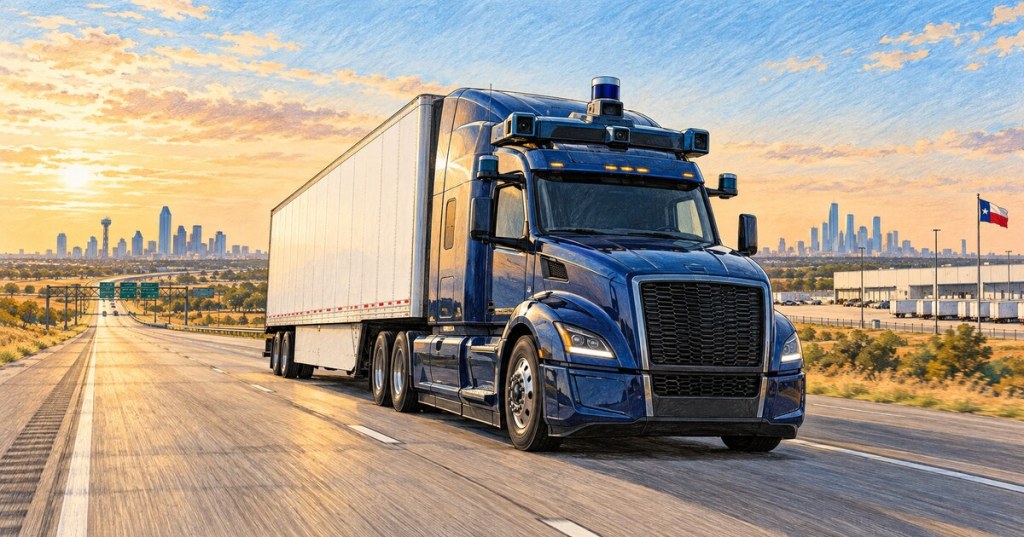
Conceptual illustration of Aurora’s autonomous freight truck on a Texas highway; not a photograph of the inaugural run.
Aurora Innovation’s first commercial autonomous freight run in Texas marked a major shift for long-haul trucking: an autonomous Class 8 tractor-trailer carried customer freight on public highways without a human safety driver in the cab. The initial Dallas-to-Houston lane showed how Aurora’s Driver system could move from supervised testing into a commercial operating model.
The truck, not the trailer, is the breakthrough
The inaugural run covered roughly 200 miles between Dallas and Houston, according to reported coverage. The freight was frozen pastry, and the route followed years of monitored testing in which Aurora said its vehicles accumulated more than three million autonomous miles and thousands of customer loads.
Aurora’s system uses cameras, radar and long-range lidar to interpret the roadway, vehicles, construction zones and objects around the truck. The commercial operating design focuses on the long-haul middle mile, while human logistics workers can continue handling terminal operations, local delivery and customer-facing work.
Watch the autonomous freight run
The supplied video provides the visual reference for the truck and the Texas freight milestone. The player below uses the clean YouTube watch URL so the video can load inside the article.
Why Dallas to Houston matters
The Dallas–Houston corridor is long enough to expose a truck to highway merges, changing traffic, construction, weather variation and terminal handoffs while remaining operationally concentrated. That makes it useful for proving the repeatability of autonomous freight, not merely demonstrating a vehicle on a closed test track.
The move also belongs to a broader autonomy and infrastructure trend visible in our coverage of Kodiak AI’s Dallas–Houston lane, TIER IV’s open autonomous racing platform, 4D lidar production and open control systems for AI infrastructure. Each involves a different vehicle or machine, but all depend on sensors, compute, control software and dependable operating procedures.
Commercial autonomy still requires a human operating system
Driverless does not mean unattended. Commercial freight still requires dispatch, maintenance, loading, inspections, terminal coordination, remote assistance and a clear response process when road conditions exceed the system’s operating design. The autonomous truck removes a driver from the cab during the validated highway portion; it does not remove the rest of the logistics workforce.
TechCrunch later reported that Aurora moved into a commercial agreement with McLane for driverless Dallas–Houston hauls, with human workers continuing local delivery after the middle-mile trip. That model shows how autonomy can be inserted into an existing supply chain without requiring every part of the freight movement to become autonomous at once.
The next test is repeatable service
A first commercial run proves that one carefully prepared trip can be completed. A durable business requires thousands of predictable trips across day and night conditions, construction zones, changing freight schedules and maintenance events. Aurora’s Texas launch therefore matters less as a futuristic spectacle than as an operating benchmark for reliability, safety assurance and route expansion.
BitcoinVersus community promotion
Readers exploring small-scale mining hardware can review the published offer below and independently verify the seller and current terms. The promotion is separate from the Aurora reporting.
BitcoinVersus.Tech Editor’s Note:
We volunteer daily to ensure the credibility of the information on this platform is Verifiably True. If you would like to support our research initiatives, you can donate here: 3C9o19EH5HSiwEPyCTmEKzxhNCbo2X6TTb
BitcoinVersus.tech is not a financial advisor. This media platform reports on financial subjects purely for informational purposes.


Leave a Reply