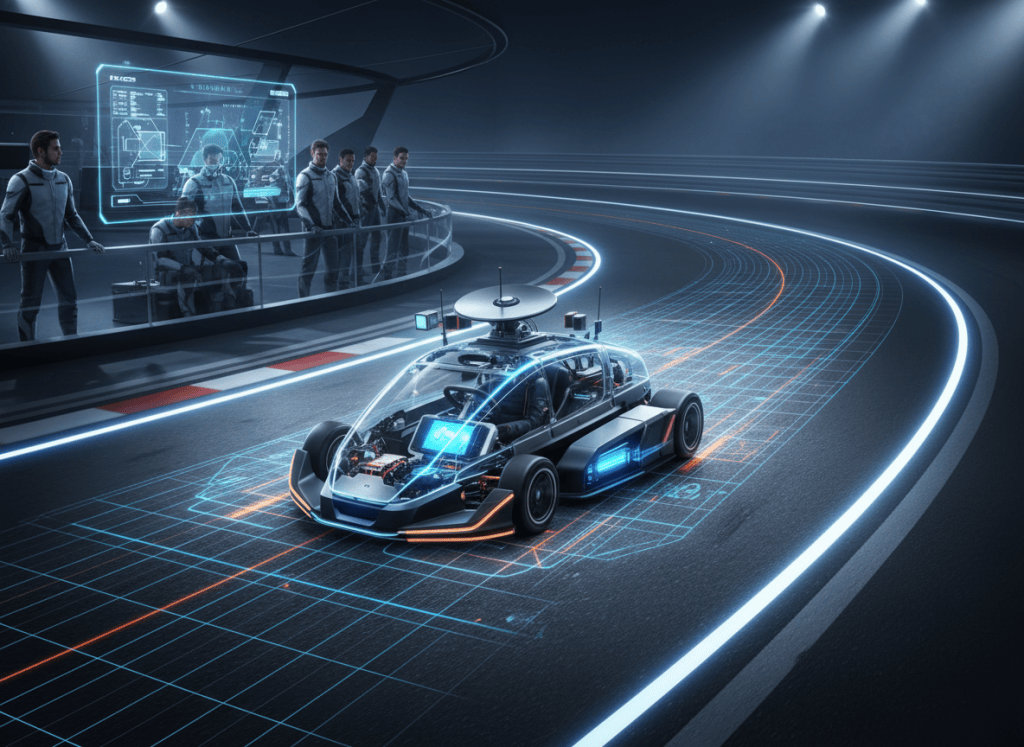
Open-source autonomous driving is moving onto the racetrack. TIER IV has released a public reference design for autonomous racing karts built on Autoware, giving developers a common platform that connects simulation, onboard computing and real-world EV kart testing.
From simulator to real racing kart
The reference design combines a TOM’S electric racing kart with GNSS positioning, an inertial measurement unit, an onboard computer and Autoware-based autonomous-driving software. TIER IV also provides a racing-kart simulator and development tools so teams can test software before moving to a physical vehicle.
That simulator-to-track workflow is important because autonomous systems are not just AI models. They depend on sensors, compute, vehicle controls, positioning and software operating together with predictable timing.
240 teams used the platform
The system was used in the 2026 Autonomous Driving AI Challenge organized by the Society of Automotive Engineers of Japan. TIER IV says 240 teams representing roughly 600 participants used the reference design during qualifying and final rounds from July through September.
The September 19-20 finals included both simulation and real-vehicle challenges. Giving every team a shared technical foundation allowed competitors to spend more time improving autonomous-driving algorithms and AI models instead of assembling an entire hardware and software stack from scratch.
Why open-source racing matters
Motorsport has long been a testing ground for automotive engineering. Autonomous kart racing adds software engineering, robotics and machine learning to that tradition. A lightweight kart also provides a relatively accessible platform for testing perception, localization, planning and vehicle control at meaningful speeds.
TIER IV has published the autonomous-driving software, simulator and design information through a public GitHub repository. That makes the project useful beyond a single competition: developers, researchers and students can inspect the architecture and build on the same foundation.
The bigger technology story
The project sits at an unusual intersection of sports and engineering. The competition is racing, but the underlying challenge is systems integration: sensors feed data to onboard compute, software estimates vehicle state and surroundings, planning chooses a path, and control systems turn those decisions into motion.
For open-source autonomous driving, racing provides something especially valuable: a measurable environment where different software approaches can be compared under pressure.
Sources
BitcoinVersus.tech verified the technical specifications, participation figures and competition timeline against TIER IV’s September 24 announcement and supporting coverage of the 2026 Autonomous Driving AI Challenge.


Leave a Reply