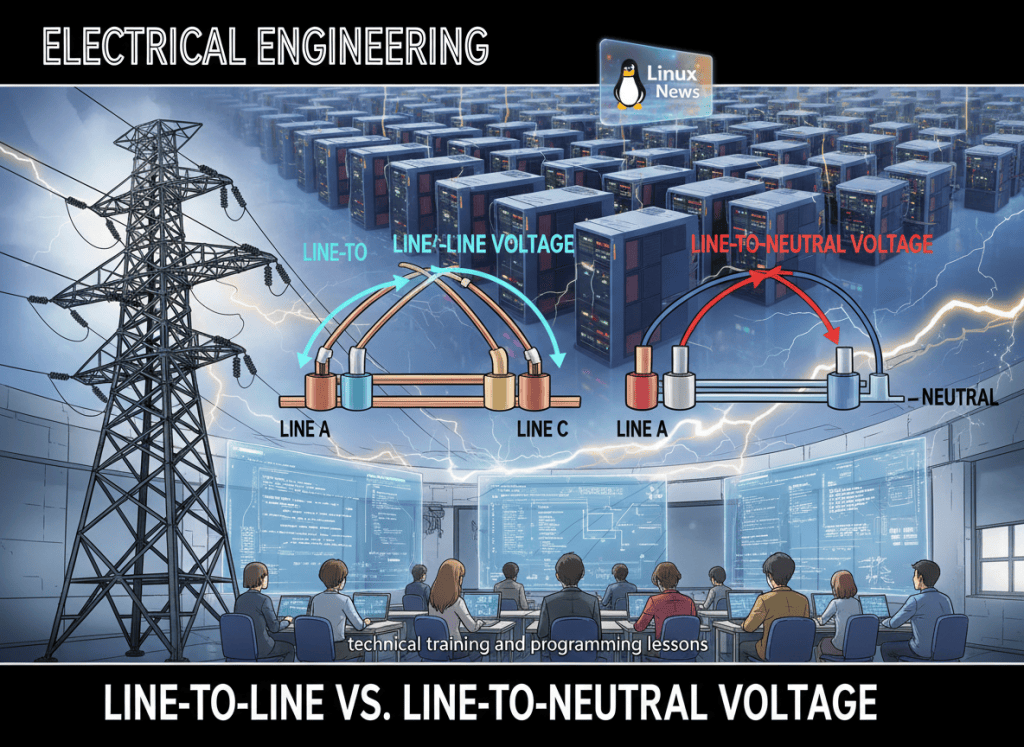
Three-phase wye systems commonly provide both line-to-line and line-to-neutral voltages. In a 208Y/120 V system, the nominal values are 208 V line-to-line and 120 V line-to-neutral. In a 480Y/277 V system, they are 480 V and 277 V.
The square-root-of-three relationship
For a balanced wye system, line-to-line voltage is approximately 1.732 times line-to-neutral voltage. That is why 120 V corresponds to about 208 V and 277 V corresponds to about 480 V.
Why technicians care
Knowing which conductors a voltage refers to helps when reading panel schedules, equipment labels, schematics, PDUs, and data-center power distribution. A voltage number is meaningful only when you know the two points between which it is measured.
Measurement context
Fluke’s three-phase guidance distinguishes measurements across phase conductors from measurements referenced to neutral or ground. Energized electrical measurements can expose workers to shock and arc-flash hazards, so only qualified and authorized personnel should perform them using appropriately rated equipment, PPE, and procedures.
Quick reference
208Y/120 V: about 208 V line-to-line and 120 V line-to-neutral.
480Y/277 V: about 480 V line-to-line and 277 V line-to-neutral.
Balanced wye: V(L-L) ≈ √3 × V(L-N).
BitcoinVersus.Tech Editor’s Note: We volunteer daily to ensure the credibility of the information on this platform is Verifiably True. Support our research: 3C9o19EH5HSiwEPyCTmEKzxhNCbo2X6TTb
BitcoinVersus.tech is not a financial advisor. This media platform reports on financial subjects purely for informational purposes.


Leave a Reply