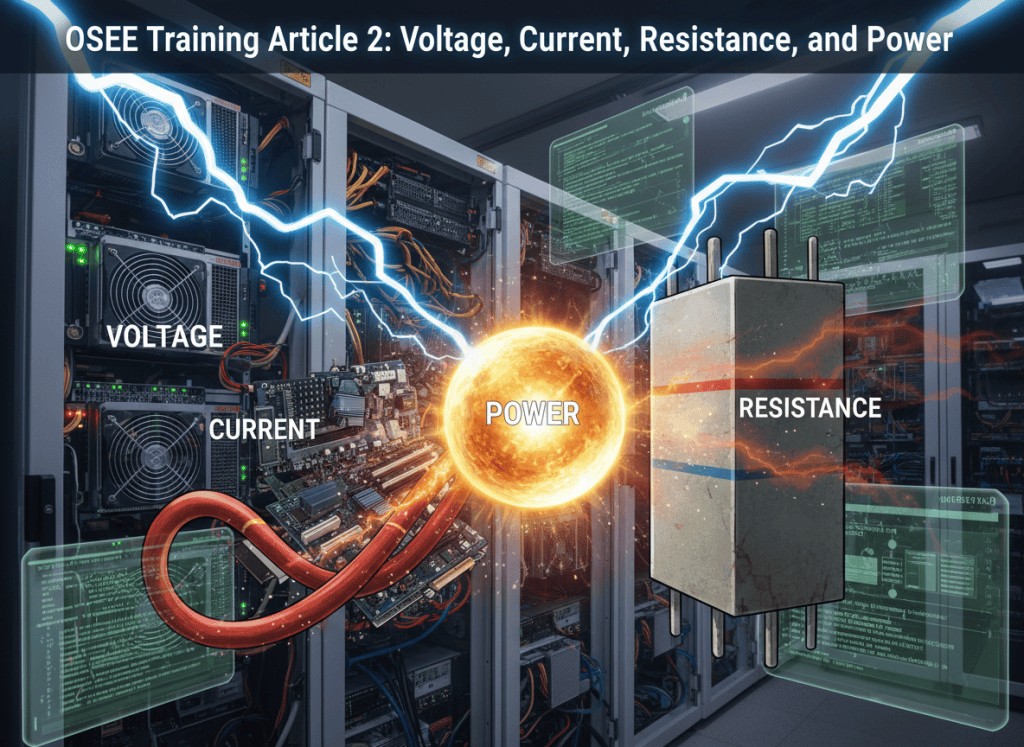
In simple terms: Think of a simple DC circuit like water moving through a pipe. Voltage is like the pressure difference that drives flow. Current is like the amount flowing each second. Resistance makes flow harder. Power tells you how quickly energy is delivered or used. For example, a 12 V device drawing 2 A uses 24 W. The water comparison is only a memory aid, but it helps separate the four ideas before you use the formulas.
Definitions: Voltage (V) is electrical potential difference between two points, measured in volts. Current (I) is the rate of electric-charge flow, measured in amperes (A). Resistance (R) is opposition to current, measured in ohms (Ω). Power (P) is the rate of energy transfer, measured in watts (W). One watt means one joule of energy per second.
Article 2 of the BitcoinVersus.Tech Open-Source Electrical Engineering Training Program establishes four quantities that appear throughout nearly every later electrical lesson: voltage, current, resistance, and power. The goal is not memorization alone. It is learning what each quantity means when looking at a real circuit, meter reading, power supply, rack, or piece of industrial equipment.
Voltage: electrical potential difference
Voltage is the electrical potential difference between two points. A meter does not measure “voltage at one point” by itself; the reading is always a difference between the two measurement points. This is why identifying line, neutral, ground, and phase relationships matters in field work.
Current: movement of electric charge
Current describes the rate of electric-charge flow and is measured in amperes. A load draws current when connected to an appropriate source and operating circuit. Current measurements are especially useful when checking load conditions, circuit utilization, imbalance, and equipment behavior.
Resistance: opposition to current
Resistance is measured in ohms. Ohm’s law connects voltage, current, and resistance:
V = I × R
I = V / R
R = V / I
If a 12 V source is applied across a 6 Ω resistance, the idealized current is:
I = 12 V / 6 Ω = 2 APower: how fast electrical energy is transferred
Electrical power is measured in watts. For a simple DC circuit:
P = V × IA 12 V load drawing 2 A therefore uses 24 W in this simplified example. Later lessons will extend these ideas into AC systems, power factor, single-phase and three-phase power.
Why these four quantities matter
These relationships become the language used to interpret equipment labels, breaker loading, power supplies, ASIC miners, server racks, batteries, control circuits, and test-instrument readings. Understanding the relationships is more useful than simply memorizing formulas.
Practice
1. A 24 V circuit has 12 Ω of resistance. Calculate current.
2. A device operates at 48 V and draws 5 A. Calculate power.
3. A 120 V load draws 10 A. Calculate its simple V×I apparent numerical product, while remembering that later AC lessons will distinguish real power and power factor.
Safety boundary
These examples are mathematical training, not authorization to work energized. Real electrical work requires appropriate training, procedures, PPE, test equipment, and compliance with the applicable rules and authority having jurisdiction.
BitcoinVersus.Tech Editor’s Note: We volunteer daily to ensure the credibility of the information on this platform is Verifiably True. Support our research: 3C9o19EH5HSiwEPyCTmEKzxhNCbo2X6TTb
BitcoinVersus.tech is not a financial advisor. This media platform reports on financial subjects purely for informational purposes.


Leave a Reply