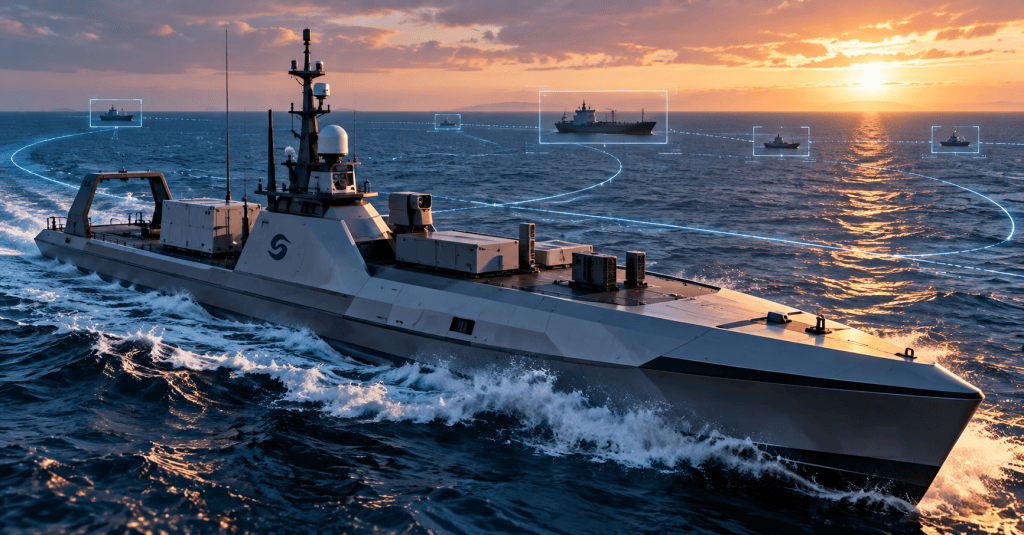
Saronic’s 180-foot Marauder autonomous ship has moved from at-sea evaluation into production for the U.S. Navy after completing more than 140 test scenarios across eight straight days of 24/7 operations without a reported failure.
In its production-award announcement, Saronic says Marauder was tested as the same full-size platform now covered by the Navy’s Medium Unmanned Surface Vessel Marketplace award rather than as a surrogate or one-off demonstration vehicle.
The hardest part was seeing without announcing itself
The trial was not just a navigation exercise. Marauder had to track and maneuver around other vessels while also completing passive-perception scenarios that required it to detect, track and follow ships using onboard passive sensors without relying on active radar.
That matters because active radar is useful precisely because it transmits energy and listens for the return. Passive perception flips the problem around: the autonomous system has to build a usable picture of its environment from information it can observe without continuously broadcasting its own radar emissions.
Naval News independently reported that Marauder completed the continuous evaluation and then received a production Other Transaction award under the Navy’s MUSV Marketplace. Saronic has not publicly disclosed the value of its specific award.
Marauder is closer to a robot ship than a remote-control boat
The bigger shift is architectural. Saronic is designing the vessel around autonomy from the beginning rather than taking a conventional crewed ship and bolting automation onto it later. That changes everything from software and sensing to onboard systems, maintenance assumptions and how payload space is used.
BitcoinVersus recently covered Aurora’s first commercial autonomous freight run in Texas. The operating environment is completely different, but the engineering principle is similar: move autonomous systems from controlled demonstrations into long-duration real-world operations where perception, planning and fault handling all have to work continuously.
Saronic is training for zero-crew operation
A recent interview with Saronic co-founder and CTO Vibhav Altekar provides useful context for that design philosophy. Altekar discusses building vessels for autonomy from day one, operating with passive sensing in contested environments, encoding mariner expertise into autonomous systems and reducing the gap between software development and on-water testing.
The software problem is closely related to the broader physical-AI stack emerging across robotics. BitcoinVersus recently examined AMD’s push to move physical AI from cloud development into robots, where simulation, perception and accelerated compute are being treated as one continuous deployment pipeline.
Production is becoming part of the autonomy stack
Saronic says Marauder moved from initial design to the water in under a year and that additional hulls are already moving through production. The company’s argument is that autonomy software, vessel hardware and the manufacturing process need to be designed together rather than optimized as separate programs.
That echoes what is happening in industrial robotics, where the control stack is increasingly expected to survive outside the lab. BitcoinVersus recently covered Google Intrinsic opening core industrial robotics software, another example of autonomy moving toward reusable production infrastructure instead of isolated demos.
Marauder’s Navy evaluation is notable because it tests that idea at ship scale. Eight days of round-the-clock operation, more than 140 back-to-back scenarios and passive detection without active radar are a very different benchmark from a short scripted demonstration.
If Saronic can repeat that reliability across multiple production hulls, autonomous maritime systems begin to look less like experimental drones and more like a new class of continuously operating infrastructure.
BitcoinVersus.Tech
Advertisement
Editor’s Note:
We volunteer daily to ensure the credibility of the information on this platform is Verifiably True. If you would like to support to help further secure the integrity of our research initiatives, please donate here: 3C9o19EH5HSiwEPyCTmEKzxhNCbo2X6TTb
BitcoinVersus.tech is not a financial advisor. This media platform reports on financial subjects purely for informational purposes.


Leave a Reply