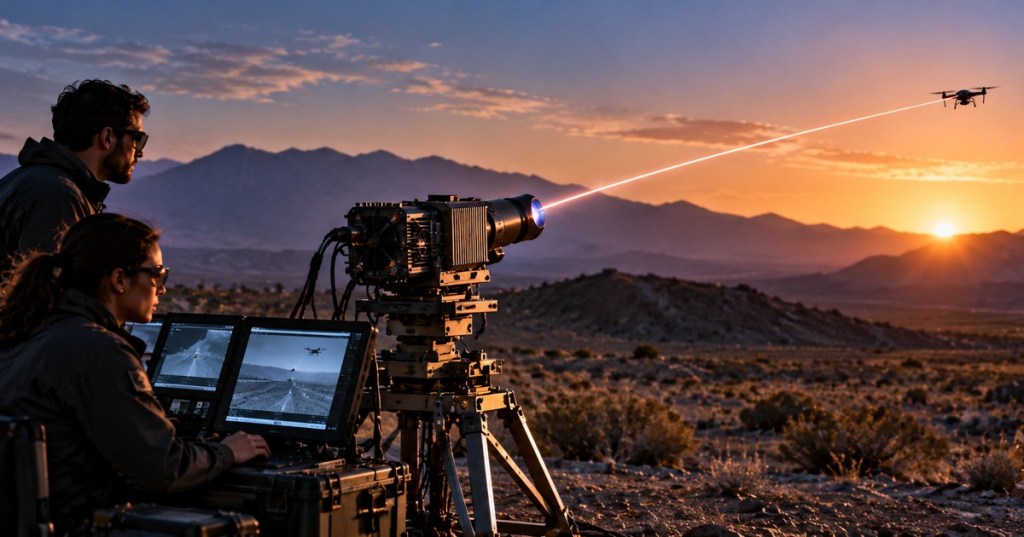
Applied Energetics says it has validated a new ultrashort-pulse laser architecture that combines higher output with improved beam quality, a combination the company believes can extend the effective range of compact counter-drone systems. The disclosure was filed with the U.S. Securities and Exchange Commission on October 9, 2026, one day after the company announced the result.
Key Takeaways
- Applied Energetics filed the development in an October 9 Form 8-K covering an October 8 event.
- The company says the new architecture delivers higher laser output and significantly better beam quality.
- Two prototypes are now under construction: an extended-range counter-drone system and a backpackable laser system.
- The filing does not disclose power levels, range figures, beam-quality measurements or independent test results.
- The technology remains in prototype development and continued testing, not an announced operational deployment.
The primary source is Applied Energetics’ October 9 SEC filing. In Item 8.01, the company says it validated a next-generation ultrashort-pulse laser architecture with higher power and improved beam quality. The attached Exhibit 99.1 says the design is intended to improve energy delivery over longer distances and support smaller, more mobile systems.
Why Beam Quality Matters
Laser output alone does not determine how useful a directed-energy system is at distance. A beam also has to remain sufficiently controlled as it propagates through the atmosphere and reaches a target. Applied Energetics says the new design improves both output and beam quality, which is why the company is connecting the architecture to longer-range operation.
The underlying physics is not unique to this company. The Air Force Office of Scientific Research describes ultrashort-pulse laser research as using extremely short pulses with high peak power, broad spectral bandwidth and very short duration for areas that include directed energy, remote sensing, communications and materials processing.
Applied Energetics is focusing that concept on sensors carried by drones and other autonomous systems. The company’s March 2026 outdoor-test material showed its laser being aimed at an electro-optic target associated with a drone test setup. The company described the result as a rapid sensor defeat rather than a conventional thermal burn-through mechanism.
Two Prototypes Are Being Built
The most concrete new detail in the filing is that Applied Energetics says it has moved beyond architecture validation and is constructing two prototype systems.
- Extended-range counter-drone prototype: designed around Group 1 and Group 2 small-drone threats.
- Backpackable laser prototype: intended for selected national-security applications where portability and rapid deployment matter.
The distinction between a validated architecture and a fielded system matters. Applied Energetics says it is still following a program of continuous testing and iterative validation to optimize power output and long-range precision. The company has not announced that either prototype is operationally deployed.
The Drone Problem Is Getting Broader
Small drones are becoming cheaper, easier to customize and easier to build. BitcoinVersus.Tech recently covered OpenDrone’s push to make FPV drone hardware open source, an example of how capable unmanned hardware can spread beyond traditional aerospace manufacturers.
At the high-performance end, systems are also getting faster and more automated. The Skydio F10 can be launched and recovered by a robotic arm while operating at speeds up to 100 mph. That combination of speed, autonomy and mass availability is part of the reason governments and defense companies are looking for lower-cost ways to defeat or disable drones without relying only on conventional interceptors.
The same broader shift toward autonomous systems is visible at sea. BitcoinVersus.Tech also reported on Saronic moving its 180-foot Marauder autonomous vessel into Navy production. Counter-autonomy is increasingly becoming a hardware, sensing and compute problem rather than a single-platform problem.
What the Filing Does Not Prove
The SEC filing is useful because it establishes exactly what Applied Energetics chose to disclose and when. It should not be read as independent technical certification of the company’s performance claims.
The filing does not provide the laser’s output power, pulse energy, beam-quality factor, tested engagement distance, atmospheric conditions, target details or a third-party test report. It also does not disclose prototype cost, battery requirements, operating duration or a deployment schedule.
Those missing numbers are important because they determine whether a laboratory or range improvement translates into a useful field system. Until more test data is published, the defensible conclusion is narrower: Applied Energetics says it has improved its architecture enough to begin building two new prototypes, and it has formally placed that claim into an SEC filing.
What Happens Next
Applied Energetics says testing and iterative validation will continue. The company is also scheduled to attend the Association of the United States Army Annual Meeting and Exposition in Washington, D.C., from October 12 through October 14.
The next meaningful evidence would be measured prototype results: disclosed range, power, beam quality, target effects, size and weight, or third-party government testing. Those data would make it easier to judge whether the new architecture is simply a promising engineering step or the beginning of a deployable counter-drone system.
Editor’s Note: Applied Energetics’ architecture validation, prototype construction and expected performance improvements are company-reported claims disclosed in an SEC filing. The SEC’s publication of the filing confirms the disclosure; it does not independently validate the underlying engineering results. BitcoinVersus.Tech found no independent test report containing the omitted performance measurements at publication time.
Support independent reporting: BitcoinVersus.Tech volunteers daily to help keep its research verifiably true. Bitcoin donation address: 3C9o19EH5HSiWEPyCTmEKzxhNCbo2X6TTb.
BitcoinVersus.Tech is not a financial advisor. This media platform reports on technology and financial subjects for informational purposes.


Leave a Reply