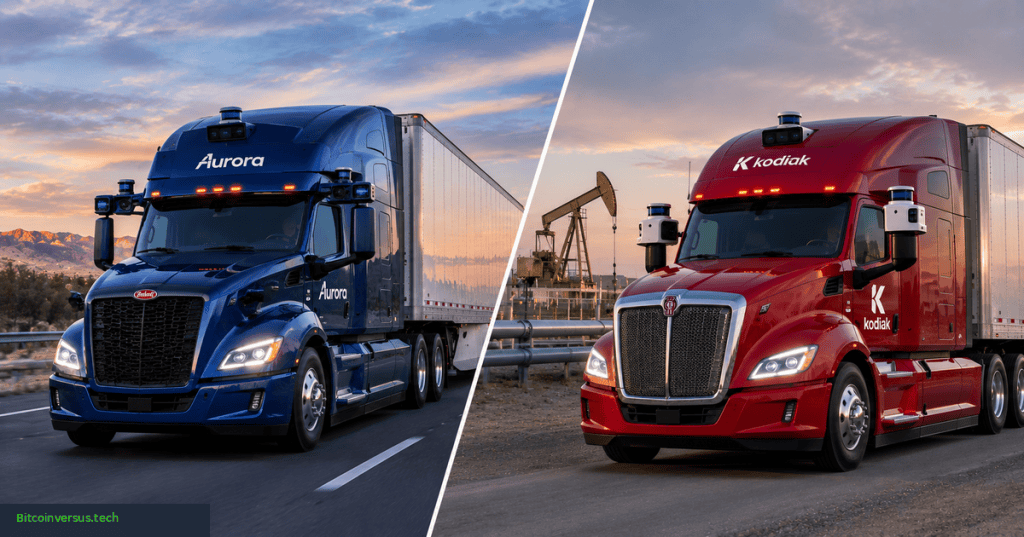
A truck can be capable of driving without a person in the cab long before a customer deploys an entire fleet. A binding order, a nonbinding expansion plan and a vehicle already working in commercial service represent three different measures of autonomous trucking. The distinction has become central after Kodiak AI announced a 75-truck binding agreement with DTL Transport on October 28, 2026, while rival Aurora disclosed two separate 500-truck nonbinding plans involving Hirschbach Motor Lines and Charger Logistics.
Aurora, “The Next Generation of the Aurora Driver” (July 23, 2026). Official manufacturer footage of Aurora’s vehicle technology; the video does not establish delivery of either proposed 500-truck order.
Kodiak’s Binding Commitments Grow 75%
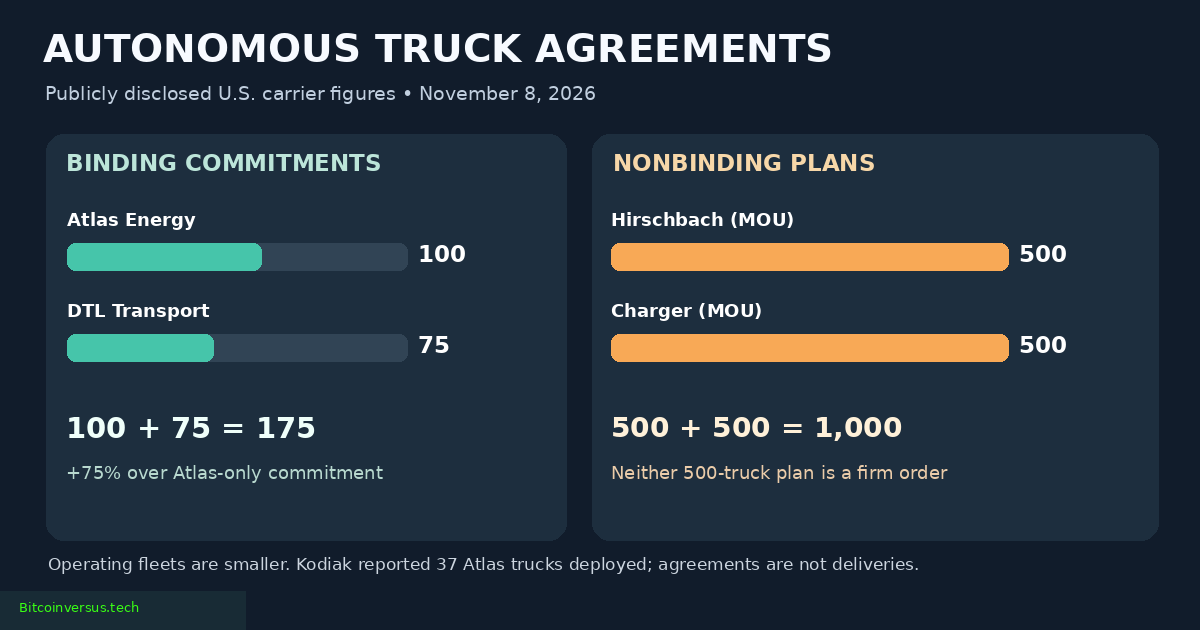
Kodiak’s securities filings establish an earlier binding commitment for 100 trucks at Atlas Energy Solutions, a West Texas industrial hauler. By September 30, the company had equipped and delivered 37 Atlas-owned trucks for driverless industrial work. DTL’s separate 75-truck agreement covers future unsupervised long-haul freight operations, with DTL owning the vehicles and paying Kodiak by the mile. Together, the two disclosed commitments cover 175 trucks.
The correct calculation is (175 − 100) ÷ 100 × 100 = 75% growth in Kodiak’s two publicly disclosed binding customer commitments. DTL’s planned 75 trucks equal approximately 203% of the 37 Atlas trucks reported deployed. But adding 75 future vehicles to a separate operating customer’s actual fleet would mix contractual capacity with completed deployments. The original 75-truck DTL report describes the planned routes and the limits of the announcement.
Aurora Has Larger Plans, Not Larger Firm Orders
Aurora’s April 30 announcement placed 500 trucks in a proposed fleet expansion for Hirschbach. On October 26, Charger Logistics announced another intention to acquire up to 500 trucks, with potential deliveries in 2027 and 2028. Combined, the intentions represent up to 1,000 vehicles, approximately 5.7 times Kodiak’s 175 binding commitments. However, both Aurora arrangements are explicitly nonbinding memoranda of understanding, subject to final agreements. Neither represents 500 vehicles already purchased or operating.
Aurora also has existing commercial transport-service agreements and trucks conducting driverless freight movements. Its October 28 quarterly report said more than 20 trucks were built and entering its fleet, while a revised outlook put its 200-truck milestone after year-end, by February 2027. A company’s projected manufacturing rate is not an order book either. Earlier Aurora driverless freight coverage documented the distinction between tested routes and commercial service.
Kodiak AI, “Kodiak AI Delivers Western Star 49X Driverless Trucks to Atlas Energy Solutions” (November 3, 2026). Official manufacturer footage shows trucks delivered for industrial operations, not DTL’s future interstate fleet.
Who Holds the Largest Driverless Truck Contract?
Among the specific named U.S. customer agreements verified for the comparison, Aurora’s 500-truck proposals are larger than either Kodiak customer commitment—but they are not binding purchase orders. Atlas’s 100-truck commitment is larger than DTL’s 75-truck binding highway-carrier agreement. Kodiak calls DTL the first publicly announced definitive agreement for a long-haul carrier to operate driverless trucks within its own fleet, a narrower claim than largest autonomous fleet worldwide.
Global comparisons require care. China’s Pony.ai reported a 210-vehicle robotruck fleet earlier in 2026, including different levels of driving automation and vehicles with safety drivers. Its expectation for 500–1,000 next-generation heavy-duty trucks is a deployment target, not an identified single-customer binding order. Neither a mixed-autonomy fleet nor a production forecast belongs in the same ranking as fully driverless contracted trucks.
The practical test will be deliveries and miles traveled without a human onboard, rather than headline agreement counts. Kodiak must complete its public-highway safety preparations, while Aurora must convert proposed carrier purchases into firm documentation. Existing reporting on Kodiak’s Dallas–Houston lane, autonomous fleet operating models and real-world autonomous-vehicle safety provides additional context.
Primary sources: Kodiak September 2026 SEC Form 10-Q; Kodiak–DTL binding agreement, October 28; Aurora–Hirschbach announcement, April 30; Aurora–Charger MOU, October 26; Aurora third-quarter update, October 28; Pony.ai SEC annual filing.
BitcoinVersus.Tech Editor’s Note
Published November 8, 2026. Contract terms and vehicle counts were verified from company announcements and securities filings. Kodiak’s 175 reflects two disclosed binding customer commitments, not trucks operating concurrently. Aurora’s two 500-truck figures are separate nonbinding plans, not completed purchase contracts. No comprehensive global database of executed autonomous-truck contracts was established, so no worldwide-largest claim is made. The featured illustration and agreement-count chart are original editorial graphics, not photographs of the contract signings. Videos show manufacturer technology and earlier field operations rather than deliveries under the proposed expansion agreements.
We volunteer daily to ensure the information on this platform is Verifiably True. If you would like to support the research, please scan QR code.

To support independent research, readers may make an optional 5,000-satoshi donation. Scan the QR with a Bitcoin wallet from a second device, or use a compatible saved-image scanning feature on mobile. Confirm recipient 3C9o19EH5HSiwEPyCTmEKzxhNCbo2X6TTb and the payment amount before sending.
BitcoinVersus.Tech is not a financial advisor. Financial coverage is provided purely for informational purposes.


Leave a Reply