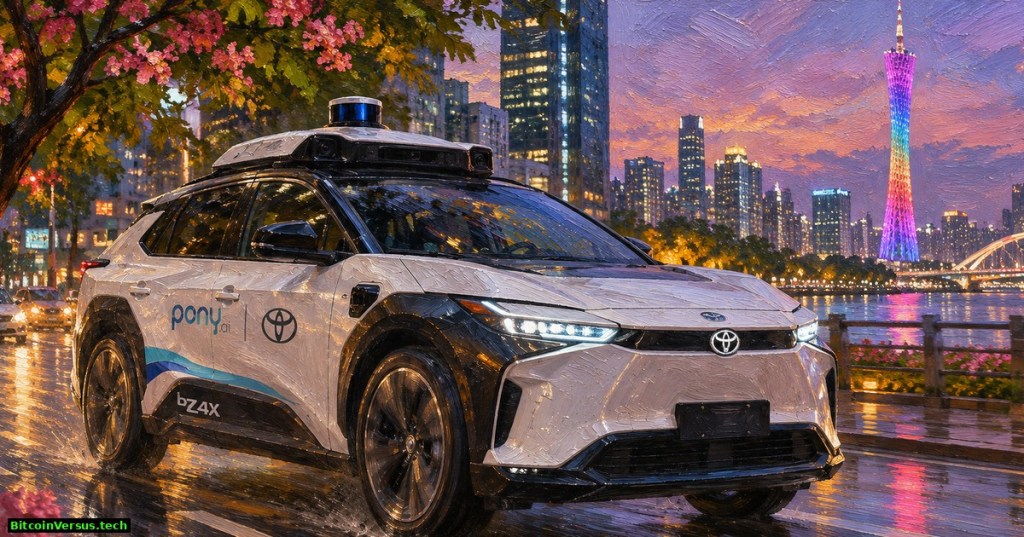
Toyota and Pony.ai have put a seventh-generation bZ4X electric robotaxi into fully driverless commercial service in Guangzhou, China. Announced November 16, 2026, the launch adds another mass-produced vehicle to Pony.ai’s fleet. Riders can book the car around the clock using PonyPilot, WeChat or Alipay. The launch arrives as the operator reports 165.4% year-over-year growth in quarterly Robotaxi services revenue, an important business milestone that should not be mistaken for revenue generated by the newly launched Toyota model alone.
Official Pony.ai video from April 2026 showing earlier fully driverless vehicles navigating Chinese city traffic. Archival demonstration, not footage of the November bZ4X launch.
Toyota supplies the vehicle, Pony.ai supplies the autonomous driver
Pony.ai and Toyota have worked together since 2019, with GAC Toyota also involved in manufacturing. The first mass-produced bZ4X robotaxi rolled off the assembly line in February 2026. The companies aim to deploy around 1,000 bZ4X robotaxis across major Chinese cities, but have not provided a confirmed number of bZ4X units already carrying passengers. Other models in Pony.ai’s Gen-7 lineup remain in service.
The bZ4X was engineered for Level 4 automated driving, meaning driverless operation inside defined conditions and permitted areas, not unrestricted autonomy on every road. Toyota and Pony.ai say redundant systems and fail-operational capabilities were incorporated into vehicle engineering. Bluetooth unlocking, an in-car voice assistant, personalized climate settings and entertainment are passenger-facing features; safe navigation still depends on reliable sensors, onboard computation, vehicle controls and operational procedures.
Pony.ai’s original November 16 announcement describes the launch and proposed fleet expansion. Guangzhou service is distinct from Toyota’s separate Waymo robotaxi program planned for Japan, which uses a related vehicle family but a different autonomous-driving operator.
SmartChart #10: Revenue growth is measurable, profitability remains distant
The company’s November 18 earnings release records Robotaxi services revenue of $17.763 million in Q3 2026, compared with $6.694 million in Q3 2025. Robotruck revenue rose from $10.183 million to $17.952 million, while intelligent solutions increased from $8.565 million to $8.859 million. Summing all three segments gives $44.574 million in total revenue, up from $25.442 million, a 75.2% rise.
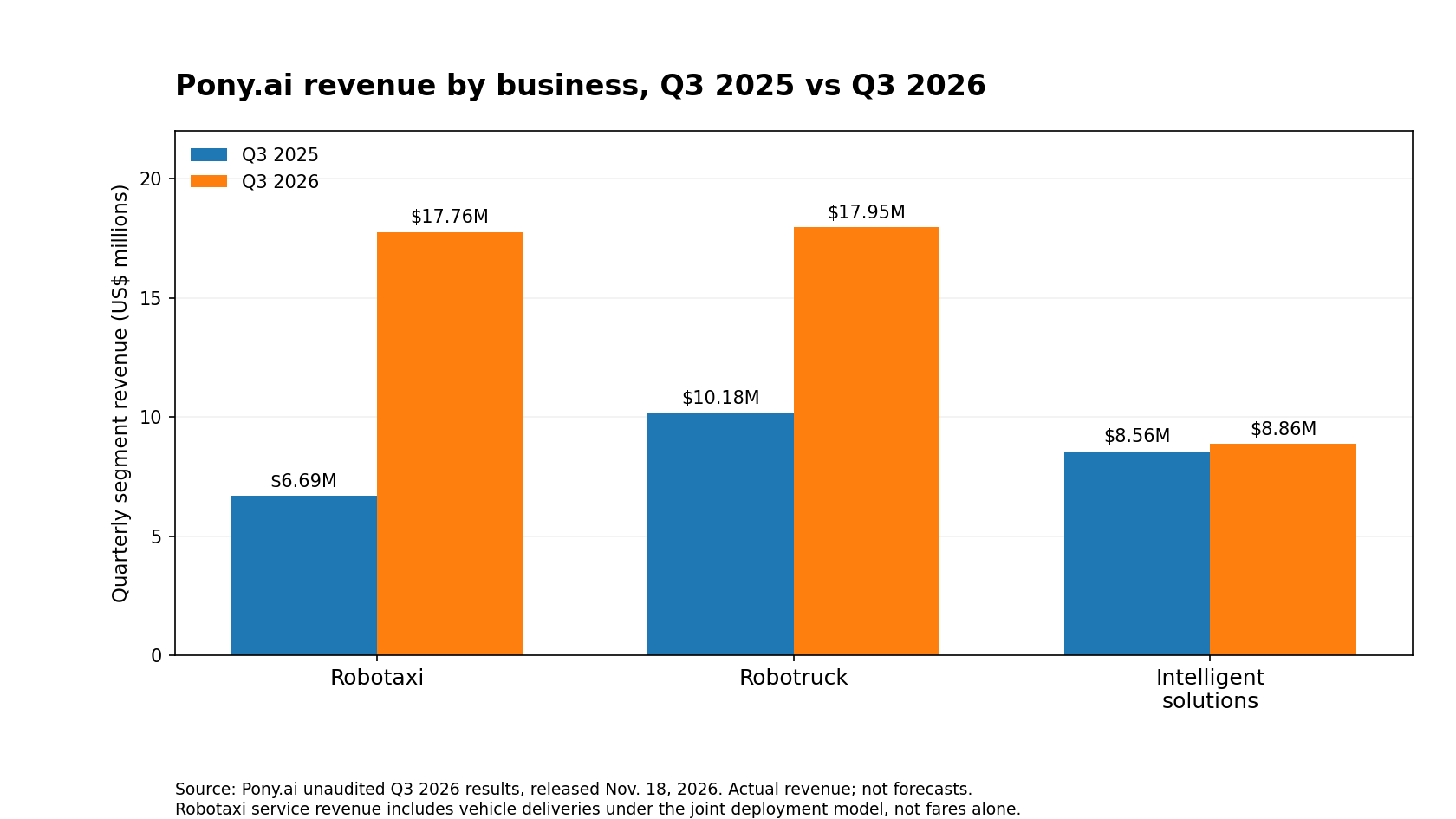
The chart uses comparable quarterly periods and a zero baseline. Grouped bars make each segment’s increase easier to evaluate than a stacked composition or a slopegraph. Importantly, Pony.ai says Robotaxi services revenue includes deliveries of vehicles under its joint deployment model as well as fare-charging operations. Passenger fares alone increased by nearly 400% year over year, but no separate fare-revenue dollar amount was supplied in the cited release.
A larger fleet does not guarantee a profitable operator
Pony.ai counted 2,768 Robotaxi vehicles worldwide at September 30 and targets 3,500 by the end of 2026. Both figures concern its entire Robotaxi business, not solely Toyota bZ4Xs in Guangzhou. The company also reported a 17.8% gross margin, $68.7 million in operating losses and a $136.3 million net loss in the third quarter. Management attributed much of the net-loss increase to fair-value changes in trading securities. Stronger revenue therefore does not mean the overall company has reached profitability.
Official Pony.ai archival footage published January 2026 illustrating driving around pedestrians, cyclists and construction zones. The clip does not establish the performance of the newly deployed Toyota model.
Scale creates technical and economic pressure. Vehicles need charging, cleaning, maintenance, remote assistance and regulatory authorization, while sensor calibration and safe responses to road closures remain critical. A recent Waymo freeway restriction demonstrates why driverless deployment must be judged by operational evidence as well as software capability. Readers comparing competitors can also review Amazon’s Zoox rollout and commercial driverless trucking plans.
The next milestone
The near-term test is whether Toyota and Pony.ai publish city-by-city counts of bZ4X vehicles actually licensed and carrying paying passengers, alongside consistent utilization, safety and cost data. A planned thousand-car expansion is not a thousand deployed vehicles. Guangzhou now has a commercial launch; the evidence for sustainable, large-scale economics is still developing.
Primary sources: Pony.ai and Toyota launch announcement, November 16; Pony.ai Q3 2026 financial report, November 18. Financial comparisons use the issuer’s unaudited quarterly statement.
Editor’s Note: We volunteer daily to ensure the credibility of the information on this platform is Verifiably True. If you would like to support our work and help further secure the integrity of our research initiatives, please scan the QR code below to donate 5,000 sats.

Disclaimer: BitcoinVersus.tech publishes information and analysis for educational and journalistic purposes, not investment, financial, legal, engineering or transportation-safety advice. Forward-looking plans are not guaranteed; verify claims independently before making decisions.


Leave a Reply