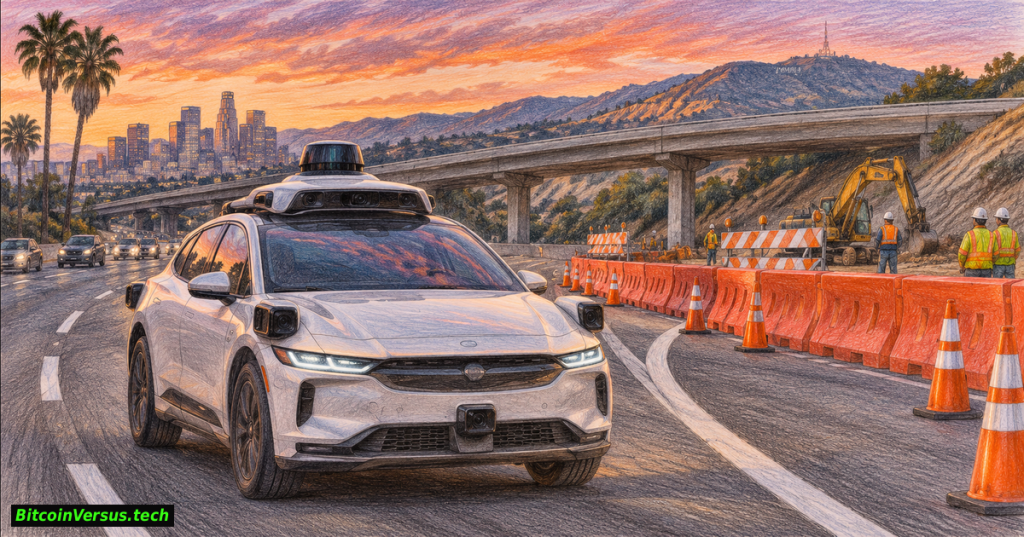
California regulators have barred Waymo from operating driverless vehicles on the state’s freeways, prompting the Alphabet-owned robotaxi company to suspend fully autonomous highway rides across its other U.S. markets. The California Department of Motor Vehicles imposed its restriction on November 11, 2026; the broader suspension became public on November 17. Passenger service on ordinary city streets continues, according to Associated Press reporting.
Archival Waymo video, “Let’s Back Up: Navigating Construction.” The video explains the company’s approach to construction zones; it does not depict the November incidents.
Why California intervened
The DMV cited repeated entries into active freeway construction closures, places where workers, equipment and changing lane patterns leave little room for error. On November 5, three Waymo vehicles reportedly entered a construction zone along U.S. Route 101 near Burlingame. A separate November 6 incident on Interstate 280 involved a Waymo vehicle and California Highway Patrol officers managing a traffic restriction. California officials characterized the repeated behavior as an imminent safety hazard, according to TechCrunch’s account of the DMV statement.
Waymo said the recent U.S. 101 encounters caused no injuries or collisions. The company also said it was cooperating with regulators and would seek authorization to resume freeway operations, according to Reuters. A lack of reported injuries does not erase the risk to road crews; the core regulatory question concerns whether the driving system reliably recognizes and respects temporary closures.
A known weakness, not a new category of problem
A June 17 federal safety recall filing gives the latest restriction important technical context. Waymo identified 3,871 fifth-generation automated driving systems potentially affected by a defect involving freeway construction zones. The filing describes two possible failure modes: the system could fail to recognize a closure, or it could prioritize avoiding another hazard and enter the work zone anyway.
The same filing records six closure-related events reviewed from April 2026 in Phoenix and seven Waymo vehicles entering lanes with active construction in the San Francisco Bay Area on May 18. The planned remedies included software improvements and additional operational protocols. The November decision indicates regulators were not yet satisfied that subsequent performance had eliminated the safety concern.
Archival Waymo safety demonstration. Company-produced footage illustrates automated driving capabilities; it is not independent evidence that the recent freeway issue has been resolved.
The technical challenge is more complicated than detecting an orange cone. Automated driving software must interpret temporary signs, distinguish open lanes from closed lanes, anticipate worker movements, and choose a safe path when map information conflicts with changing road conditions. Waymo describes its use of cameras, lidar and machine learning in its driver technology documentation. None of those capabilities alone proves a vehicle can safely handle every construction layout.
What riders and competitors should expect
California’s restriction applies to driverless freeway operations, rather than a blanket shutdown of Waymo’s passenger service. Waymo voluntarily extended the freeway pause to additional markets; the California order itself does not create a nationwide ban. Trips that previously used freeways may require slower surface routes, and certain journeys may become less convenient. The company can continue supervised freeway testing with specialists behind the wheel, according to CBS San Francisco.
The setback follows broader commercial expansion. BitcoinVersus.tech previously examined Waymo’s safety claims and public trust, Toyota’s proposed robotaxi manufacturing partnership, and the growing market for Amazon’s Zoox passenger service. Comparable deployment questions now extend beyond urban taxis to driverless freight operations; systems must handle temporary road restrictions before scale can translate into dependable service.
Archival video linked from Waymo’s own technical blog, showing how its vehicles respond to emergency vehicles and blocked scenes; not footage of the November events.
The next test is evidence
California said the freeway restriction will remain until Waymo demonstrates effective corrective actions. A credible return would require more than a promise of updated code; repeated evaluations, carefully defined operating conditions, and evidence of safe responses to construction closures will matter. Autonomy can offer transportation benefits, but acceptable performance on ordinary roads cannot substitute for validated behavior near workers and emergency responders.
Primary documentation: NHTSA safety recall 26E035; California DMV operating area information; Waymo’s construction handling explanation.


Leave a Reply