
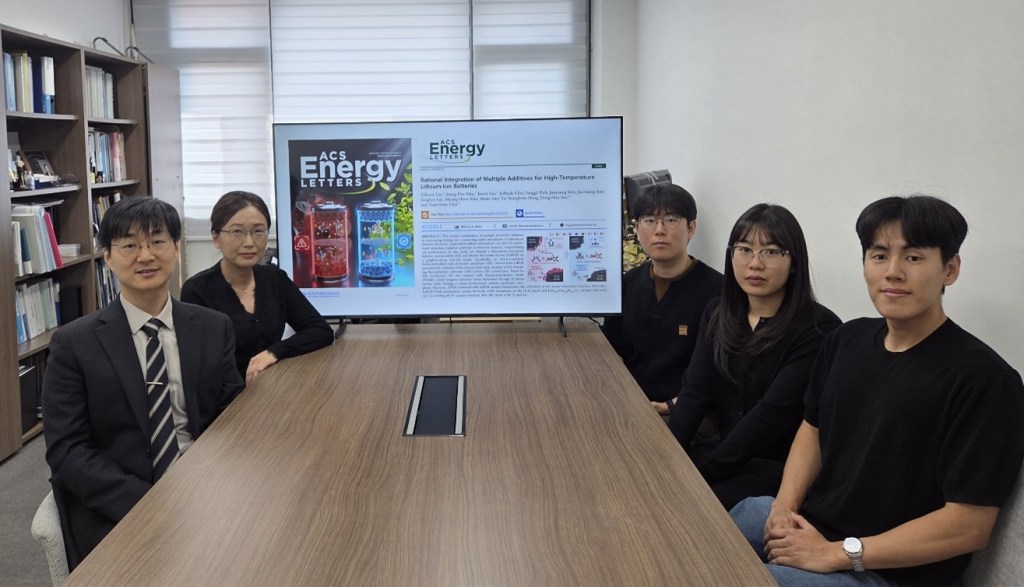
Battery additives intended to extend lithium-ion cell life can undermine one another when mixed. Researchers at the Korea Advanced Institute of Science and Technology (KAIST) identified a damaging interaction between lithium bis(oxalato)borate (LiBOB) and succinonitrile (SN), then tested a replacement additive, triisopropanolamine borate (TPAB), designed to stabilize protective films on both electrodes. KAIST announced the findings on November 17, 2026, after a peer-reviewed paper appeared in ACS Energy Letters on October 19.
The optimized electrolyte achieved 68.7% capacity retention after 300 cycles at 45°C and a 1C rate in the study’s graphite-silicon and high-nickel battery configuration. The result is a demanding laboratory measurement, not a promise of equivalent service life or range in production electric vehicles.
How two protective chemicals become a problem
Electrolyte transports lithium ions between a battery’s positive and negative electrodes. Small additives help form the cathode electrolyte interphase (CEI) and solid electrolyte interphase (SEI), surface layers that limit unwanted chemical reactions. Silicon-containing anodes make the job harder because silicon expands and contracts as lithium enters and leaves. Fractured protection encourages more electrolyte decomposition and consumes lithium that would otherwise remain available for cycling.
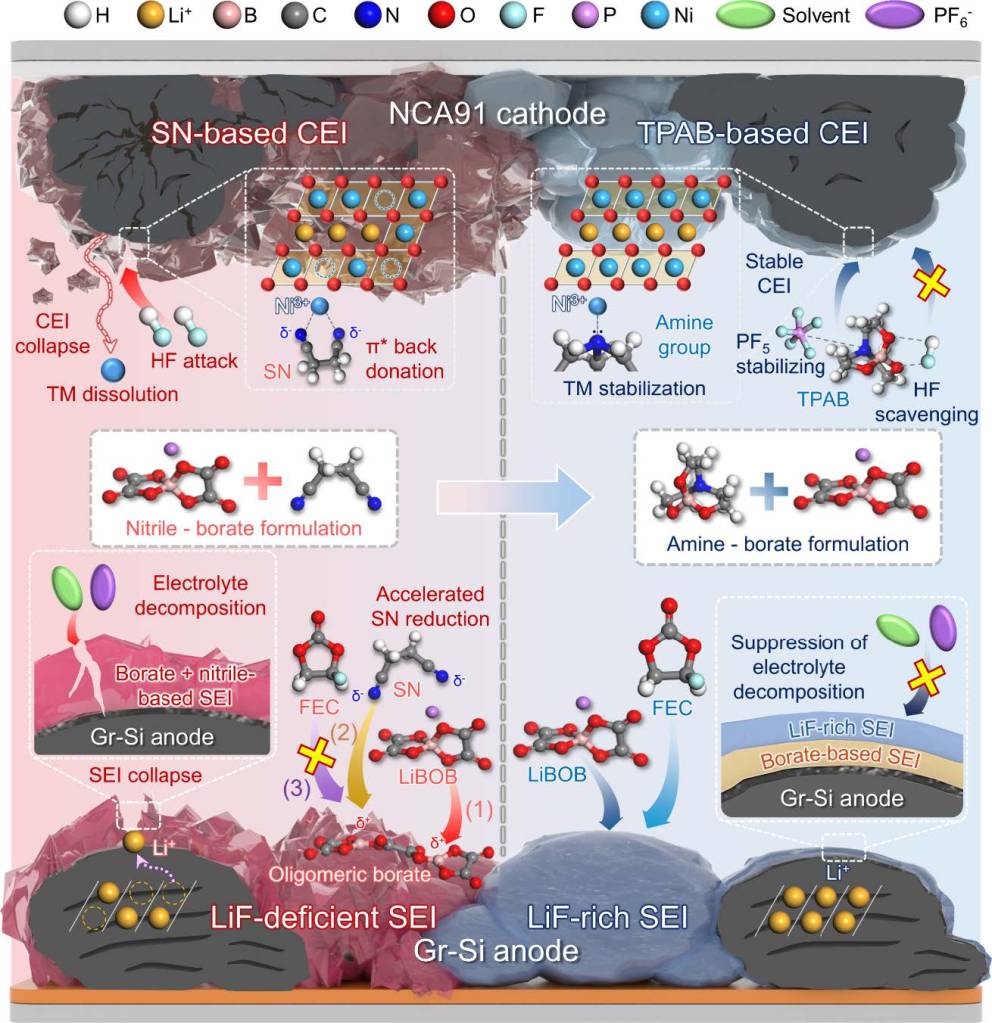
The KAIST team found that decomposition products from LiBOB encouraged unwanted breakdown of SN. The interaction disturbed formation of the anode’s protective layer, leaving less lithium fluoride, increasing resistance and accelerating deterioration at elevated temperatures. Two useful ingredients evaluated separately therefore behaved differently inside the same electrolyte.
The TPAB alternative
Instead of retaining SN in the additive mixture, researchers used TPAB, a compound combining amine and borate functionality in one molecule. The amine component helped reduce transition-metal dissolution at the cathode, while the borate chemistry supported more durable interphases. In the optimized formula, fluoroethylene carbonate (FEC) also contributed to a lithium-fluoride-rich protective layer on the graphite-silicon anode.
The tested cell paired a high-nickel LiNi0.91Co0.08Al0.01O2 cathode with a graphite-silicon anode. The paper describes 4.8 mAh/cm² cathode areal capacity and 68.7% remaining capacity after 300 charge-discharge cycles at 45°C and 1C. The cells using TPAB also resisted degradation during elevated-temperature storage better than the earlier additive combination, according to KAIST. The study does not establish equivalent performance in every cell size, chemistry or temperature range.
Why longevity matters as much as capacity
Battery research often emphasizes maximum energy storage, but cycle life and thermal stability determine how much of the original performance remains useful over time. Talga’s graphite-anode cycle testing offers a separate illustration of materials durability; its conditions and chemistry are not interchangeable with KAIST’s complete-cell test. UNSW’s rapid used-battery testing addresses the related problem of measuring remaining health.
Alternative active materials can change storage chemistry itself, as shown by UCL’s four-electron iodine research. KAIST instead targets degradation inside familiar lithium-ion architecture, an approach potentially relevant to electric vehicles and energy storage systems. Demand for dependable cells is expanding alongside the growth of U.S. grid battery installations.
What remains unproven
Commercial adoption would require larger cell testing, safety qualification, reproducible manufacturing, cost analysis and comparisons under realistic duty cycles. Results from 300 accelerated cycles cannot directly predict a ten-year vehicle warranty. KAIST reported support from Samsung SDI and public research programs, but neither the university announcement nor the paper demonstrates a mass-produced TPAB battery.
Primary sources: KAIST announcement, November 17, 2026; Gihoon Lee and colleagues, ACS Energy Letters, published October 19, 2026. Independent reporting: Aju Press, November 17, 2026.


Leave a Reply