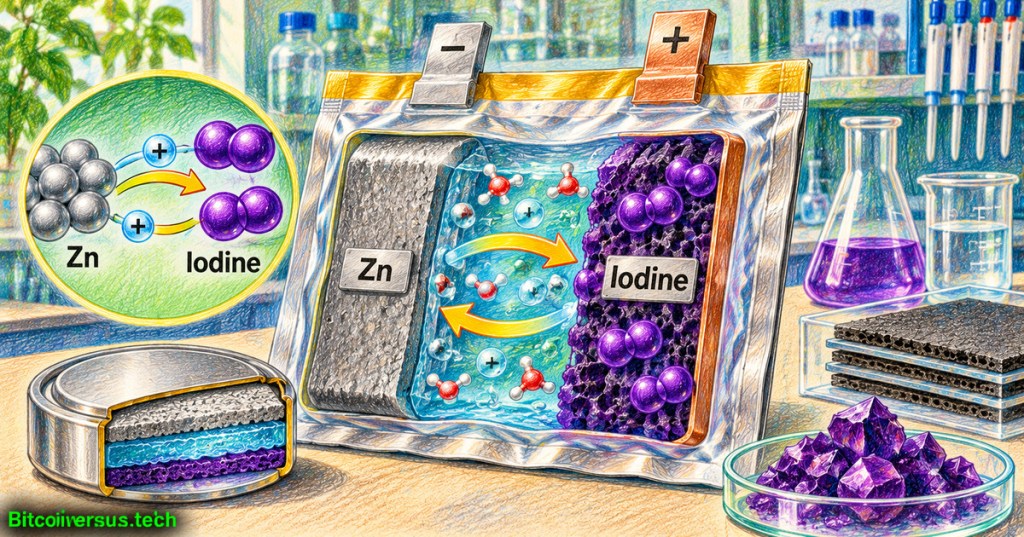
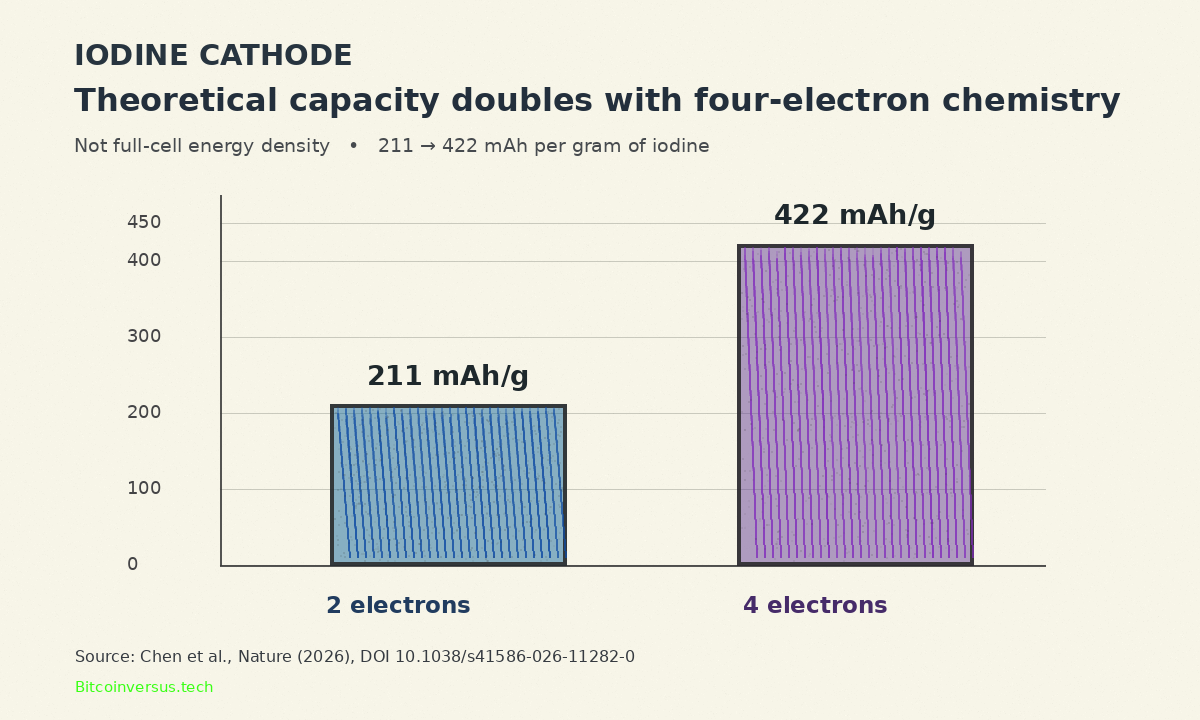
Researchers at University College London (UCL) have demonstrated a water-based zinc–iodine battery chemistry that enables iodine to exchange four electrons during charging and discharging instead of the conventional two. The approach raises iodine’s theoretical specific capacity from 211 to 422 milliampere-hours per gram, according to a peer-reviewed study published in Nature on November 11, 2026. The gain applies to the iodine active material, not the complete battery’s energy density.
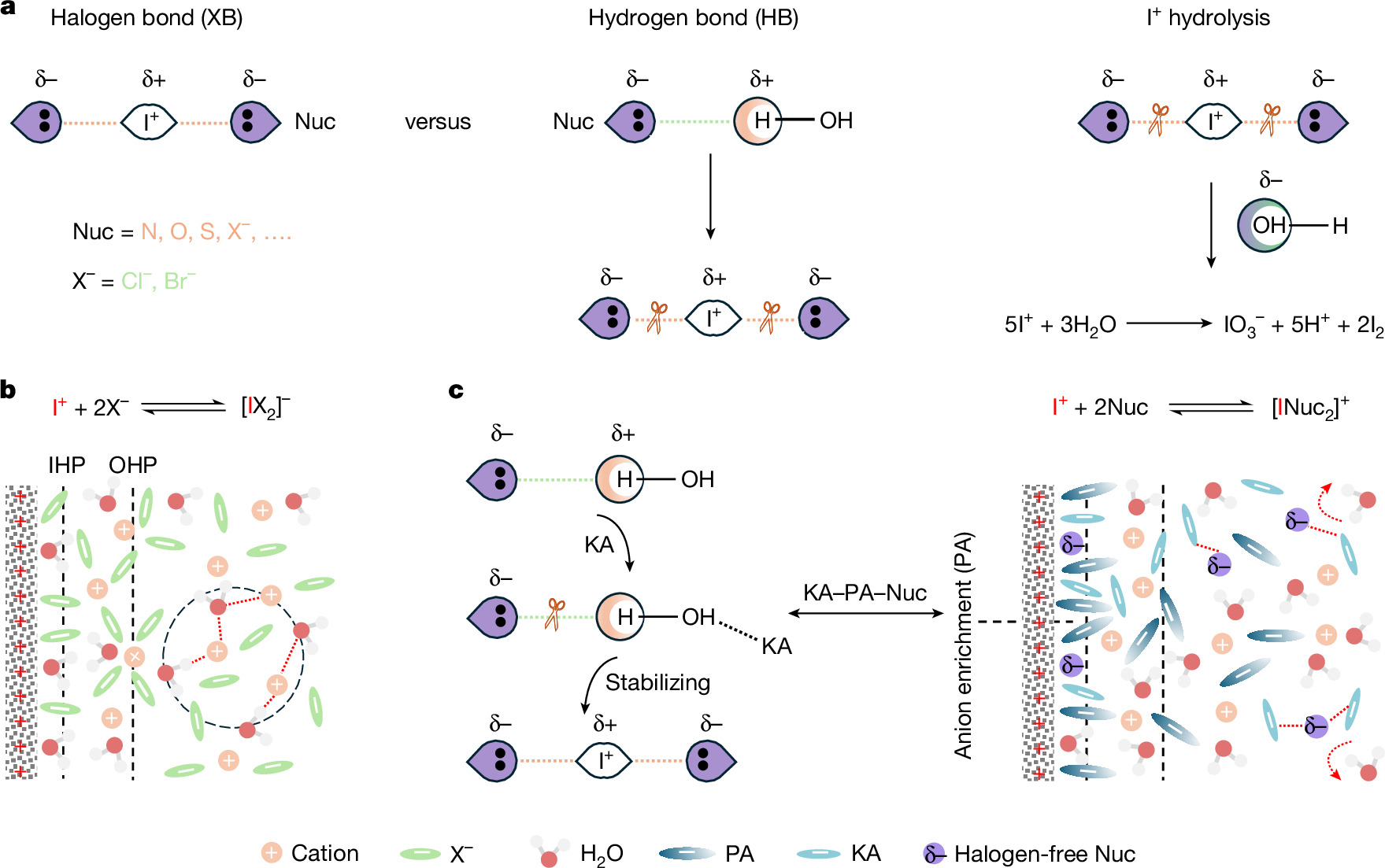
The study, led by UCL researchers Ruwei Chen and Guanjie He with Oxford collaborators, addresses a problem in rechargeable aqueous batteries: reactive iodine species tend to degrade when exposed to water. Previous four-electron approaches commonly relied on concentrated chloride- or bromide-containing electrolytes. The new formulation avoids the need for those concentrated supporting halogen salts while retaining iodine as the energy-storing material. UCL announced the results November 13.
How the electrolyte protects iodine
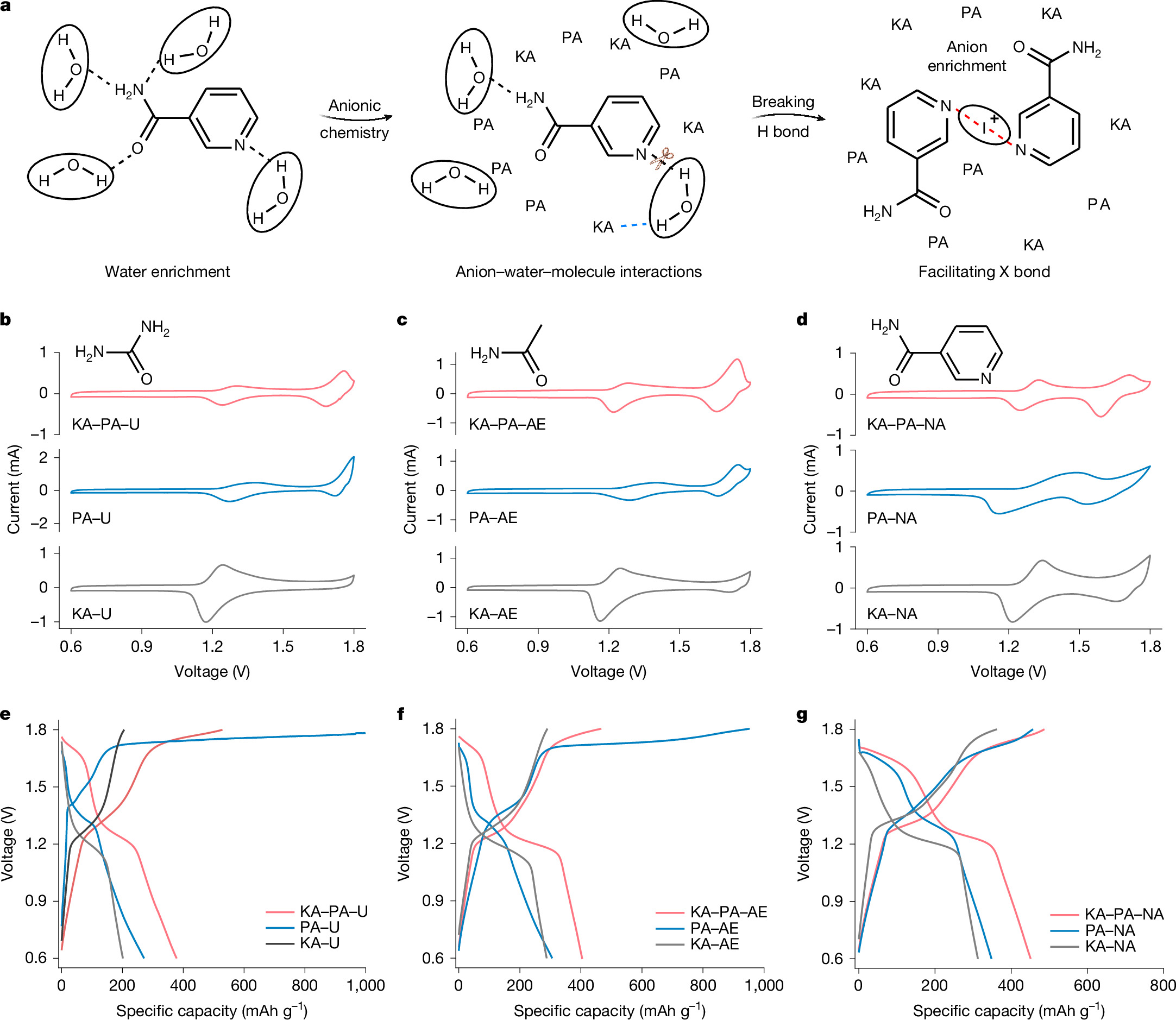
The researchers combined polar anions, water-structuring anions and nucleophilic molecules. Their complementary functions keep water away from critical iodine reaction sites and stabilize highly reactive iodine cations, allowing the added oxidation step to remain more reversible. Experiments included urea, acetamide, pyridine and nicotinamide as stabilizing molecules. The chemistry is therefore more involved than merely dissolving iodine in water.
What the cells actually delivered
In zinc–iodine laboratory cells, the researchers reported 96% capacity retention after 1,000 cycles at 1 A/g and 94% after 2,000 cycles at 2 A/g. The current conditions differ, so the retention figures should not be mistaken for two checkpoints in an identical cycling test. The team also reported iodine loadings as high as 12.2 mg/cm², evaluated coin-cell and pouch-cell configurations, and demonstrated the framework with aluminium–iodine chemistry.
The paper describes a 1.1-ampere-hour pouch-cell prototype, but the result does not establish a commercial battery pack or factory-scale production. Real systems must account for electrolyte, separator, enclosure, inactive materials and cost. For context, sodium-ion storage and solid-state battery work are pursuing different technical pathways with their own performance claims.
The commercial hurdle
The researchers acknowledge iodine-inventory losses and capacity fade, especially at higher loading, alongside remaining questions about realistic operating conditions. Cell-level safety, long-term stability, manufacturing yield and economics need further validation. The prospect matters for large grid batteries and long-duration storage development, but UCL has not announced a commercially deployed zinc–iodine system based on the reported formulation.
The research advances a difficult electrochemical reaction. Whether the material-level gain survives larger cells and sustained field operation remains an open engineering question. The primary evidence is the Nature article by Chen and collaborators, not a commercial product specification.
Editor’s Note: Primary reporting was checked against the November 11, 2026 open-access Nature paper and UCL’s November 13 research announcement. The 211 and 422 mAh/g values are theoretical iodine-material capacities; 96% and 94% are experimental retention measurements at different cycling currents. No commercialization, cost saving or system energy-density improvement is claimed. The colored-pencil featured artwork is an original conceptual illustration, not an image of the UCL prototype. The original data chart is labeled, while Figures 1 and 2 are credited to Chen et al. under CC BY 4.0. No relevant official study video was verified for embedding. Actual cell performance and video playback were not independently tested.

For mobile scanning, display the QR on another screen and scan with a compatible Bitcoin wallet. Some wallets also allow scanning an image saved on the same phone. Confirm the recipient before donating 5,000 sats: 3C9o19EH5HSiwEPyCTmEKzxhNCbo2X6TTb.
We volunteer daily to ensure the credibility of the information on this platform is Verifiably True. If you would like to support our work and help further secure the integrity of our research initiatives, please scan the QR code above to donate 5,000 sats.
BitcoinVersus.tech is not a financial advisor. This media platform reports on financial subjects purely for informational purposes.

