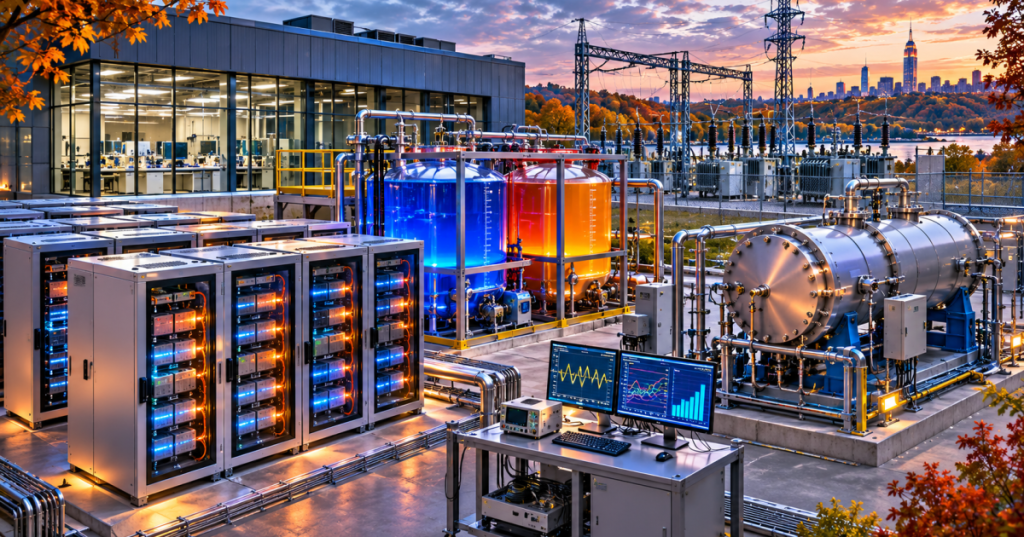
New York has awarded nearly $13 million to 15 energy-storage technology projects, including iron-sodium batteries, compressed-air storage, zinc-manganese cells and vanadium flow batteries. The November 6, 2026 announcement by the New York State Energy Research and Development Authority (NYSERDA) targets development, prototypes and demonstrations—not 15 newly operating grid-scale power plants.
Long-duration energy storage (LDES) holds electrical energy for use hours after generation. A battery rated at 1 megawatt (MW) with 10 megawatt-hours (MWh) of usable stored energy could theoretically discharge at full rated power for 10 hours, before accounting for operating limits and conversion losses. NYSERDA emphasizes technologies capable of more than 10 hours at rated power to reduce reliance on short-duration storage and help manage peak demand.
Iron-sodium storage receives the largest named award
Inlyte Energy received over $2.4 million to deploy an iron-sodium battery designed for more than ten hours of discharge at substations facing peak-load growth. Inlyte’s manufacturer website describes systems intended for long-duration service, but commercial operating performance and lifetime economics require third-party verification at deployed sites.
Other large awards include $1.8 million for Standard Potential to design a sodium-ion portable power station and nearly $1.5 million for Urban Electric Power to validate zinc-manganese dioxide storage. Sprocket Power received over $1 million to demonstrate electric-vehicle fast charging supplied by an underground vanadium redox flow battery. Daqus Energy was awarded nearly $1 million to advance a metal-free organic cathode for lithium-ion batteries.
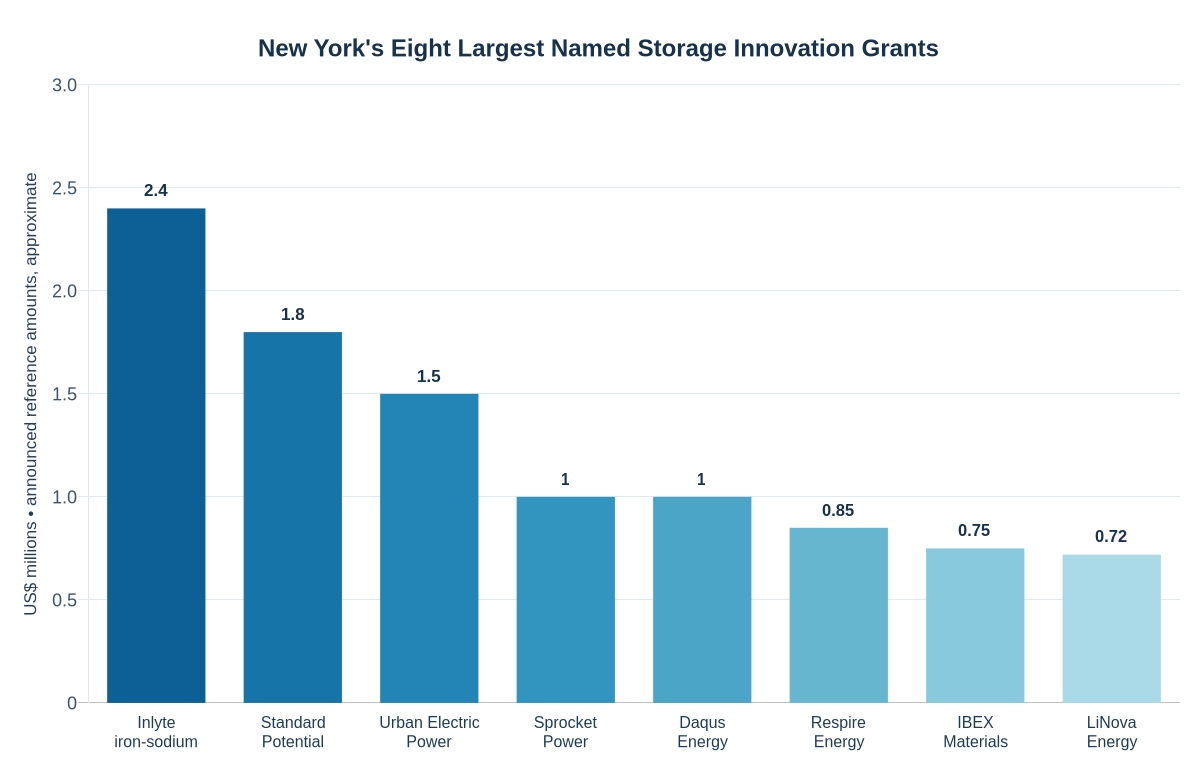
The grants span alternative chemistries as well as manufacturing improvements. Respire Energy obtained over $850,000 for metal-air battery development, while IBEX Materials received $750,000 for silicon-rich anodes combined with solid-state electrolytes. The diversity reflects a search for lower material costs, improved safety and longer discharge periods rather than a single winning battery chemistry.
Prototype energy cannot be confused with commercial capacity
Aestus Energy Storage received more than $590,000 to test approximately 35 kilowatt-hours (kWh) of ceramic heat-sink materials for a proposed 20 MWh advanced compressed-air system. The small subscale test and the proposed utility-scale design are separate engineering milestones, and thermal and electrical energy ratings cannot be treated as interchangeable without conversion assumptions. NYSERDA describes a design and test—not a completed 20 MWh operating plant.
Alsym Energy received more than $290,000 for a 10 kWh sodium-ion prototype. The experimental size differs greatly from the multi-MWh grid systems discussed in earlier BitcoinVersus.Tech coverage of sodium-ion storage commercialization and large battery-complex proposals. Those projects must not be added together as installed electricity supply.
Grid relief remains a demonstration goal
Storage can absorb surplus electricity and discharge during constrained or expensive hours, although its effectiveness depends on charging access, efficiency and transmission location. BitcoinVersus.Tech has covered grid-connection delays facing solar development and large pumped-hydro storage proposals. Emerging chemistries might complement established lithium-ion systems, but manufacturing, safety certification, cycling endurance and cost remain obstacles.
NYSERDA’s energy-storage innovation program targets roughly 10–100-hour applications and novel alternatives to conventional lithium-ion technology. A separate September round contracted 950 MW of bulk storage planned for operation by 2030; those projects are not part of the newly announced 15-project innovation awards. New York’s grants now establish research funding commitments, not operational megawatts or guaranteed future electricity production.
Primary sources: NYSERDA November 6 award announcement; NYSERDA storage innovation program; NYSERDA official webinar directory; September bulk storage awards; and Inlyte Energy project background.
Editor’s Note: Grant figures follow NYSERDA’s November 6, 2026 announcement. “Over” and “nearly” awards are not exact amounts; the vertical chart uses approximate reference values. Announced project intentions, prototype specifications and deployed grid capacity are separate categories. Both videos predate the funding decision. Featured artwork is conceptual and does not depict a specific recipient installation.
Support BitcoinVersus.Tech
Support independent research with the original approved BitcoinVersus.Tech QR below for a 5,000-satoshi donation. Mobile readers can open the article on a second screen and scan the QR with a compatible Bitcoin wallet. Confirm recipient and amount before sending.

We volunteer daily to ensure the information on this platform is Verifiably True. If you would like to support the research, please scan QR code.


Leave a Reply