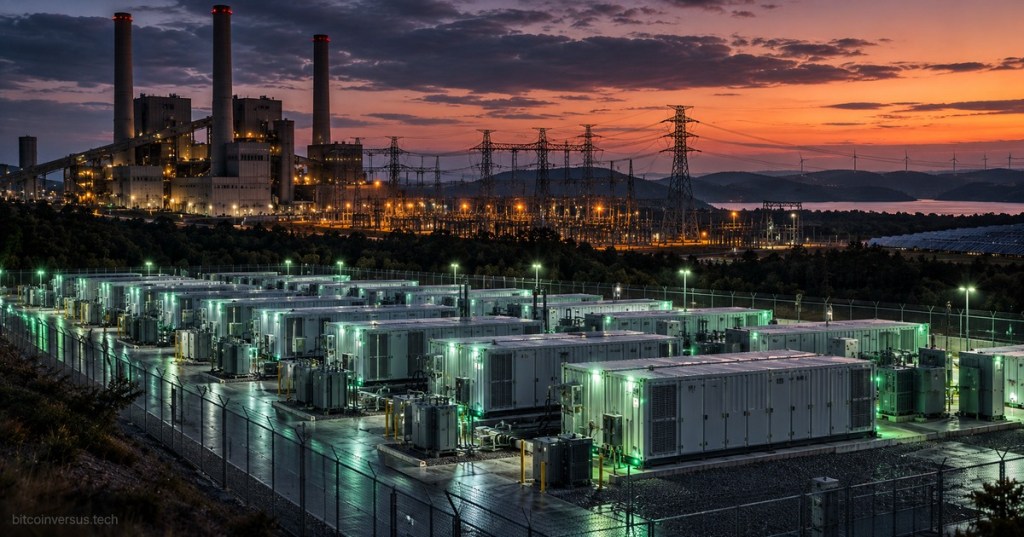
Origin Energy is seeking approval to expand the battery complex beside Australia’s Eraring power station toward a stated maximum of 1.2 GW / 8.6 GWh, turning one of the country’s biggest coal-generation sites into an increasingly large grid-storage hub.
Origin’s current Eraring battery project page says the company is seeking approval for an additional 500 MW, eight-hour battery on land beside the existing project. The same page states that the expanded precinct could reach a combined maximum registered capacity of 1,200 MW / 8,600 MWh, subject to detailed design.
The proposal is important because it shows how quickly grid batteries are moving from short-duration support assets toward infrastructure that can shift very large amounts of electricity across several hours. At the headline maximum, 8.6 GWh means the site could theoretically deliver 1.2 GW for a little over seven hours if it were discharged evenly at full rated power.
MW and MWh are not the same thing
The easiest way to understand the proposal is to separate power from stored energy. Megawatts measure how fast the battery can deliver electricity. Megawatt-hours measure how much electricity it can store and deliver over time.
BitcoinVersus recently published an easy guide to MW versus MWh. A 1,200 MW battery is about discharge rate; an 8,600 MWh battery is about the size of the energy reservoir behind that rate.
Eraring is already becoming a battery site
Origin says Battery 1 is already operating at 460 MW / 1,770 MWh. Battery 2 is in construction and expected online in early 2027, taking the currently committed precinct to 700 MW / 3,160 MWh. The new expansion proposal would add another 500 MW of discharge capacity and substantially extend the amount of energy that can be shifted into evening and peak-demand periods.
pv magazine Australia reports the proposed Eraring North addition at about 4.9 GWh of accessible storage and says the overall precinct is being planned toward 1.2 GW / 8.6 GWh. Because the project remains in approvals and detailed design, those maximum figures should be treated as planning targets rather than final installed specifications.
Why build the battery beside a coal plant?
One of the strongest advantages is infrastructure that already exists. The Eraring site already has high-voltage transmission, a major switchyard, grid access, industrial land and decades of power-system history. Reusing that grid connection can be more practical than building a new storage site far from transmission.
This is one reason old generation sites can remain valuable even after the original plant retires. The turbine may eventually stop, but the substation, transmission corridors and grid node can still support batteries, synchronous condensers, renewable generation or other large electrical assets.
Longer-duration storage changes what a battery can do
A battery with only one or two hours of storage can be extremely useful for fast-response grid services and short peaks. A much larger energy reservoir can cover longer evening demand periods, absorb more midday solar production and give grid operators more flexibility when renewable output falls.
That same storage problem is showing up globally. India’s recently approved transmission program includes 50 GWh of battery storage alongside transmission for 135 GW of renewable capacity, showing that generation buildout increasingly has to be matched with storage and grid infrastructure.
Big batteries are becoming power-system infrastructure
The Eraring proposal also illustrates the difference between distributed batteries and utility-scale storage. Thousands of home batteries can be coordinated as a virtual power plant, while a single industrial battery complex can connect directly to the high-voltage grid and dispatch hundreds of megawatts from one location.
California has already demonstrated the distributed version at scale: BitcoinVersus covered how Tesla and Sunrun aggregated home batteries to deliver roughly 580 MW. Eraring represents the opposite architecture—large centralized storage connected at transmission scale.
The next milestone is approval, not construction
The proposed expansion is not yet a finished project. Origin is still moving through environmental and planning approvals, technical studies and stakeholder consultation. That means the final battery chemistry, exact usable energy, construction sequence and commissioning dates can still change.
But the direction is already clear. The same site that historically supplied New South Wales with coal-fired generation is being redesigned around a much larger storage role. If the expansion reaches the company’s current maximum target, Eraring would become a striking example of how existing power-station sites can be repurposed for a grid with more variable renewable generation.
BitcoinVersus.Tech
Advertisement
Editor’s Note:
We volunteer daily to ensure the credibility of the information on this platform is Verifiably True. If you would like to support our research initiatives, please donate here: 3C9o19EH5HSiwEPyCTmEKzxhNCbo2X6TTb
BitcoinVersus.tech is not a financial advisor. This media platform reports on financial subjects purely for informational purposes.


Leave a Reply