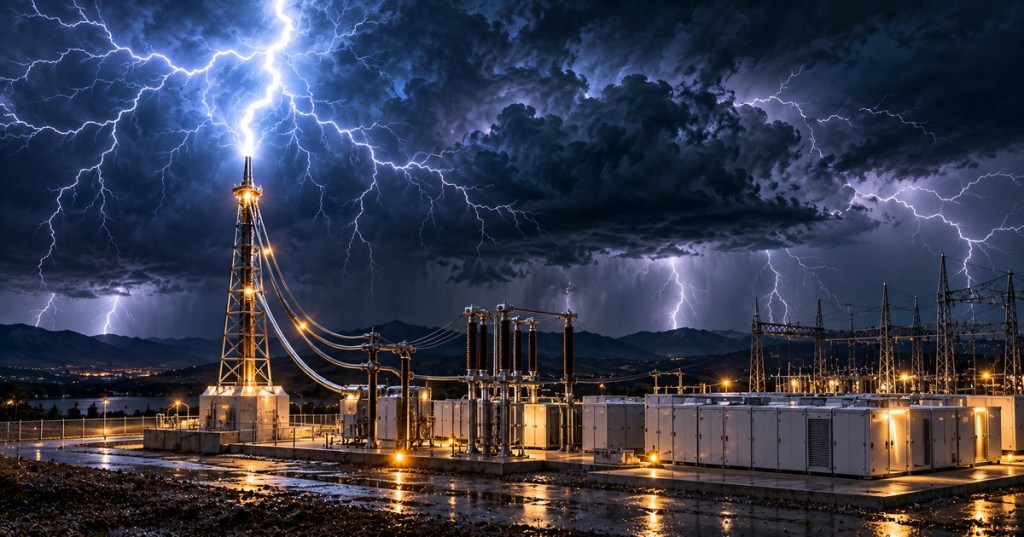
Lightning looks like free electricity falling out of the sky. A bolt can carry hundreds of millions of volts, tens of thousands of amps, and enough energy to make almost any power engineer stop and stare. So why do we build wind farms, solar arrays, geothermal plants, and batteries instead of giant lightning collectors?
Because lightning has the opposite characteristics of a good power source. It is extremely powerful, extremely brief, unpredictable, geographically scattered, and difficult to convert into electricity that the grid can actually use.
The Short Verdict
| Question | Verdict |
|---|---|
| Does lightning contain usable electrical energy? | Yes. |
| Could engineers capture some of it? | In principle, yes. |
| Could lightning become a dependable grid-scale power source? | Probably nah. |
| Is research into lightning capture pointless? | No. It can still improve surge protection, storage, materials, and high-voltage engineering. |
A Lightning Bolt Really Is That Powerful
The National Weather Service says a typical lightning flash is around 300 million volts and roughly 30,000 amps. Multiplying those numbers gives an instantaneous electrical power on the order of terawatts.
That sounds enormous because it is. But power and energy are not the same thing. Lightning delivers its power in an extremely short pulse, so the total amount of energy available from one strike is much smaller than the frightening instantaneous power number suggests.
The Energy Number Is Less Impressive Than The Power Number
The U.S. Department of Energy estimates roughly 1,500 megajoules of energy in one lightning strike. That works out to about 417 kilowatt-hours before capture and conversion losses.
DOE points out the scale problem directly: more than 58,000 lightning strikes would have to be captured every day to equal the electricity production of a 1 GW power plant. And that calculation assumes the full energy of every strike is successfully captured, converted, stored, and delivered—which a real system would never achieve.
This is another reason capacity factor matters more than headline power. A power source is valuable not because it can briefly produce an enormous number, but because it can reliably deliver useful energy over time.
Problem #1: You Cannot Schedule A Thunderstorm
A utility can forecast solar production, schedule gas turbines, dispatch batteries, and estimate wind output. Lightning is much less cooperative. Individual strikes occur where charge conditions allow them, not where the grid operator needs electricity.
You could build capture towers in lightning-prone regions, and tall grounded structures can increase the probability of a local strike. But increasing probability is not the same as creating a dispatchable power plant. There could still be hours, days, or longer periods with little useful activity.
Problem #2: The Hardware Has To Survive The Thing You Are Harvesting
Power electronics normally try to keep voltage and current inside carefully controlled operating ranges. Lightning does the opposite. It arrives as a violent high-voltage impulse with steep current rise times, electromagnetic interference, heating, arcing, and mechanical stress.
A practical collector would need to intercept the strike, route the current safely, step the electrical conditions into something power electronics can tolerate, and then move the energy into storage. Every stage adds losses, cost, insulation requirements, and failure modes.
Problem #3: Batteries Do Not Want A Terawatt Punch
A battery may store hundreds of megawatt-hours, but that does not mean it can accept energy at any possible rate. Energy capacity and power capacity are different engineering limits.
A lightning capture system would likely need multiple buffering stages—surge components, high-power capacitive storage, conversion equipment, and then slower transfer into a battery or the grid. That is very different from simply connecting a lightning rod to a battery container.
The same distinction shows up in conventional storage projects such as Origin’s proposed 1.2 GW / 8.6 GWh Eraring battery complex: engineers specify both how much energy the system can hold and how quickly it can charge or discharge.
Could We Trigger Lightning On Purpose?
Scientists can sometimes trigger lightning with rockets and conductive paths for research. That is useful for studying lightning physics and testing protection systems, but it does not solve the energy problem. The storm still has to contain the electrical charge in the first place.
Triggering a discharge can influence when and where stored atmospheric charge releases. It does not manufacture the storm energy, and deliberately triggering thousands of strikes for power production would introduce obvious safety, infrastructure, insurance, and operational problems.
Is Lightning Renewable Energy?
In the broad physical sense, thunderstorms continually regenerate atmospheric electrical charge, so lightning is naturally replenished. But classifying something as renewable does not automatically make it a practical energy resource.
That is the same distinction behind clean versus renewable energy. Engineering usefulness depends on reliability, conversion efficiency, environmental impact, economics, location, and whether the energy can be delivered when customers actually need it.
The Better Idea Is Protecting Equipment From Lightning
The most valuable lightning technology today is not harvesting it—it is surviving it. Lightning rods, grounding systems, surge arresters, shielding, bonding, and protection coordination help buildings, substations, wind turbines, transmission systems, and data centers send lightning energy somewhere safe.
That may sound less exciting than a lightning farm, but it solves a real grid problem. A strike that does not destroy a transformer, inverter, turbine blade, or control system can save far more money than a speculative collector might earn from capturing the strike’s energy.
So: Lightning Power — Or Nah?
Scientifically valid? Yes. Commercial grid resource? Mostly nah.
Lightning is genuine electrical energy, and there is no law of physics preventing engineers from capturing some fraction of a strike. The problem is everything surrounding the strike: timing, location, conversion, storage, protection, utilization, and cost.
If future materials and ultrafast storage become dramatically cheaper, lightning harvesting could become an interesting niche experiment. But as a serious answer to global electricity demand, solar, wind, geothermal, hydro, nuclear, and ordinary energy storage all begin with a massive advantage: they can be engineered around predictable energy flows instead of waiting for the sky to randomly throw a terawatt punch at them.
BitcoinVersus.Tech
Advertisement
Editor’s Note
We volunteer daily to ensure the credibility of the information on this platform is Verifiably True.
If you would like to support our research and publishing work, please donate here: 3C9o19EH5HSiwEPyCTmEKzxhNCbo2X6TTb
BitcoinVersus.tech is not a financial advisor. This media platform reports on financial and technology subjects purely for informational purposes.


Leave a Reply