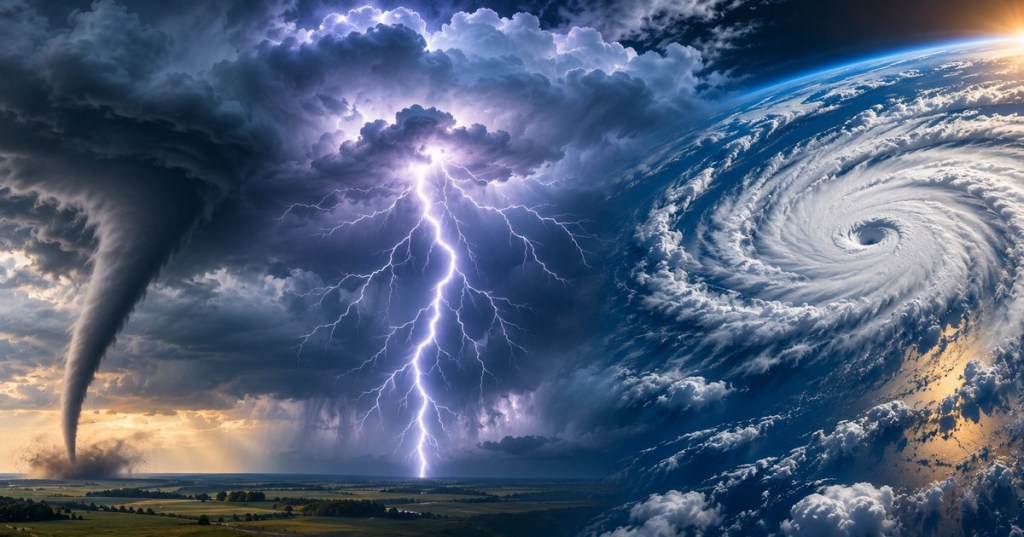
Tornadoes rotate with destructive intensity, lightning delivers enormous electrical pulses, and hurricanes transport extraordinary amounts of energy across entire oceans. Yet none has become a practical, direct source of commercial electricity. The underlying forces are familiar to engineers; the ability to collect their power safely, steadily and economically remains a different problem.
The ranking examines three forms of atmospheric energy by physical scale, concentration, collection difficulty and the prospects for useful conversion. It is not a list of demonstrated power plants or a prediction that spectacular weather will someday replace conventional renewables. For a wider perspective, the Kardashev civilization scale describes humanity’s theoretical progression from today’s subplanetary energy use toward planetary and even stellar levels of power.
#3 — Tornadoes: enormous wind speed, almost no usable operating window
A tornado is a tightly rotating column of air extending from a thunderstorm to the ground. Its motion contains kinetic energy, the same physical category harvested by ordinary wind turbines. The difference is that a tornado concentrates fast, turbulent winds and debris in a moving, destructive vortex rather than supplying a stationary, reasonably predictable air stream.
The NOAA National Severe Storms Laboratory reports that a typical tornado may remain on the ground for only about five minutes, although individual events can last much longer. Mobile radar has observed wind speeds as high as 318 mph above ground level in an Oklahoma tornado. Neither fact supplies a credible average electrical rating: speed alone cannot determine energy without the affected air volume, mass flow, location, duration and recoverable fraction.
A proposed direct-harvesting machine would need to anticipate a rare, rapidly shifting path, withstand debris and violent wind shear, remain connected to an electrical grid and continue producing useful energy for enough hours to repay its cost. NOAA notes that tornadoes can travel at highly variable speeds and sometimes dissipate in moments. Designing equipment around the most dangerous part of a storm would also raise severe safety and liability concerns.
Engineers can exploit controlled rotating flows in industrial equipment, and ordinary wind farms already harvest a portion of atmospheric kinetic energy. Neither achievement establishes a tornado-powered generating station. Verdict: tornado rotation is real energy, but chasing or intercepting natural tornadoes is among the least practical ways to supply electricity.
NOAA / NASA-funded GOES-R satellite imagery of tornadic cells over Iowa on June 28, 2017, published by NOAA NESDIS. The footage documents storm observation, not energy harvesting.
#2 — Lightning: a powerful pulse without a reliable energy supply
Lightning offers a more direct-looking electrical source: thunderstorms naturally separate electric charge until a discharge occurs. The flash may be exceptionally bright and intense, but electrical infrastructure needs controllable voltage, current, repeated supply and storage. Lightning instead arrives in short, highly variable pulses whose location and electrical characteristics make collection difficult.
The U.S. Department of Energy uses an illustrative value of about 1,500 megajoules per strike. Converted into electrical energy units, 1,500 MJ equals approximately 417 kilowatt-hours, before any collection, conversion or storage losses. That sounds substantial until duration and frequency enter the calculation.
A power plant delivering 1 gigawatt continuously generates 24 gigawatt-hours in a day. At the DOE illustrative energy per lightning strike, replacing that output would require approximately 57,600 perfectly captured strikes every day. The DOE similarly estimates more than 58,000 per day. In reality, collecting every joule would be impossible; equipment would also need to survive enormous transient current and dispose of dangerous electrical surges.
A lightning rod protects infrastructure by offering a relatively safe path to ground; it is not a commercially viable lightning battery. Research on lightning triggering, sensing, surge protection and fast storage may produce valuable technologies without establishing lightning as a scalable power resource. BitcoinVersus.Tech previously examined the same basic issue in Can We Harvest Lightning for Electricity, or Nah?
Verdict: lightning has a genuine electrical energy budget, but short duration, low capture probability and the cost of protection and storage defeat the apparent advantage.
NOAA GOES-19 Geostationary Lightning Mapper imagery, released October 17, 2024. The satellite detects lightning and follows storm intensification; it does not collect the discharge as electricity.
#1 — Hurricanes: planetary-scale heat and wind, not a power plant
Hurricanes occupy the top position for the scale of the energy circulating through a large atmospheric system. Warm ocean water supplies heat and moisture, the atmosphere transports that moisture, and condensation releases latent heat as clouds and precipitation form. A fraction of the energy maintains the rotating winds; much of the rest participates in convection and exchanges with the surrounding environment.
The NOAA Atlantic Oceanographic and Meteorological Laboratory provides illustrative mature-hurricane calculations for two different physical processes. The condensation-related heat release is about 5.2 × 10¹⁹ joules per day, equivalent to an average power rate of roughly 600 terawatts. The estimated rate of kinetic-energy generation and dissipation in the winds is much smaller, around 1.3 × 10¹⁷ joules per day, or 1.5 terawatts. Heat released throughout a storm must not be described as wind power that a turbine can capture.
Even the 1.5-TW wind figure represents a storm-wide atmospheric energy rate, not a proposed generator’s output. Capture would demand extensive infrastructure across constantly changing ocean conditions, while structural loads, waves, corrosion, drifting wind fields and grid transmission would add cost and risk. Extracting energy on a large enough scale could also change the flow being harvested; the system cannot be treated as a stationary reservoir of free power.
Modern wind turbines demonstrate the safer alternative: harvesting ordinary wind when conditions stay within a controlled operating envelope. The Department of Energy explains that wind turbines typically shut down above a design-dependent cut-out speed, often around 55 mph, to limit mechanical strain. A hurricane would push conventional hardware far beyond its preferred operating regime.
Coastal renewables can still harvest energy associated with ocean and atmospheric systems without intercepting an active hurricane. Tidal and ocean-energy systems collect currents, waves and thermal gradients under engineered conditions, while Eco Wave Power’s shoreline equipment illustrates a different approach to moving water. None converts the full energy budget of a hurricane into electricity.
The goal of stopping or steering a hurricane by deliberately extracting its energy remains speculative. NOAA has explicitly rejected claims that technology can currently create, control or redirect hurricanes. Verdict: hurricanes contain the largest energy flow among the three ranked phenomena, but the most realistic near-term harvest remains ordinary wind and marine power outside extreme storm conditions.
NOAA Satellites’ “Earth from Orbit: Hurricane Season Heats Up,” published August 2021, shows satellite observations of tropical storms and hurricanes. The imagery is meteorological evidence, not footage of a storm-powered generating plant.
Type 0, Type I and Type II: where humanity fits on the Kardashev scale
Soviet astronomer Nikolai Kardashev proposed a classification of technologically advanced civilizations in 1964 based on the scale of usable power. The original Type I referred approximately to Earth’s energy use at the time. A later, popular interpretation sets a Type I civilization near 1016 watts, a Type II civilization near 1026 watts and a Type III near galactic power. Calling current humanity “Type 0” is a later shorthand, not an original fourth Kardashev category.
Using International Energy Agency data, 2025 world total energy supply was approximately 655 exajoules. Dividing 655 × 1018 joules by 31,536,000 seconds yields about 20.8 terawatts of average power. Carl Sagan’s continuous interpolation, K = (log10 P − 6)/10 for power P in watts, gives humanity approximately K = 0.732. The estimate depends on using the IEA’s primary-energy accounting and the later Sagan benchmark convention; it is not a claim that Earth has captured 73% of its available power.
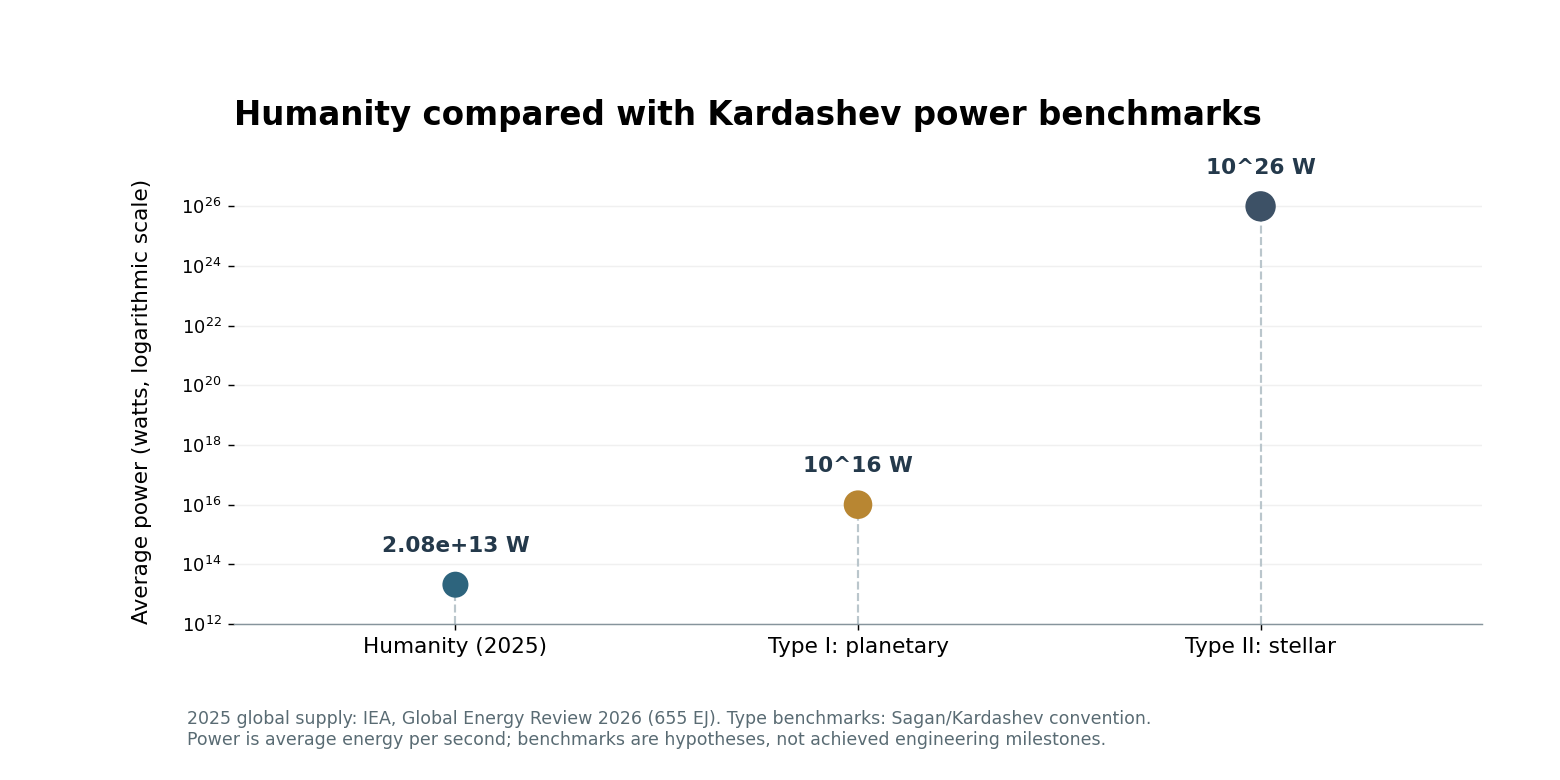
The popular modern Type I threshold of 1016 W is roughly 480 times the 2025 global average. Type II’s 1026 W threshold is another 10 billion times Type I. Those are proposed classification benchmarks rather than engineering schedules. The chart uses logarithmic points instead of zero-based bars because the power ranges span thirteen orders of magnitude, making conventional linear comparisons nearly unreadable.
A Type I society would not necessarily build enormous devices inside tornadoes. A more credible pathway involves reliable solar, wind, nuclear, geothermal and marine energy, larger storage systems, resilient transmission and better conversion efficiency. Actual output must be measured across time rather than inferred from nameplate capacity, a distinction covered in BitcoinVersus.Tech’s capacity-factor explainer. A hypothetical Type II society would require stellar-scale collection, frequently illustrated by speculative space-based collector swarms; no demonstrated human technology approaches that capability.
PBS Space Time, “How Can Humanity Become a Kardashev Type 1 Civilization?” (November 7, 2024), examines the planetary-energy interpretation and the gap between modern power systems and proposed civilization thresholds.
The decisive obstacle is usable electricity, not raw natural energy
Tornadoes, lightning and hurricanes are manifestations of broader atmospheric energy exchanges, not three separate energy sources waiting inside a reservoir. Their strongest moments are often the least suitable for conversion. Site availability, mechanical survival, capture efficiency, storage, transmission and public safety determine whether physical energy can become a dependable commercial product.
The ranking therefore identifies three dramatic energy flows that humanity has not directly commercialized as generators, rather than three assured future fuels. Progress toward planetary-scale power would be better measured by annual useful energy delivered, reliability, cost and environmental performance. Capturing nature safely is a stronger engineering milestone than chasing its most destructive extremes.
BitcoinVersus.Tech
BitcoinVersus.Tech Editor’s Note: We volunteer daily to ensure the credibility of the information on this platform is Verifiably True. If you would like to support our work and help further secure the integrity of our research initiatives, please scan the QR code below to donate 5,000 sats. For best results, scan the QR code from a laptop or larger screen.

Bitcoin address: 3C9o19EH5HSiwEPyCTmEKzxhNCbo2X6TTb. On a phone, open the QR image on another screen or copy and verify the address in your wallet before sending.
BitcoinVersus.tech is not a financial advisor. This media platform reports on financial subjects purely for informational purposes.


Leave a Reply