
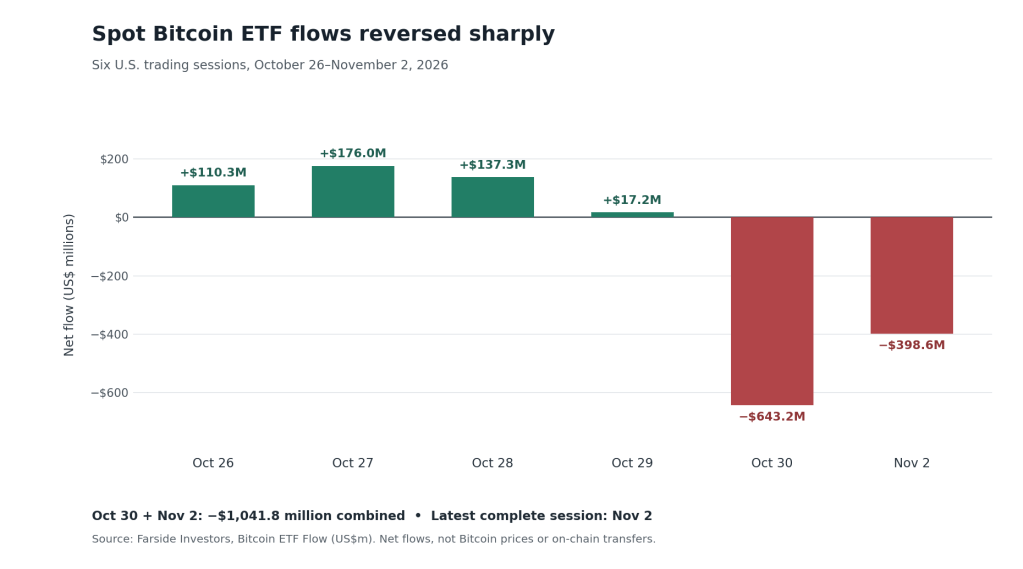
U.S. spot Bitcoin exchange-traded funds recorded $1.0418 billion in net outflows across October 30 and November 2, 2026, reversing four consecutive sessions of inflows as Bitcoin faced renewed selling pressure. Farside Investors’ daily figures show $643.2 million leaving on Friday and $398.6 million on Monday. The November 3 ETF trading session was not included in the latest complete flow data at reporting time.
BlackRock’s iShares Bitcoin Trust (IBIT) led both days, with $233.7 million in Friday outflows and $405.3 million Monday. Its combined $639 million represented roughly 61% of the two-session net withdrawal total. Fidelity’s FBTC was the only fund showing positive net flows Monday, taking in $6.7 million and partly offsetting IBIT’s larger loss.
IBIT Led the Exit, but Friday Was Broader
The reversal followed four trading sessions with combined net inflows of $440.8 million from October 26 through October 29. Friday’s withdrawals were spread across IBIT, Fidelity’s FBTC, ARK 21Shares’ ARKB, Bitwise’s BITB and Grayscale’s GBTC. Monday’s negative aggregate was concentrated in IBIT. The contrast matters because a broad exit and a single large fund redemption can imply different patterns of investor behavior.
CNBC Crypto World, May 30, 2024: an archival report about IBIT becoming the largest spot Bitcoin ETF. The video provides historical context, not evidence for November 2026 flows.
Bitcoin briefly traded near $76,300 during the European morning on November 3 before recovering toward $76,900, CoinDesk reported. Those prices were intraday observations, not a November 3 closing price. U.S. midterm elections, weakness in technology stocks and expectations surrounding economic data also formed part of the broader market backdrop. The timing alone cannot establish that ETF redemptions caused Bitcoin’s decline.
ETF Flows and Bitcoin Prices Are Not Identical
Spot Bitcoin ETF flows measure net creations and redemptions in dollar terms, not an independently verified quantity of Bitcoin sold on exchanges at a particular minute. BlackRock describes IBIT as a vehicle intended to track Bitcoin before expenses. The fund’s SEC filing also describes share creation, custody and investment risks. Fund flows and the underlying spot price should be analyzed separately.
The selloff does not erase the ETFs’ longer record. Farside’s cumulative figures still show approximately $56.6 billion in net inflows since the U.S. spot funds began trading in January 2024. Our earlier October ETF flow analysis documented a similarly volatile week; an older IBIT milestone report provides perspective on the product’s expansion.
What Investors Can Verify Next
ETF redemptions are only one way to assess institutional appetite. Firms holding Bitcoin directly have different funding and liquidity exposures, as explored in BitcoinVersus.Tech’s six-year Strategy review. Market forecasts likewise remain uncertain: the recent Cardone–Calacanis Bitcoin wager proposal highlights the gap between price conviction and settled outcomes.
The next reliable reading will be the completed November 3 U.S. ETF flow report, rather than a partial intraday estimate. A return to inflows could suggest renewed demand, while continued redemptions would extend the reversal. Investors should track IBIT against the other funds, the Bitcoin price at comparable timestamps and revisions to source data rather than interpreting any isolated session as a permanent trend.
BitcoinVersus.Tech Editor’s Note
We volunteer daily to strengthen the credibility of our reporting through verifiable sources. To support independent research, you may donate 5,000 sats using the original QR code below. Verify the receiving address before sending.

Donation address: 3C9o19EH5HSiwEPyCTmEKzxhNCbo2X6TTb.
Disclaimer: BitcoinVersus.Tech provides financial and technology reporting for information and education. This report does not constitute investment advice.


Leave a Reply