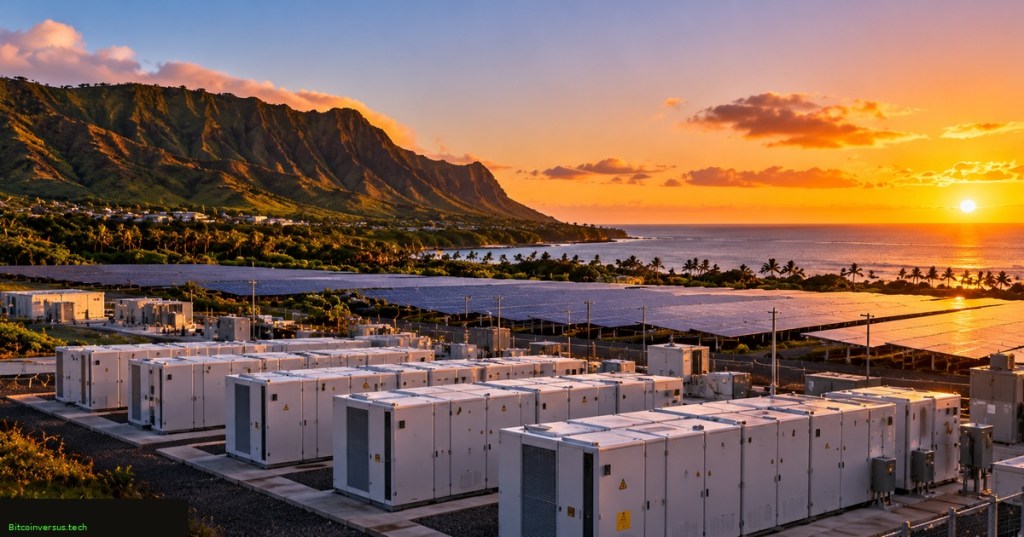
Maui’s power grid is getting a large new battery designed to move renewable electricity from when it is generated to when customers actually need it. Hawaiian Electric says the first six Tesla Megapacks have arrived for the Waena Battery Energy Storage System, a planned 40 MW / 160 MWh project in Central Maui.
The project will use 54 Megapacks and become Maui’s first standalone load-shifting battery energy storage system. Hawaiian Electric says the first units were delivered by semi-truck and lifted into place by crane at the Waena site along Pulehu Road. The utility described the milestone in its September 21 project update.
40 MW of Power, 160 MWh of Stored Energy
The easiest way to understand the project is through the difference between megawatts and megawatt-hours. The 40 MW figure is the system’s maximum power output. The 160 MWh figure is how much energy it can store.
That means Waena could theoretically discharge at its full 40 MW rating for about four hours. In practice, the battery can be dispatched flexibly, so operators can spread that stored energy across different periods depending on grid conditions and demand.
Why Maui Needs Load-Shifting Storage
Solar and wind do not produce electricity at a constant rate. A solar plant can generate strongly during the middle of the day and then fall rapidly toward sunset, while customer demand can remain high into the evening. That mismatch is one reason nameplate capacity does not equal constant output.
A load-shifting battery acts as a buffer. It can charge when renewable generation is plentiful and discharge later when demand is higher or renewable output is lower. That does not create additional energy, but it can make renewable generation more useful to the grid.
54 Tesla Megapacks Become Grid Infrastructure
Each Megapack is effectively a large containerized battery system with battery cells, thermal management, power electronics, controls and protection integrated into a utility-scale package. When dozens of those units are operated together, the result behaves more like a power plant than a collection of individual batteries.
Hawaii already has experience using Megapacks at grid scale. Tesla’s video below shows how Megapacks at the Kapolei Energy Storage project on Oahu help support the grid after Hawaii’s last coal plant retired.
Waena Is Part of a Much Bigger Hawaii Storage Buildout
Waena is not an isolated project. Hawaii is combining solar, wind, geothermal and storage across multiple islands as it works toward a power system that relies much less on imported oil. The Hawaii State Energy Office tracks a broader pipeline of renewable generation and storage projects, including multiple solar-plus-battery developments on Oahu, Maui and Hawaii Island.
The scale of those projects shows why grid batteries are becoming a separate layer of infrastructure rather than an accessory attached to a solar farm. BitcoinVersus recently covered a 1.2 GW / 8.6 GWh battery proposal in Australia, another example of storage being planned as its own large grid asset.
Why This Matters More on an Island Grid
An island grid cannot lean on neighboring states through huge interstate transmission networks in the same way mainland systems can. Maui therefore has to balance more of its generation and demand locally. Batteries give operators another fast-response resource for managing that balance.
They can also help reduce renewable curtailment. If solar or wind output exceeds what the grid can use at a particular moment, some generation may otherwise have to be reduced. Charging a battery during those periods can preserve more of that electricity for later use.
What Happens Next
Hawaiian Electric still has dozens of Megapacks to install before Waena becomes operational. The utility’s renewable-project status board lists the 40 MW / 160 MWh system for completion in 2027.
Once commissioned, the most important metric will not simply be how many batteries sit on the site. It will be how effectively Waena shifts renewable electricity into Maui’s evening peaks, reduces curtailment and supports a grid with a growing share of variable generation.
BitcoinVersus.Tech
Advertisement
Editor’s Note
This story focuses on the engineering role of utility-scale battery storage in Hawaii’s grid transition. Project schedules and operating plans can change as construction and commissioning progress.
We volunteer daily to ensure the credibility of the information on this platform is Verifiably True. If you would like to support to help further secure the integrity of our research initiatives, please donate here: 3C9o19EH5HSiwEPyCTmEKzxhNCbo2X6TTb
BitcoinVersus.tech is not a financial advisor. This media platform reports on financial subjects purely for informational purposes.


Leave a Reply