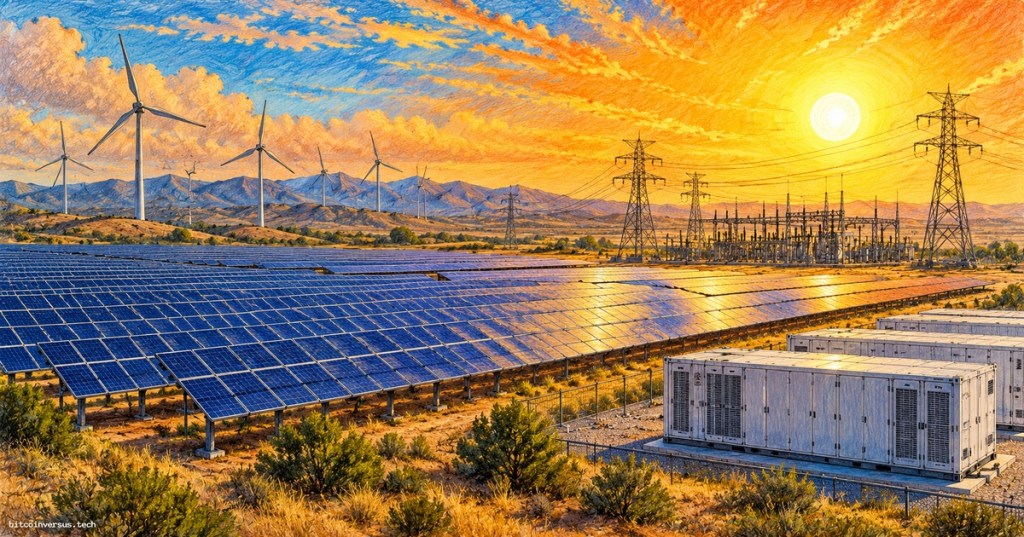
The summer of 2026 gave the U.S. power grid a stress test: record heat, rising air-conditioning demand and rapidly growing electricity demand from data centers. Instead of forcing fossil-fuel generation to rise at the same pace, much of the extra electricity came from renewable energy—especially solar and wind—with batteries helping shift daytime generation into the evening.
A Reuters analysis published October 6 found that renewable generation grew faster than electricity demand across several of the country’s largest power markets. Texas was the clearest example: ERCOT load grew roughly 4% during the first nine months of 2026, while clean-power generation rose by more than 11%. Solar output increased about 26% and wind more than 8%, while fossil generation grew by less than 1%.
Texas Hit 91.1 GW—and Solar Was 32% of the Peak
The strongest primary-source evidence comes from the U.S. Energy Information Administration. EIA reported that ERCOT reached an all-time hourly peak load of 91.1 GW on July 22 at 6:00 p.m. Central Time. Natural gas supplied 48% of generation during that peak hour, while solar supplied 32%—an unusually large contribution during one of the most demanding hours the Texas grid has ever seen.
That is important because the useful question is not whether solar can produce a lot of electricity at noon. It is whether renewable generation overlaps with real system demand. Summer air-conditioning loads often remain high into late afternoon, so solar power increasingly covers part of the same period when the grid is under the most stress.
Batteries Extend Solar Into the Evening
Solar’s limitation is obvious: output falls as the sun sets, even if electricity demand remains elevated. That is where battery energy storage changes the operating picture. Batteries can charge when solar output is abundant and discharge later, shifting some renewable generation into the evening ramp.
This is why batteries should not be described as a renewable generator. They do not create energy. Instead, storage changes when electricity can be used, allowing solar and wind output to serve more hours of the day and reducing the amount of flexible generation needed during short peaks.
The 2026 Buildout Is Still Accelerating
The summer results did not happen in isolation. Earlier this year, EIA projected a record wave of new U.S. generating capacity for 2026: 43.4 GW of utility-scale solar, 24 GW of battery storage and 11.8 GW of wind if planned projects are completed. Texas alone was expected to account for about 40% of new solar capacity and more than half of new battery capacity.
That buildout also explains why nameplate megawatts are only part of the story. A generator’s real contribution depends on when it produces, how often it is available and how much energy it delivers over time—concepts BitcoinVersus.Tech breaks down in our guide to capacity factor.
Wind Still Matters Even When Solar Gets the Headline
Solar dominated the summer reliability story because hot afternoons create a natural overlap between sunlight and cooling demand. Wind works differently. Its output is often strongest at different hours and in different seasons, which can make the two resources complementary rather than interchangeable.
The operating value of wind and solar also changes with market conditions. BitcoinVersus.Tech recently covered how flexible loads can benefit from low- and negative-price renewable hours, showing why the timing of renewable output matters as much as the annual energy total.
Renewables Are Becoming Grid Resources, Not Side Projects
The strongest takeaway from summer 2026 is not that the grid no longer needs gas, transmission or other flexible resources. It still does. The lesson is that solar, wind and batteries are increasingly doing more than reducing emissions. They are serving real peak demand, absorbing load growth and participating directly in reliability.
That distinction matters as U.S. electricity demand keeps rising. If new demand from AI, manufacturing, cooling and electrification continues to arrive quickly, the power system will need more generation, more storage and more transmission at the same time. Summer 2026 showed that renewables are already carrying a meaningful share of that expansion.
BitcoinVersus.Tech
Editor’s Note
BitcoinVersus.Tech independently covers energy systems, data centers, Bitcoin mining, semiconductors and the infrastructure connecting them.
If you would like to support our research and technical publishing, donations are welcome: 3C9o19EH5HSiwEPyCTmEKzxhNCbo2X6TTb
BitcoinVersus.Tech is not a financial advisor. This media platform reports on financial and technology subjects purely for informational purposes.


Leave a comment