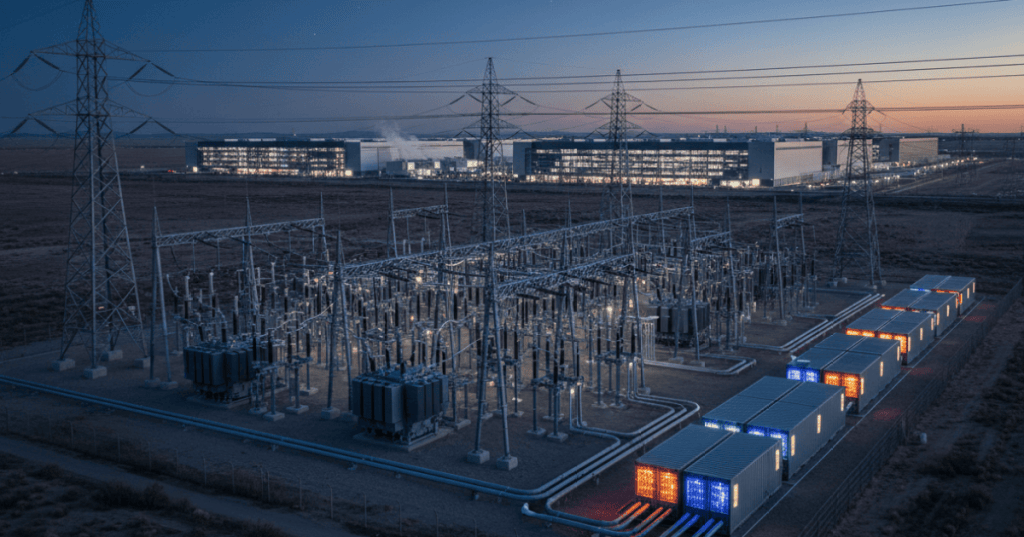
U.S. electricity use is on track to set new records in both 2026 and 2027 as AI data centers, cryptocurrency computing, manufacturing and broader electrification push more demand onto the grid.
Reuters reported on October 6 that the U.S. Energy Information Administration expects total power demand to rise from a record 4,195 billion kilowatt-hours in 2025 to 4,288 billion kWh in 2026 and 4,356 billion kWh in 2027.
Data Centers Are Becoming a National Load-Growth Story
The power story around AI is no longer confined to individual hyperscale campuses. Demand from the commercial sector—which includes data centers—is now large enough to materially affect national electricity forecasts.
In its October Short-Term Energy Outlook, EIA said commercial-sector electricity demand is expected to increase steadily through 2027, growing 2.8% year over year. Industrial demand is forecast to rise another 2.7%, while residential consumption stays roughly flat from 2026 levels.
Bitcoin Mining Is Part of the Same Grid Conversation
Reuters said the demand increase is being driven in part by data centers dedicated to artificial intelligence and cryptocurrency. Large proof-of-work mining sites are unusually visible to grid operators because electricity is one of their largest operating inputs.
Mining loads can often be curtailed more quickly than an enterprise AI workload because shutting down mining machines does not interrupt a customer inference request. BitcoinVersus.Tech recently explored whether Bitcoin mining can stabilize the power grid by reducing load during periods of scarcity.
Wholesale Power Prices Are Rising Too
EIA expects wholesale electricity prices across the 11 hubs it tracks to average about $52 per megawatt-hour in 2026, roughly 11% higher than in 2025. The national average is then forecast to ease slightly to about $49/MWh in 2027.
The national average hides major regional differences. EIA forecasts wholesale prices in PJM to rise 41% in 2026 compared with 2025, while prices in the Northwest Mid-Columbia region are expected to fall 23%.
That regional split matters because data-center economics depend on where new capacity can actually connect. BitcoinVersus.Tech has already covered PJM’s 6.8 GW backstop and the fight over who pays for new grid capacity.
More Demand Means More Generation and Grid Hardware
EIA expects U.S. electricity generation to reach about 4,545 billion kWh in 2026 and 4,613 billion kWh in 2027. Solar capacity is forecast to climb from 152 GW in 2025 to 182 GW in 2026 and 223 GW in 2027, while wind capacity rises more gradually from 159 GW to 170 GW and then 179 GW.
New generation alone is not enough. Utilities also need substations, transformers, transmission lines, switchgear and interconnection capacity capable of moving those electrons to the places where new load is concentrated.
Large Tech Buyers Are Contracting Around the Bottleneck
One response is for major technology companies to support new or expanded generation directly rather than waiting for general-purpose grid capacity to appear. That model is already visible in Google and Constellation Energy’s 3.59 GW PJM power agreement, which combines contracted existing supply with 890 MW of new nuclear capacity created through reactor uprates.
The Bigger Point
The AI infrastructure boom is no longer just a semiconductor or data-center story. It is becoming a national electricity-system story.
When EIA’s baseline forecast assumes record electricity use in consecutive years, the question becomes how quickly utilities, generators and transmission operators can build around it. AI and cryptocurrency computing are now competing inside the same physical system as every other large load.
BitcoinVersus.Tech
Advertisement
Editor’s Note
Demand totals cited in the opening are Reuters’ summary of EIA’s October forecast. EIA’s own electricity report separately publishes generation, sector-growth and wholesale-price forecasts. Electricity demand, electricity sales and electricity generation are related but not identical measures.
Support BitcoinVersus.Tech research through the donation options listed on the site.
BitcoinVersus.tech is not a financial advisor. Content is provided for informational purposes.


Leave a Reply