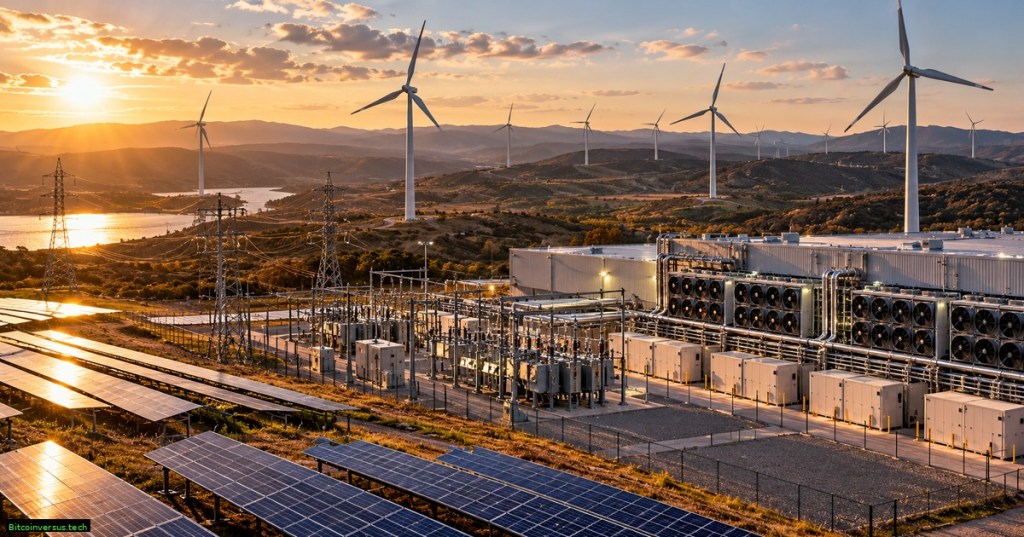
A new 2026 study in Renewable Energy reaches a conclusion that sounds simple but matters for real mining operations: renewable-powered Bitcoin mining gets its biggest economic advantage when miners are flexible enough to stop running during expensive hours.
The paper analyzes source-tagged electricity prices inside the California Independent System Operator market and finds that wind and solar stand out most in the lowest-price tail of the market. At ordinary median prices, the renewable advantage becomes much smaller. That turns flexible load—not simply renewable ownership—into the key operating idea.
Wind Gets Cheapest When the Grid Has Too Much Power
The researchers used CAISO nodal electricity-price data from January 2018 through May 2020 and grouped locations by generation source. At the 5th percentile of prices, wind-linked nodes averaged about -$33.48/MWh, solar about -$16.16/MWh, and natural gas about -$15.33/MWh.
A negative electricity price means the market is effectively signaling that supply is temporarily more abundant than demand or transmission capacity can efficiently absorb. That is the same basic condition behind renewable curtailment: generators may have available wind or solar energy that cannot be economically delivered to ordinary loads.
At Normal Prices, the Renewable Advantage Nearly Disappears
The most important result is what happens away from those extreme low-price hours. At the median, the study reports wind at about $15.77/MWh and natural gas at about $16.88/MWh. That is a much smaller gap than the difference seen in the bottom 5% of the market.
In other words, the value is concentrated in timing. A mining site that can consume power when wind or solar is abundant—and curtail when electricity becomes expensive—can capture a price advantage that a 24/7 load may largely miss.
The Study Models Mining as Dispatchable Demand
The paper models Bitcoin miners less like conventional factories and more like dispatchable electrical loads. When power falls below an economic threshold, the machines run. When electricity becomes too expensive relative to mining revenue, the machines shut down.
That operating model fits the idea behind stranded-energy mining. ASICs can be placed close to generation and can change load far faster than many industrial processes. But the economics depend on how often cheap power actually appears and whether the mining operation can tolerate lower uptime.
The Historical Break-Even Numbers Need Context
Using historical mining hardware and pre-2020-halving conditions, the model produced a wind-colocated Bitcoin break-even price of roughly $3,200 per BTC compared with about $5,800 per BTC for natural-gas-linked mining under its threshold-dispatch assumptions. The authors also find that halving the block subsidy roughly doubles modeled break-even Bitcoin prices.
Those values are not current 2026 profitability estimates. The study calibrates older ASIC generations—including the Antminer S9 and Whatsminer M31S+—against historical power-market and block-reward conditions. Today’s hashprice, network difficulty, transaction fees, ASIC efficiency, financing cost and curtailment strategy are different.
Efficiency Still Changes the Math
Cheap renewable power cannot rescue every machine. An inefficient miner consumes more kilowatt-hours for the same hashrate, so its maximum profitable electricity price is lower. That is why modern fleet decisions still have to combine electricity price with wall-level J/TH, uptime and cooling overhead.
A newer ASIC can therefore stay online through a larger portion of the price curve. An older machine may only make sense during the deepest negative-price or very-low-cost renewable windows.
California Still Tracks the Conditions This Model Depends On
CAISO’s monthly renewable reports continue to track wind and solar curtailment, renewable output, net-load ramps and the frequency of negative real-time electricity prices. Those are exactly the grid conditions a flexible mining load would need to monitor.
That does not mean California is automatically an attractive Bitcoin-mining market. BitcoinVersus has already examined why large-scale Bitcoin mining remains uncommon in California, including retail power costs, regulation and siting economics. The study isolates wholesale-market timing; a real project still has to solve land, interconnection, transmission, capital cost, tax and permitting.
Clean Energy Does Not Mean 24/7 Energy
Wind and solar are variable resources. Their output depends on weather, location and time of day, while mining revenue depends on Bitcoin’s block subsidy, fees, difficulty and market price. The clean-energy strategy works best when the mining load can follow the power rather than demanding the power follow the miner.
That distinction also explains why batteries are not automatically the answer. Storing surplus renewable electricity and releasing it later can improve utilization, but storage adds capital cost and energy losses. For some projects, it may be cheaper to curtail the ASICs and wait for the next low-price window.
The Takeaway
The study does not show that every renewable-powered mine is automatically cheaper or cleaner. It shows something more specific: Bitcoin mining can extract unusual value from surplus renewable electricity because the load is interruptible.
The strongest clean-energy mining model may therefore be less about running green power around the clock and more about running ASICs precisely when the grid has too much low-cost renewable energy—and shutting them off when it does not.
BitcoinVersus.Tech
Advertisement
Editor’s Note
This article discusses a peer-reviewed economic model built from historical CAISO electricity prices and older Bitcoin-mining hardware. Its modeled break-even prices should not be interpreted as current 2026 mining profitability estimates.
Support and donation options are available through BitcoinVersus.Tech.
BitcoinVersus.tech is not a financial advisor. Content is provided for informational purposes.


Leave a Reply