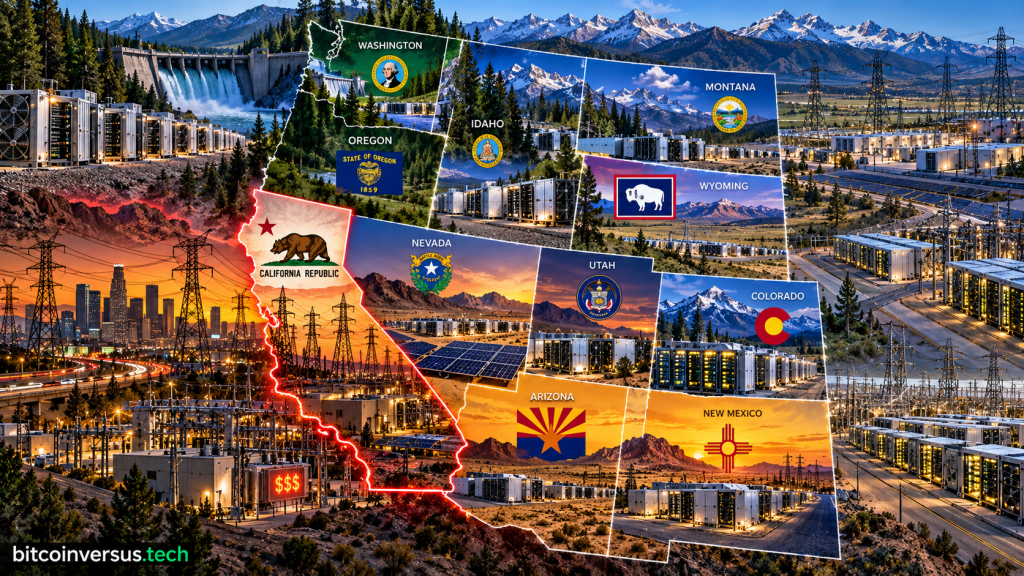
Bitcoin mining never disappeared from the American West. It moved toward the places where electricity, land, grid access and operating conditions still make continuous ASIC computing economical. That distinction matters because California sits next to some of the best mining geography in the country, yet today it has almost no publicly visible industrial Bitcoin-mining footprint.
This report uses “Western U.S.” more broadly than the literal Pacific Coast. The core comparison includes California, Oregon, Washington, Nevada, Arizona, New Mexico, Idaho, Utah, Colorado, Wyoming and Montana. Texas is intentionally excluded because it has become its own major mining market and would overwhelm a report focused on the western states.
The short answer on California is important: California has not imposed a statewide Bitcoin-mining ban. Instead, the state has become an unusually difficult place to make industrial proof-of-work economics work. Electricity is expensive at the meter, land and construction are expensive in the strongest data-center markets, environmental and local permitting can add time and uncertainty, and miners must compete with higher-margin AI and cloud operators for the same substations and transmission capacity.
The Electricity Map Explains Most of the Mining Map
The clearest starting point is July 2026 state industrial electricity data from the U.S. Energy Information Administration. Statewide industrial averages are not the same thing as a negotiated mining power contract, but they show why the West separates into very different mining markets.
The table below adds an illustrative 10 MW continuous-load electricity cost. It assumes 87.6 GWh of annual consumption and uses roughly ₿1 = $85,400 only to show scale. Real miners can pay materially less—or more—depending on demand charges, wholesale access, curtailment, behind-the-meter generation and power-purchase agreements.
| State | July 2026 industrial rate | Illustrative 10 MW annual electricity cost | Current public mining picture |
|---|---|---|---|
| California | 25.11¢/kWh | ≈₿258 ($22.0M) | No industrial crypto-mining facility currently tracked in the major public dataset used for this report |
| Washington | 7.51¢/kWh | ≈₿77 ($6.58M) | Strongest Pacific Northwest mining footprint; Merkle Standard and Salcido sites remain visible |
| Oregon | 8.92¢/kWh | ≈₿91 ($7.81M) | Small footprint; Abundant Mines operational, DMG Boardman proposed |
| Idaho | 9.02¢/kWh | ≈₿93 ($7.90M) | Peak Digital operational; GeoBitmine proposed |
| Nevada | 10.04¢/kWh | ≈₿103 ($8.80M) | No major tracked operating mine; Sarcobatus off-grid solar mine is permitted |
| Arizona | 9.35¢/kWh | ≈₿96 ($8.19M) | No large crypto-mining facility in the current tracked inventory |
| New Mexico | 4.16¢/kWh | ≈₿43 ($3.64M) | Very cheap industrial average, but current large projects skew toward AI/data centers rather than Bitcoin mining |
| Colorado | 9.54¢/kWh | ≈₿98 ($8.36M) | Aspen Creek Digital Olathe plus a smaller flare-mitigation mining site |
| Utah | 9.10¢/kWh | ≈₿93 ($7.97M) | No major dedicated crypto mine in the current tracked inventory |
| Wyoming | 8.62¢/kWh | ≈₿88 ($7.55M) | CleanSpark plus smaller operators; one of the strongest active Western states |
| Montana | 7.71¢/kWh | ≈₿79 ($6.75M) | Atlas Power and Sentinum remain significant current operators |
California’s July industrial average was roughly 2.6 times the U.S. industrial average, more than three times Washington’s, and about six times New Mexico’s. At 10 MW continuously, the gap between California and New Mexico is roughly ₿215 ($18.4M) per year before the miner buys a single ASIC, pays payroll, replaces fans, or repairs a hashboard.
Where the Western Bitcoin Miners Actually Are
For the site map, BitcoinVersus.Tech reviewed filings, current operator disclosures and Compute Atlas’s source-cited U.S. crypto-mining inventory. The dataset is not a census, so an unlisted farm is not proof that no small private operation exists. It is, however, useful for separating large publicly documented mines from ordinary data centers, AI campuses and mining-hardware factories.
| Operator | State / Site | Publicly documented scale | Status / why it matters |
|---|---|---|---|
| Merkle Standard | Usk, Washington | 100 MW | One of the largest clearly documented operating Bitcoin-mining sites in the West |
| CleanSpark | Cheyenne, Wyoming | 75 MW portfolio / campus target | Public filings continue to list Wyoming mining operations; CleanSpark became one of the West’s largest public miners |
| Atlas Power | Butte, Montana | About 75 MW operating; larger expansion history | Former CryptoWatt site; grid-scale mining/data processing complex |
| Salcido Enterprises | Central Washington | Multiple sites; disclosed examples include 2 MW, 4 MW and 4.8 MW | Distributed hydro-region operator across Chelan, Douglas and Grant counties |
| Sentinum / Hyperscale Data | Sidney, Montana | 10 MW | Operating Bitcoin-mining facility |
| Aspen Creek Digital | Olathe, Colorado | 6 MW mining load paired with 10 MW solar | Operating behind-the-meter solar Bitcoin mine |
| Peak Digital Solutions | Orofino, Idaho | Capacity not publicly established | Operational crypto-mining facility |
| Abundant Mines | Cascade Locks, Oregon | Capacity not publicly established | Operating Oregon crypto-mining site |
| Crypto Knight Hosting / H6 Coin | Wyoming | Capacity not publicly established | Smaller operating sites alongside CleanSpark |
BitcoinVersus.Tech covered CleanSpark’s westward move when the company acquired its Wyoming mining sites. Wyoming illustrates the profile large miners like: lower electricity costs, industrial land, expandable substations, a cooler climate and fewer competing uses for every megawatt than California’s largest load centers.
Washington Is Still the Real Pacific-Coast Mining State
If “West Coast” is used literally, Washington remains the clear mining center. Hydroelectric regions east of the Cascades created an early Bitcoin-mining ecosystem around Wenatchee, Moses Lake, Douglas County, Grant County and Pend Oreille County.
Merkle Standard’s Usk facility is currently documented at 100 MW. Salcido Enterprises still has several smaller sites in the public record, including ELLER in Douglas County, Wheeler near Moses Lake, Entiat in Chelan County, Broadway in Grant County and additional Wenatchee/Cashmere locations.
But Washington also shows where the industry is going next. Keel Infrastructure—formerly Bitfarms—stopped Bitcoin mining at its 18 MW Washington site on April 28, 2026 and began converting it to HPC/AI. Cheap hydropower was not enough to keep Bitcoin as the highest-value use of the site once AI infrastructure could command more revenue per megawatt.
Oregon, Idaho and Colorado Are Smaller but Real
Oregon has abundant hydro and a huge cloud-data-center market, but only a thin mining layer. Abundant Mines in Cascade Locks is listed as operating; DMG Blockchain has a proposed 3.75 MW Boardman facility; Boxminer’s 20 MW La Pine proposal was cancelled. In other words, Oregon’s cheap-ish power exists, but hyperscale cloud operators have captured much of the region’s prime power and fiber infrastructure.
Idaho is similarly small. Peak Digital Solutions operates in Orofino, while GeoBitmine has a proposed 6 MW Bingham County project. Colorado has the most technically interesting small site: Aspen Creek Digital’s 6 MW Olathe mine sits behind the meter with a 10 MW solar array, showing the kind of energy pairing that could theoretically make mining work even in a region without massive hydro.
Wyoming and Montana Are the Western Growth Markets
Wyoming and Montana combine cheap power, cool weather, transmission access, industrial land and political comfort with energy-intensive industry. CleanSpark’s Wyoming expansion is the most visible example. Montana adds Atlas Power’s Butte complex and Sentinum’s 10 MW Sidney mine, with other projects permitted or proposed.
The power-first logic is exactly why land prices alone can be misleading. BitcoinVersus.Tech previously examined why mining sites are ultimately priced around usable megawatts and infrastructure, not simply cheap acreage.
Nevada Has the Mining Industry, But Not Much Mining
Nevada is a useful distinction. Bitdeer is building its U.S. SEALMINER manufacturing facility in Sparks, which BitcoinVersus.Tech covered as a major domestic ASIC-manufacturing move. But an ASIC factory is not a mining farm.
The current Nevada public inventory shows one dedicated crypto-mining project: the permitted Sarcobatus Solar Project near Scotty’s Junction. The design is unusually relevant to the California discussion because it is planned as an off-grid solar mine rather than a conventional grid-connected campus.
Arizona, New Mexico and Utah Have Power—But AI Is Winning the Land Rush
Arizona and Utah have enormous conventional and AI data-center pipelines, yet their current public facility inventories show no dedicated large-scale crypto-mining sites. New Mexico is the paradox: its July 2026 industrial electricity average was only 4.16¢/kWh, the lowest in this Western comparison, but current projects are being pulled toward AI campuses and other high-value compute rather than Bitcoin.
That tells us electricity price is necessary but not sufficient. Operators also need a tractable interconnection, a willing utility, fiber, land, predictable permits, cooling strategy, financing and an economic reason to choose SHA-256 compute over GPU compute.
So Why Is There Almost No Industrial Bitcoin Mining in California?
1. Delivered industrial electricity is brutally expensive
California’s 25.11¢/kWh industrial average is the biggest single explanation. Bitcoin mining is an electricity-arbitrage business disguised as a computing business. If a modern mine cannot lock in low-cost power for most of the year, efficiency gains from newer ASICs are overwhelmed by the energy bill.
A 10 MW facility running continuously at California’s statewide industrial average implies roughly ₿258 ($22.0M) in annual electricity. The same illustrative load at Washington’s average is about ₿77 ($6.58M). In New Mexico it is about ₿43 ($3.64M). A California operator begins with a structural disadvantage of millions of dollars per year before hardware, labor or financing.
2. Cheap California wholesale hours are not the same thing as cheap 24/7 mining power
California can actually have very cheap wholesale electricity during strong solar periods. The EIA projected summer 2026 California wholesale prices around 2.3¢/kWh on average at the cited hub. That sounds perfect for mining until the difference between wholesale energy and delivered firm load is considered.
A mine needs a physical interconnection, transmission and distribution capacity, protection equipment, demand service, backup plans and enough hours of operation to amortize the ASICs. Midday solar oversupply does not automatically give a 50 MW miner a firm 50 MW retail service at the wholesale clearing price. A flexible mine could monetize curtailed power, but it would need a structure specifically designed around that opportunity.
3. AI and cloud data centers can pay more for the same megawatt
The California Energy Commission says the state already has more than 200 active data centers. Those facilities accounted for about 1,000 MW of CAISO peak demand in early 2026 and are projected to reach about 4,500 MW by 2040.
Bitcoin miners therefore compete for substations, transmission upgrades and development sites against cloud and AI operators that can often produce much more revenue per delivered megawatt. The Washington Bitfarms-to-HPC conversion shows this is not merely a California problem: when a site can host high-density AI, owners may rationally retire ASIC mining even when the underlying power is cheap.
4. California has more permitting layers around large energy infrastructure
There is no special statewide ban on proof-of-work mining, but a large California facility can still face local land-use review, utility interconnection studies, air-district permitting, noise constraints and California Environmental Quality Act review depending on the project. If a site needs large thermal generation or extensive backup generation, California Energy Commission processes can also enter the picture.
California’s Digital Financial Assets Law is also sometimes confused with a mining restriction. It regulates many businesses that exchange, store or transfer digital assets for California residents; it is not a statute that simply prohibits a company from running SHA-256 machines.
5. The climate and real-estate tradeoff is awkward
Coastal California offers mild temperatures but expensive land and crowded infrastructure. Inland California offers cheaper land but much hotter summer conditions, which raises fan power, derating risk and cooling complexity. Immersion and hydro systems can reduce that penalty, but they add capital cost.
6. Miners can cross a state line and improve the economics immediately
A California developer does not have to move far to find better economics. Nevada, Idaho, Oregon, Washington, Utah, Wyoming, Colorado and New Mexico all posted July industrial electricity averages below California by wide margins. Once the business is location-flexible, there is little reason to insist on California unless the operator controls an unusually cheap behind-the-meter energy source.
Could Bitcoin Mining Still Work in California?
Yes—but probably not as a conventional grid-retail mine. The California models that make the most sense are behind-the-meter or highly flexible: curtailed solar, geothermal, landfill gas, stranded renewable power, demand response, flare or waste-gas capture, or a mine paired with a generation asset that would otherwise sell power at very low or negative prices.
California’s Imperial Valley is especially interesting because it combines geothermal resources, transmission development and large amounts of renewable generation. But even there, Bitcoin must compete with batteries, hydrogen, conventional data centers and AI for the same electrons.
The Western U.S. Mining Hierarchy in 2026
Tier 1 — Established Western mining: Washington, Wyoming and Montana.
Tier 2 — Smaller but real: Colorado, Oregon and Idaho.
Tier 3 — Permitted or ecosystem presence, little current mining: Nevada.
Tier 4 — Cheap power or huge data-center markets, but no major publicly tracked Bitcoin mines: New Mexico, Arizona and Utah.
Outlier — California: one of America’s biggest data-center states and one of the world’s technology capitals, yet almost absent from industrial Bitcoin mining because the economics of delivered power overwhelmingly favor other Western states.
Bottom Line
California did not lose Bitcoin mining because lawmakers outlawed it. It lost the competition for miners because proof-of-work is ruthlessly sensitive to electricity cost and because the West gives operators many alternatives.
Washington built the original Pacific Northwest mining ecosystem around hydro. Wyoming and Montana offer cheap power, cool air and industrial space. Colorado proved a behind-the-meter solar model can work. Oregon and Idaho retain smaller operations. Nevada is trying off-grid solar. California, meanwhile, has expensive delivered electricity and a line of AI, cloud and conventional data-center developers willing to pay more for scarce grid capacity.
That is why the Western mining map looks the way it does in 2026: not a political border around Bitcoin, but an economic map drawn by the price and availability of megawatts.
BitcoinVersus.Tech
Advertisement
Editor’s Note
We volunteer daily to ensure the credibility of the information on this platform is Verifiably True. If you would like to support to help further secure the integrity of our research initiatives, please donate here: 3C9o19EH5HSiwEPyCTmEKzxhNCbo2X6TTb
BitcoinVersus.tech is not a financial advisor. This media platform reports on financial subjects purely for informational purposes.


Leave a Reply