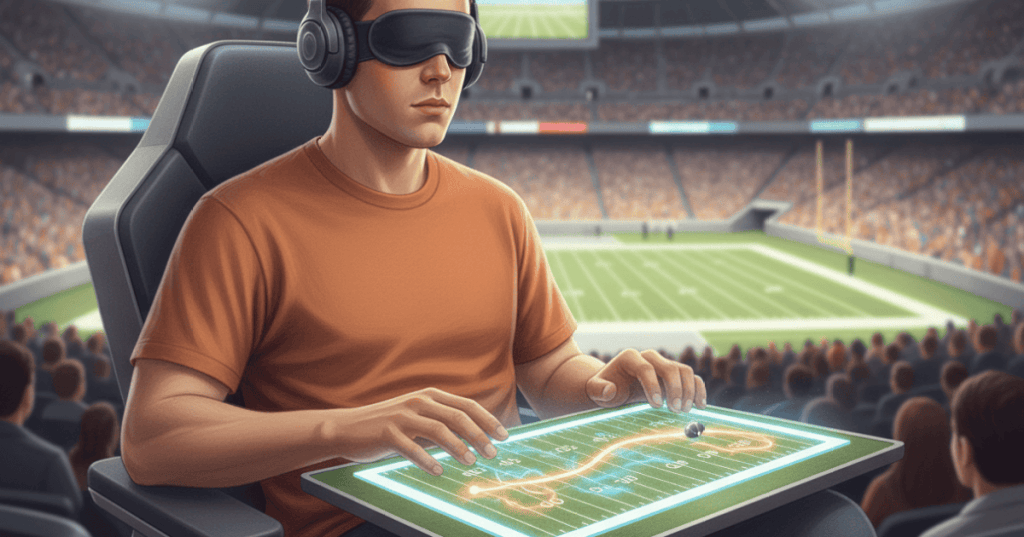
At select Seattle Seahawks home games this season, blind and low-vision fans can follow football through their fingertips.
The team is expanding its use of OneCourt, a tablet-sized tactile broadcast device that converts live football data into trackable vibrations while syncing radio audio closely with the action. The 2026 rollout includes the October 4 home game against the Los Angeles Chargers, followed by additional dates later this month and in November.
The football field becomes a haptic surface
The Seahawks’ official announcement says OneCourt translates live game action into tactile feedback so users can track where the ball is moving and experience key moments as they happen. Fans also receive synchronized radio audio, reducing the disconnect between what happens on the field and what a blind spectator hears.
The device is built around a raised representation of the field. Instead of trying to describe every spatial change verbally, OneCourt turns positional data into a vibration pattern that can be followed by touch.
Seattle already helped test the idea
The Seahawks previously participated in an NFL OneCourt pilot, giving blind and low-vision fans a chance to test the system during live games. The 2026 program moves beyond a limited experiment and makes devices available across multiple regular-season home dates.
An Associated Press report on OneCourt’s Super Bowl deployment described users tracking the football through vibrations while listening to real-time audio. Fans interviewed during earlier trials said the biggest benefit was independence: they could understand the flow of the game without constantly asking a companion what had just happened.
Sports data is becoming a new accessibility layer
Modern stadiums already generate huge amounts of tracking data. The NFL can locate players and the ball in real time, broadcasters turn that data into graphics, and teams use it for performance analysis. OneCourt takes the same basic idea and uses data as an accessibility interface.
BitcoinVersus.Tech recently covered how shoulder-pad sensors can turn football collisions into measurable data. OneCourt shows another side of the same trend: once a sport becomes machine-readable, that information can be repurposed for entirely new experiences.
The same transformation is happening in other sports. IBM is using limb tracking to turn tennis serves into biomechanics scores, while Sony’s optical tracking can rebuild sprint finishes as 3D broadcast replays.
Accessibility does not have to mean a separate experience
The most important part of OneCourt may be that it does not replace the live stadium experience. The fan still sits in the same crowd, hears the same radio call and reacts to the same play at roughly the same moment as everyone else.
What changes is the interface. Instead of depending only on visual information, the game is translated into touch.
That is a useful model for sports technology more broadly: take the data already being collected, then ask whether it can make the experience available to people who were previously excluded from part of it.
BitcoinVersus.Tech
Advertisement
Editor’s Note
We volunteer daily to ensure the credibility of the information on this platform is Verifiably True. If you would like to support to help further secure the integrity of our research initiatives, please donate here: 3C9o19EH5HSiwEPyCTmEKzxhNCbo2X6TTb
BitcoinVersus.tech is not a financial advisor. This media platform reports on financial subjects purely for informational purposes.


Leave a Reply