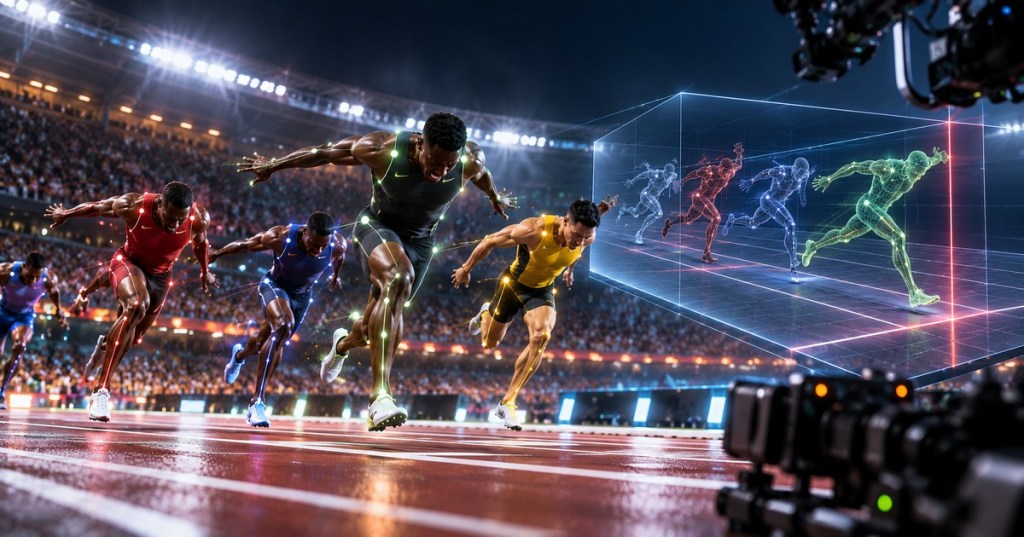
Sony and World Athletics are turning one of track’s hardest moments to read—the split-second sprint finish—into a 3D broadcast reconstruction built from athlete movement data.
At September’s inaugural World Athletics Ultimate Championship in Budapest, the governing body said Sony would deploy proprietary optical tracking as a proof of concept for sprint events, capturing athlete movement and rebuilding decisive finishes as immersive three-dimensional computer graphics for the international broadcast feed.
The finish line becomes a data model
In its September 9 announcement, World Athletics described a system developed specifically for track disciplines. Instead of relying only on the traditional camera angle at the line, Sony’s tracking layer captures movement data and recreates the race finish in 3DCG so viewers can inspect the spacing, body positions and final surge from a perspective that a single camera cannot provide.
World Athletics highlighted the same project in a specific X status announcing Sony’s optical-tracking proof of concept for the Ultimate Championship.
The concept fits a broader sports-computer-vision shift. BitcoinVersus.Tech recently showed how YOLO and OpenCV can turn football video into player tracks and heatmaps. Sony’s system operates at a different production level, but the underlying idea is similar: video and optical data stop being only pictures and become structured motion information.
3D replay changes what viewers can see
A sprint finish can be decided by hundredths of a second, and television viewers normally depend on a side-on replay or photo-finish image. A reconstructed 3D scene can make the geometry of that moment easier to understand by letting the broadcaster present athlete positions as a spatial model rather than a flat image.
Sony said the visualizations would be integrated into the host broadcaster’s international feed, reaching more than 30 broadcasters worldwide. Its technology announcement also said Hawk-Eye Innovations, a Sony group company, would provide video replay services for officials during the championship.
That combination matters because broadcast augmentation and officiating are converging around the same raw material: synchronized cameras, tracking data and fast reconstruction. One output explains the race to viewers; another can help officials review what happened.
Sports labs are moving from markers to cameras
The same transition is happening away from stadium broadcasts. BitcoinVersus.Tech recently covered a Premier League club adopting markerless motion capture for rapid squad testing. In both cases, camera systems can infer useful body movement without asking the athlete to perform inside a traditional reflective-marker laboratory.
Wearable systems are not disappearing, either. NFL shoulder-pad sensors can quantify impacts and workload in ways optical tracking cannot fully replace. The more likely future is sensor fusion: cameras, wearables, timing systems and computer vision feeding different parts of the same sports-data stack.
The Ultimate Championship became a broadcast technology test bed
World Athletics designed the Budapest event as more than another meet on the calendar. The new championship brought elite athletes into a compact format and made broadcast presentation part of the experiment. Sony’s sprint reconstruction was one of the clearest examples of that approach: use a major competition to test whether advanced tracking can make elite performance easier to understand on television.
The next sports replay may be a simulation
Traditional replay asks viewers to watch the same camera footage again, perhaps slower or from a different angle. Optical tracking adds another possibility: reconstruct the event as data, then render that data into a new view that never existed as a physical camera shot.
That does not make the reconstruction more “real” than the original footage, and it should remain clearly presented as an augmentation. But when used carefully, the model can expose relationships—who leaned first, how far apart athletes were, how quickly the gap changed—that are difficult to see in real time.
For sports broadcasting, that is the bigger story. The camera is no longer only recording the event. Increasingly, it is becoming one sensor in a computational system that measures the event, reconstructs it and gives viewers a second way to understand what happened.
BitcoinVersus.Tech
Advertisement
Editor’s Note
We volunteer daily to ensure the credibility of the information on this platform is Verifiably True. If you would like to support to help further secure the integrity of our research initiatives, please donate here: 3C9o19EH5HSiwEPyCTmEKzxhNCbo2X6TTb
BitcoinVersus.tech is not a financial advisor. This media platform reports on financial subjects purely for informational purposes.


Leave a Reply