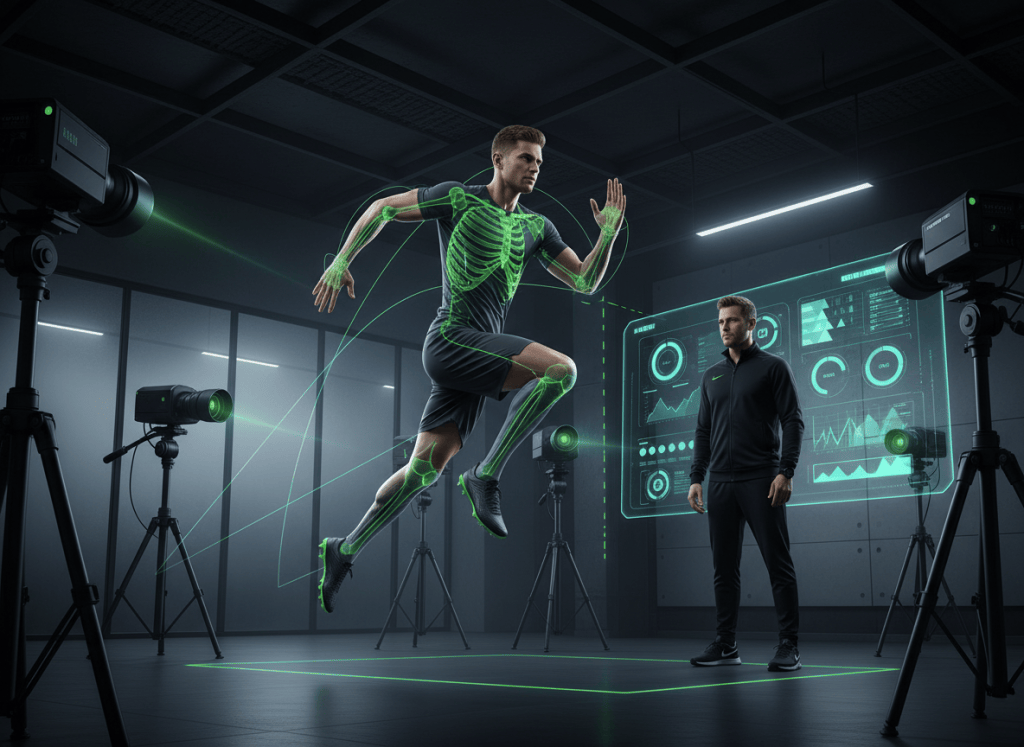
A Premier League club has begun using a markerless motion-capture system that can test an entire squad without attaching reflective markers or wearable sensors to the athletes.
Qualisys announced on September 18 that an unnamed Premier League club signed a commercial agreement for OnTraq, its markerless athlete-assessment platform. The company says approximately 20 athletes can be assessed in about 30 minutes, with the club planning to use the system for readiness, recovery and regular performance testing.
The performance lab is moving onto the training floor
Traditional motion capture often asks athletes to wear reflective markers while a calibrated camera array reconstructs movement in three dimensions. That approach can deliver highly detailed biomechanics, but the setup time and specialist workflow make it difficult to repeat across an entire professional roster every week.
Markerless systems try to remove that bottleneck. Computer-vision models identify the athlete’s body directly from camera footage, estimate joint positions and reconstruct movement without physically instrumenting the player. In practical terms, a jump, sprint or change-of-direction test can become a software pipeline rather than a lengthy lab appointment.
Twenty players in 30 minutes changes the economics of biomechanics
The interesting number in the announcement is not a joint angle. It is throughput. Testing roughly 20 players in half an hour means biomechanical assessment can begin to fit inside an elite club’s existing training schedule rather than compete with it.
That matters because longitudinal data is often more useful than a one-time test. A club can compare an athlete against his own healthy baseline, watch movement change through a congested fixture period, and look for asymmetries during return-to-play work.
The same shift toward continuous measurement has been appearing across sports. BitcoinVersus.tech recently covered Marshawn Lynch’s account of sensor-equipped shoulder pads, which turned repeated football contact into measurable collision data.
Computer vision can measure movement without a wearable
Markerless motion capture is part of a broader move from instrumenting the athlete to instrumenting the environment. Instead of asking every player to wear a device, cameras and software can extract movement information from the space around them.
That approach has obvious appeal in football, where clubs already capture large amounts of video. It also complements the wearable-tracking systems covered in BitcoinVersus.tech’s report on FIFA’s updated wearable technology standards. Wearables can describe workload and position; markerless biomechanics can add information about how the athlete is actually moving.
Return-to-play is where the technology could matter most
A 2026 peer-reviewed review of markerless 3D motion capture concluded that the technology is becoming increasingly useful for return-to-sport assessment because it can quantify movement quality outside traditional laboratories. The authors also emphasized that validation is still stronger for some movement planes and tasks than others, and that more sport-specific evidence is needed.
That caveat is important. A camera-derived skeleton is not automatically a medical diagnosis. The useful workflow is comparison: establish a healthy baseline, repeat the same test over time, and let sports scientists interpret meaningful changes alongside strength testing, medical evaluation and athlete feedback.
AI sports science is becoming less visible
The most interesting sports technology may increasingly disappear into normal training. A player does not need to stop and strap on a special device if the cameras already in the room can capture the relevant movement.
That is similar to the direction of AI-assisted cycling data: the technology becomes valuable when it fits inside the athlete’s existing behavior instead of asking the athlete to work around the technology.
For the unnamed Premier League club, OnTraq will now face the test that matters most: whether rapid, repeatable biomechanics can help performance staff make better decisions throughout a real season.
BitcoinVersus.Tech
Advertisement
Editor’s Note
We volunteer daily to ensure the credibility of the information on this platform is Verifiably True. If you would like to support to help further secure the integrity of our research initiatives, please donate here: 3C9o19EH5HSiwEPyCTmEKzxhNCbo2X6TTb
BitcoinVersus.tech is not a financial advisor. This media platform reports on financial subjects purely for informational purposes.


Leave a Reply