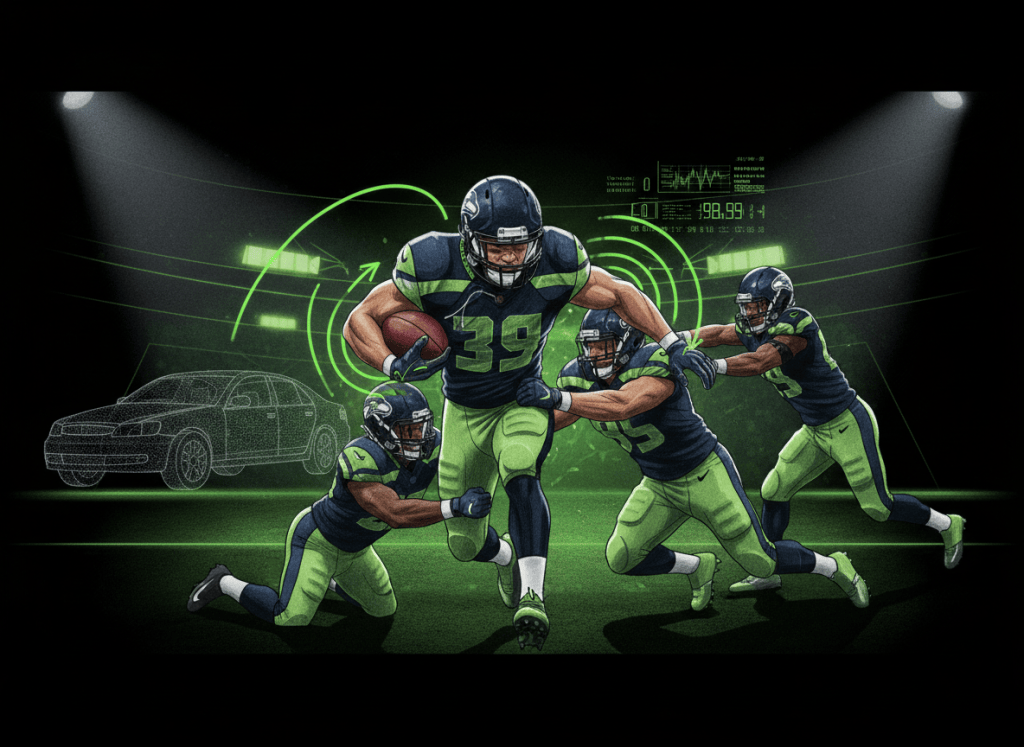
Marshawn Lynch says Seattle Seahawks staff placed small sensor packs in his shoulder pads late in his career to measure the contact he absorbed during games.
In a recent interview, Lynch said a trainer reviewed one game’s data and described the cumulative impact as equivalent to “seven total car crashes.” Yahoo Sports reported his account after the clip circulated this week.
The main Bleacher Report post is also available here.
What the sensor technology measures
Wearable impact sensors do not literally measure “car crashes.” They collect physical data such as acceleration, direction, timing and force proxies that can be analyzed to estimate collision intensity and cumulative load.
The NFL has publicly described using sensors in mouthguards, helmets and shoulder pads. Its player health and safety program says this equipment can capture impact speed, direction, force, location and severity and feed those measurements into equipment and safety research.
That means Lynch’s “seven car crashes” figure is best understood as his recollection of how a trainer translated the collected sensor data into a familiar comparison, not as a standardized scientific unit.
Running back is a cumulative-impact position
For a running back, the useful question is not only how hard the biggest tackle was. A single game can involve repeated contact on carries, pass protection and open-field collisions. Wearable telemetry can turn that repeated exposure into a dataset instead of relying only on memory or visual review.
Sports culture meets instrumentation
Football culture has always celebrated players who run through contact. Sensor systems add another layer by attaching measurements to experiences athletes previously described mostly through feel and film.
BitcoinVersus.tech has been following that shift across sports. FIFA’s updated wearable-tracking standards show sensors becoming formal infrastructure in elite competition, while AI-equipped cycling glasses put performance data directly in an athlete’s field of view.
From measurement to better decisions
The biggest value of impact sensors is not the headline comparison. It is the possibility of comparing exposure across drills, positions, play types and equipment configurations, then using that information to improve training and protective design.
Baseball is moving in the same direction with increasingly fine-grained measurement. Statcast’s first-base tracking metrics quantify difficult defensive plays; football impact sensors quantify a very different athletic event: collisions.
For Lynch, the story resonates because “Beast Mode” became a cultural image of a runner who seemed impossible to bring down. The sensor anecdote adds a technical layer: those collisions could be recorded, accumulated and analyzed instead of remaining only part of football mythology.
BitcoinVersus.Tech
Advertisement
Editor’s Note
We volunteer daily to ensure the credibility of the information on this platform is Verifiably True. If you would like to support to help further secure the integrity of our research initiatives, please donate here: 3C9o19EH5HSiwEPyCTmEKzxhNCbo2X6TTb
BitcoinVersus.tech is not a financial advisor. This media platform reports on financial subjects purely for informational purposes.


Leave a Reply