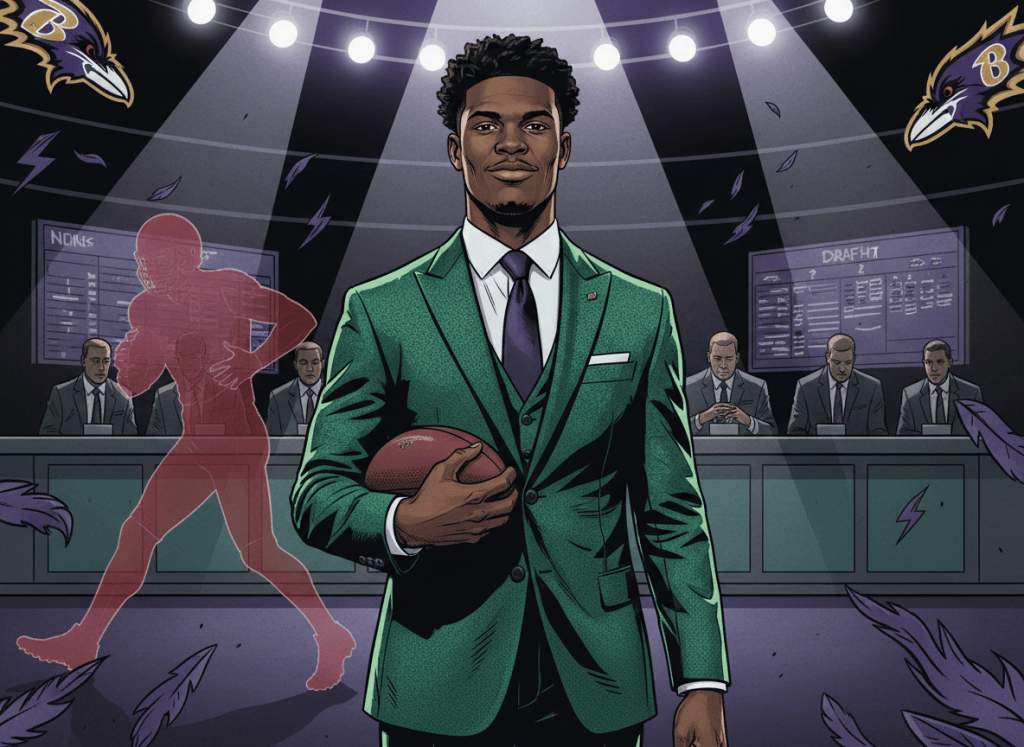
Lamar Jackson may have gone through the most disrespectful draft evaluation of any elite quarterback in modern NFL history.
Not simply because he fell. Great players fall every year. The disrespect was deeper than draft position: a Heisman Trophy-winning quarterback who left Louisville with 9,043 passing yards, 69 passing touchdowns, 4,132 rushing yards and 50 rushing touchdowns had to spend the 2018 pre-draft process repeatedly explaining that he was, in fact, a quarterback.
And there is a harder question underneath the documented criticism. Jackson’s game looked so much like Michael Vick’s that Vick himself embraced the comparison. Did that resemblance cause some evaluators to place Jackson inside an old mental box—electric athlete first, NFL quarterback second—before they had fully evaluated the player in front of them?
That part cannot be proven as the private motive of any specific general manager. But the pattern around Jackson’s evaluation is documented, and the subconscious-bias theory deserves to be discussed rather than dismissed.
The disrespect was not imagined
During the 2018 NFL Scouting Combine, NFL Network reported that multiple teams had submitted requests for Jackson to work out at wide receiver. Jackson said no team had asked him directly and made his position clear: he was a quarterback. Former Colts executive Bill Polian publicly argued that Jackson should switch to receiver, while other evaluators questioned whether his passing could translate at all. NFL.com documented the combine controversy, including Jackson saying he felt disrespected by the idea that his running ability meant he should play another position.
One anonymous offensive coordinator went even further before the draft, saying Jackson would not be able to play quarterback in the NFL and reducing his passing to the line: “when he throws, he hopes.”
Those were not ordinary questions about footwork, timing or reading coverage. Every quarterback prospect gets criticized. Jackson was being asked whether he should remain a quarterback at all.
That distinction matters. BitcoinVersus.Tech recently argued that the league should reconsider parts of its NFL draft development pipeline. Jackson’s case shows the other side of the draft problem: even when a prospect reaches the process with overwhelming production, evaluators can still misclassify what kind of player they are looking at.
Then came the Michael Vick shadow
The Vick comparison was not invented after Jackson became an NFL star. It followed him before the draft because the similarities were obvious: rare open-field speed, sudden change of direction, a powerful arm, explosive improvisation and the ability to turn a broken play into the most dangerous play on the field.
Vick did not run from the comparison. After watching Jackson destroy Florida State in 2016, Michael Vick posted that Jackson was “5x better” than he had been at Virginia Tech. Later, Vick called Jackson his “spitting image.”
Here is where the subconscious argument becomes interesting. There is no evidence that front offices sat in draft rooms and said, “He reminds us of Michael Vick, so pass.” That would be an unsupported claim about private motives. The more plausible version is subtler: Jackson may have triggered an existing archetype in football evaluation—the spectacular Black athlete whose running ability is treated as evidence against his quarterback identity rather than as an additional quarterback skill.
There was already evidence that quarterback scouting carried racialized language
A 2017 analysis of official NFL draft profiles examined 175 quarterback scouting reports from 2008 through 2016. The researchers found meaningful racial differences in how prospects were described: Black quarterbacks were more often framed through athletic traits, while white quarterbacks were more often described through intelligence, leadership, command and other internal qualities. The language differences also helped predict draft outcomes. The Washington Post summarized the study and its findings.
That study does not prove what happened inside any team’s evaluation of Jackson; he entered the draft two years after the study’s sample ended. But it establishes that the broader concern is not imaginary. NFL quarterback scouting had shown measurable differences in the language used to describe Black and white prospects.
That history matters when a quarterback with Jackson’s résumé is discussed as a possible wide receiver before he has taken a professional snap.
And the Vick comparison cuts both ways
There is an important complication: Michael Vick himself was the No. 1 overall pick in the 2001 NFL Draft. So simply resembling Vick cannot, by itself, explain Jackson falling to No. 32.
That is why the stronger argument is not that “Vick made teams afraid of Lamar.” It is that by 2018 the league had accumulated years of assumptions around the mobile Black quarterback archetype—questions about whether explosive runners could survive, whether unconventional mechanics could become accurate enough, whether the offense had to be rebuilt around them, and whether their athleticism belonged at another position.
Jackson looked enough like the most famous version of that archetype that evaluators may have unconsciously reached for the old category before recognizing that Jackson was his own quarterback.
Thirty-one selections went by before Baltimore moved
The precise fact is even stranger than the shorthand that “31 teams passed.” Thirty-one selections came off the board before Jackson was chosen; not every franchise owned a pick before No. 32. Four quarterbacks went ahead of him: Baker Mayfield, Sam Darnold, Josh Allen and Josh Rosen.
Baltimore was not perfectly clairvoyant, either. The Ravens used pick No. 25 on tight end Hayden Hurst before trading back into the first round to take Jackson with the final pick of the night.
That detail actually strengthens the story. Even the organization that understood Jackson better than the rest of the league believed it could wait.
The NFL career demolished the position-change premise
Jackson did not merely become a competent NFL quarterback. He won the 2019 Associated Press Most Valuable Player award unanimously. He won the award again for the 2023 season. In 2024 he produced 4,172 passing yards, 41 passing touchdowns, only four interceptions, a 66.7% completion rate and a 119.6 passer rating.
The irony is that the exact traits used to question his quarterback identity became part of the reason he was so difficult to defend. His running did not prevent him from becoming an elite passer. It forced defenses to play a different mathematical game before the ball was even snapped.
Modern NFL teams now build entire tracking and analytics systems around understanding movement, leverage and physical stress. BitcoinVersus.Tech recently covered how NFL shoulder-pad sensors turn contact into measurable data. Jackson’s draft story is a reminder that better measurement means little if an evaluator begins with the wrong category.
Reasonable concerns became an unreasonable conclusion
There were legitimate football questions about Jackson in 2018. His accuracy could be inconsistent. His footwork was unconventional. Teams had to think seriously about durability and offensive design. Pretending those concerns never existed would rewrite the draft process in the opposite direction.
But questioning a quarterback is different from questioning whether he is a quarterback.
That is the part that makes Jackson’s evaluation feel uniquely disrespectful. The league did not simply rank him fifth among quarterbacks. A meaningful portion of the conversation tried to move a historically productive quarterback away from the position entirely.
Our earlier Peyton Manning–Tom Brady quarterback debate argued that football evaluation should separate team context from individual quarterback ability. Jackson’s case demands a similar discipline: separate what looks familiar from what the player can actually do.
The unspoken rule may have been the real mistake
Sports has unspoken rules. One of football’s oldest was that the quarterback was supposed to look, move and win a certain way. Jackson did not fit that template. He looked like Michael Vick—but faster in some situations, more productive in college and, eventually, far more accomplished as an NFL passer than the position-change conversation imagined.
So the claim here is not that we can read the minds of 2018 general managers. We cannot. The claim is that the evidence shows Jackson entered a draft culture with documented racialized quarterback stereotypes, was explicitly compared to Vick, was publicly pushed toward wide receiver, watched four quarterbacks go before him and then became a two-time MVP at the very position some evaluators doubted he should play.
If that is not the most disrespectful quarterback evaluation ever, it belongs very near the top of the conversation.
BitcoinVersus.Tech
Advertisement
Editor’s Note
We volunteer daily to ensure the credibility of the information on this platform is Verifiably True. If you would like to support to help further secure the integrity of our research initiatives, please donate here: 3C9o19EH5HSiwEPyCTmEKzxhNCbo2X6TTb
BitcoinVersus.tech is not a financial advisor. This media platform reports on financial subjects purely for informational purposes.


Leave a Reply