Today’s foundation is the relationship between voltage, current, resistance, and power. These four quantities show up constantly when troubleshooting power supplies, motors, control circuits, semiconductor equipment, and data-center hardware.
Voltage (V) is electrical potential difference. Think of voltage as the electrical force available to move charge between two points.
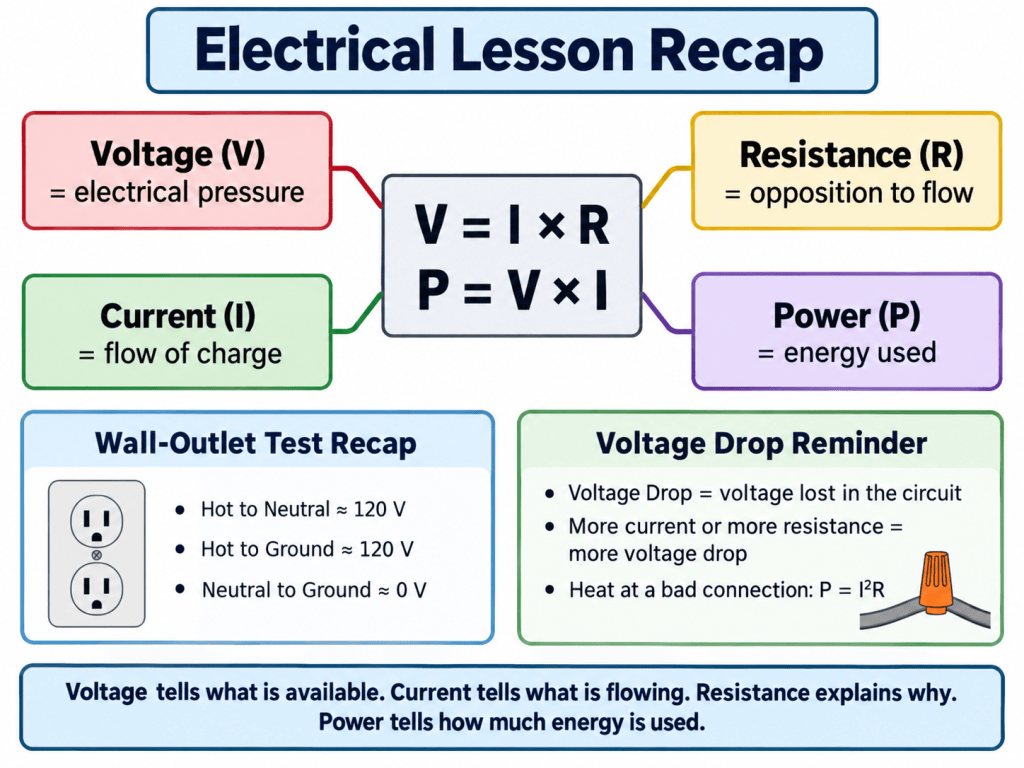
A standard U.S. receptacle should measure approximately 120 V AC from hot to neutral and approximately 120 V AC from hot to ground.
Current (I) is the rate of electric charge flow, measured in amperes (A). Equipment determines how much current flows based largely on its impedance and the applied voltage. A 120 V circuit does not automatically push the circuit breaker’s full rated current through every connected device.
Resistance (R) is opposition to current flow, measured in ohms (Ω). For a simple resistive DC circuit, Ohm’s law is:
Rearranging gives:
Power (P) is the rate at which electrical energy is transferred or consumed, measured in watts  . For a basic DC or purely resistive circuit:
So a 120 V resistive load drawing 5 A consumes approximately:
Field scenario
You are troubleshooting a piece of equipment connected to a 120 V receptacle. Your multimeter shows:
Hot → Neutral: 120 V
Hot → Ground: 120 V
Neutral → Ground: 0.4 V
Those readings are generally consistent with a properly energized receptacle. Neutral and ground should normally have very little voltage between them at the receptacle, although a small voltage can appear because current flowing through the neutral conductor creates some voltage drop.
Now suppose you measure:
Hot → Neutral: 72 V
Hot → Ground: 120 V
That combination immediately makes the neutral path suspicious. Hot-to-ground indicates the hot conductor has approximately the expected voltage, while hot-to-neutral is abnormally low. A loose, damaged, or high-resistance neutral connection becomes one possible troubleshooting target.
New term: Voltage drop
Voltage drop is the reduction in voltage across a conductor or component when current flows through resistance or impedance.
Imagine a cable feeding a machine. The source measures 120 V, but only 110 V reaches the machine while it is operating. The missing 10 V is being dropped somewhere along the circuit.
A useful troubleshooting principle is:
Higher current or higher resistance produces greater voltage drop.
A loose connector is therefore dangerous because its resistance can increase. Current flowing through that resistance produces heat:
For example, if a bad connection develops 0.5 Ω resistance while carrying 10 A:
That tiny connection could be dissipating 50 watts as heat, even though the rest of the equipment appears operational.
Practice
1. A 24 V DC control circuit has a 12 Ω load. How much current flows?
The circuit draws 2 amperes.
2. A device operates at 120 V and draws 8 A. Approximately how much power does it consume?
3. You measure 120 V hot-to-ground but only 65 V hot-to-neutral. Which conductor deserves investigation first?
Answer: Neutral. Hot-to-ground provides evidence that the hot conductor is supplying approximately the expected voltage. The abnormal hot-to-neutral measurement makes the neutral connection a logical troubleshooting target.
4. Why should resistance or continuity normally be measured on a de-energized circuit?
Answer: A multimeter supplies its own small test signal when measuring resistance or continuity. External circuit voltage can invalidate the measurement and potentially damage the meter or create a safety hazard.
5. Challenge: A connector has 0.2 Ω of unwanted resistance and carries 15 A. How much heat is generated at the connection?
That result explains why seemingly small amounts of unwanted resistance can create serious heating at high-current terminals.
Term stack
Voltage → electrical potential difference
Current → flow of electric charge
Resistance → opposition to current
Power → rate of energy transfer
Voltage drop → voltage lost across resistance/impedance
Open circuit → broken current path
Short circuit → unintended low-impedance path
Load → component consuming electrical power
Field rule to remember: Voltage tells you what electrical potential is present. Current tells you what is flowing. Resistance helps explain why that amount flows. Power tells you how quickly electrical energy is being transferred.
Next sessions can progressively move into series vs. parallel circuits, Kirchhoff’s laws, AC fundamentals, capacitance and inductance, transformers, relays/contactors, motors, schematics, grounding, three-phase power, and equipment-level troubleshooting.


Leave a Reply