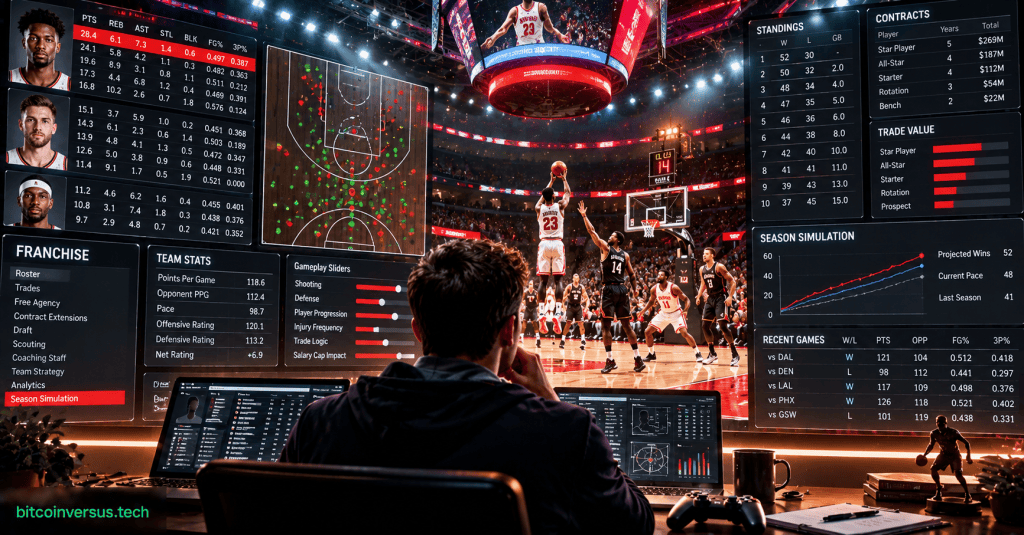
NBA 2K27 can look like basketball, animate like basketball and still fail the most important test of a franchise mode: when you simulate months or years, does the league actually behave like basketball?
That is the core issue raised by NBA 2K creator SixringsofsteeI in a September 29 video now titled “NBA 2K27 MyNBA is a Mess…” The video had already passed 123,000 views when BitcoinVersus.Tech checked it, and its criticism lands on a deceptively technical point: default franchise simulation settings should produce believable league-wide statistics without forcing every serious offline player to become a slider engineer.
Simulation realism is the foundation of franchise mode
Sports games are really two games at once. One is the contest you control possession by possession. The other is a giant statistical engine simulating every team, every player and every game you do not personally play.
For franchise players, that second game may matter more. If scoring leaders are implausible, shooting percentages drift too far from real basketball, rotations produce strange totals, stars fail to separate statistically, or league-wide pace creates distorted season numbers, the entire alternate NBA history starts feeling artificial.
Sliders are valuable because they let players customize a simulation. But there is a difference between using sliders to express preference and using them to repair the baseline. The default model should already land inside a believable statistical range.
2K itself says MyNBA is supposed to get “back to basics”
That makes the criticism especially relevant this year. On its official MyNBA page, 2K says its mission for NBA 2K27 was to “get back to basics” and deliver the improved core franchise experience the community deserves. The company highlights more realistic CBA contract negotiations, a new GM Trust system, revamped free agency and the massive 100-year MyNBA Legacy framework.
2K made the same pitch in its official MyNBA announcement on X, explicitly describing realistic negotiations and community-requested franchise improvements.
Operation Sports likewise highlighted how NBA 2K27 refocused MyNBA on franchise fundamentals, including more realistic free agency, contract negotiations, player relationships and league customization.
But a 100-year universe magnifies bad statistics
MyNBA Legacy makes simulation quality even more important because 2K is asking players to inhabit a basketball universe that can run for a century. Tiny statistical errors that are tolerable in one exhibition game become enormous over ten, twenty or fifty seasons.
Player progression affects contracts. Contracts affect roster construction. Roster construction affects rotations. Rotations affect minutes and production. Production affects awards, records, Hall of Fame outcomes and the historical identity of the league. A franchise simulation is a chain of dependent systems.
That is why the subject overlaps with BitcoinVersus.Tech’s report on Madden NFL 27 rewriting the logic behind franchise simulation. Sports games increasingly have to model organizations and statistical ecosystems, not merely animate athletes.
Graphics cannot rescue a bad league model
A sports game can have near-photorealistic arenas, signature animations and broadcast presentation, yet still feel less realistic than an older title if the simulated season produces a league that does not resemble its real-world counterpart.
The same principle appeared in BitcoinVersus.Tech’s coverage of NHL 27 fixing the state machine behind its hockey simulation. What players experience as “realism” is often the visible result of invisible state logic, probability distributions and tuning values.
Basketball adds another challenge: the numbers are familiar. Fans know what elite scoring looks like. They know what a believable rebound leader looks like. They know roughly how many threes teams take, what strong efficiency looks like and how much statistical separation should exist between stars, starters and role players. Franchise-mode errors are therefore easy to feel even before a player can explain the underlying slider or simulation variable causing them.
Default sliders matter because most players never rebuild the model
Hardcore franchise communities have always built custom slider sets, roster edits and progression formulas. That work is valuable, but it can also hide weaknesses in a default simulation because expert users are effectively recalibrating the game for everyone else.
The strongest design philosophy is the opposite: default settings should produce a statistically credible NBA, while sliders let players intentionally move away from that baseline.
That is also why BitcoinVersus.Tech’s MLB The Show 27 wishlist emphasized the systems behind long-term sports-game immersion. Franchise players notice the accumulated consequences of simulation logic because they live with those consequences for dozens of virtual seasons.
The criticism is spreading beyond one video
SixringsofsteeI is not the only creator saying NBA 2K27 needs a deeper conversation. Another community creator posted a blunt “WE NEED TO TALK ABOUT NBA 2K27” message on September 30 while linking his own video critique.
Simulation realism is king
The larger lesson applies to every serious sports game. Realism is not just player faces, sweat, jerseys, arenas or animation capture. A simulation earns credibility when thousands of hidden calculations repeatedly produce outcomes that resemble the sport.
For MyNBA, the ultimate test is simple: simulate a season, open the league leaders, standings, team statistics, contracts, awards and progression history, and ask whether that universe still feels like the NBA.
If the answer is no, graphical realism is beside the point. Franchise realism starts with the numbers.
BitcoinVersus.Tech
Advertisement
Editor’s Note
We volunteer daily to ensure the credibility of the information on this platform is Verifiably True. If you would like to support to help further secure the integrity of our research initiatives, please donate here: 3C9o19EH5HSiwEPyCTmEKzxhNCbo2X6TTb
BitcoinVersus.tech is not a financial advisor. This media platform reports on financial subjects purely for informational purposes.


Leave a Reply