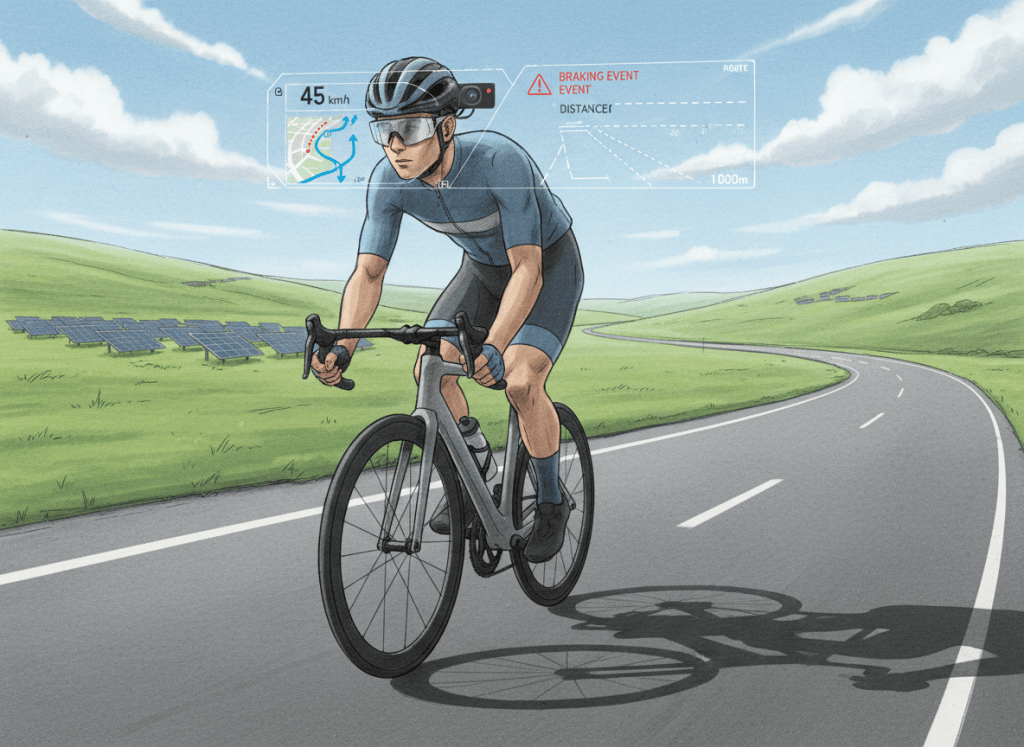
Cycling wearables are moving beyond basic ride recording. BleeqUp’s new Rover AI sports glasses combine a first-person camera, cycling telemetry, safety-event capture and AI-assisted video tools in a 53-gram frame.
BleeqUp unveiled Rover at IFA 2026 in Berlin and positions the device as a second-generation AI sports companion. The 64GB model is listed at $459 and has been available through the company’s online store since September 4.
A camera built around the ride
Rover uses a 16MP camera and supports video up to 3K at 60 frames per second with real-time HDR. The camera offers a 120-degree field of view, electronic image stabilization, loop recording and an adjustable lens angle. BleeqUp lists IP65 protection and a Qualcomm processor.
AI turns braking into a safety event
The more interesting technology is what happens around the camera. According to BleeqUp’s documentation, Rover can detect potential hard-braking events during cycling. When enabled, the system can automatically start a 60-second recording and preserve the preceding 10 seconds of footage. AI then analyzes the event footage to identify clips that may contain a hazard such as a vehicle cutting off the rider or a crash.
BleeqUp explicitly cautions that hard braking does not necessarily mean a hazardous event occurred. That distinction matters: the AI is being used to filter and organize possible incidents rather than make a definitive safety judgment.
Ride data becomes part of the video
Rover’s software can combine video, route maps and activity data into a Video Roadbook. Riders can also overlay recorded activity data onto compatible footage. The company’s AI Highlight Moments feature is designed to surface notable portions of longer rides, such as climbs, descents or group accelerations, so riders spend less time manually searching through recordings.
Sports glasses are becoming edge-computing platforms
The broader trend is the convergence of action cameras, fitness wearables and AI assistants. Instead of carrying a separate camera and later matching footage with ride data, devices such as Rover attempt to capture the athlete’s point of view and organize the resulting sensor and video information in one workflow.
That creates obvious utility for training, incident documentation and content creation, but camera-equipped eyewear also raises privacy questions when used around other people. As AI wearables become more common, transparent recording indicators and responsible use will remain important alongside the performance features.
Sources
- BleeqUp Rover documentation and FAQs
- BleeqUp Rover specifications
- Reuters: AI eyewear and privacy concerns
Related BitcoinVersus.tech coverage: Statcast scoops · Memphis AI screening · Local AI glasses · Qualcomm on-device AI
BitcoinVersus.Tech Editor’s Note: We volunteer daily to help ensure the credibility of information on this platform is verifiably true. BitcoinVersus.tech is not a financial advisor. This article is independent reporting and educational content for informational purposes only.


Leave a Reply