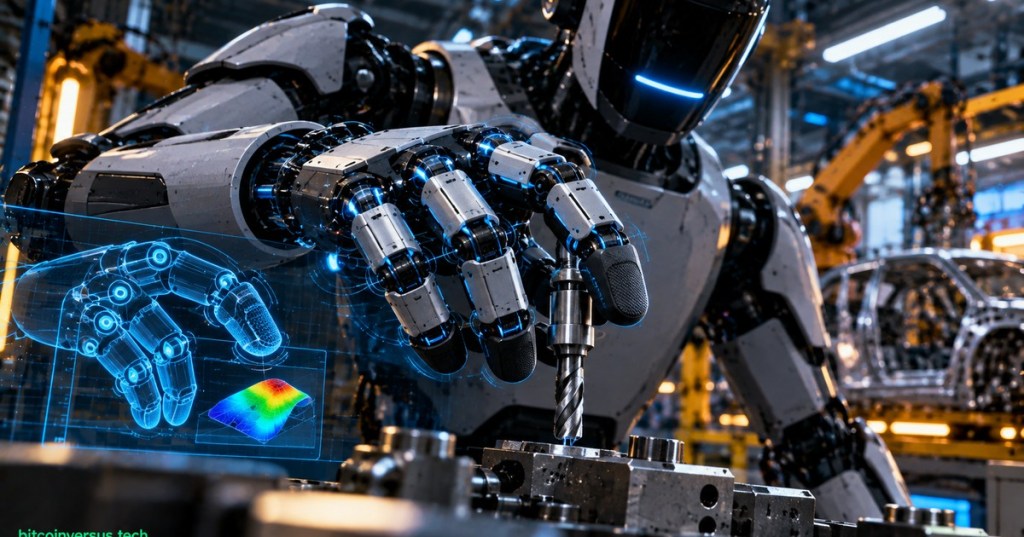
Boston Dynamics has given Atlas a new set of hands, and the most interesting part may be what the engineers deliberately left off: a fifth finger.
In its October 1 demonstration, Boston Dynamics says the new Atlas hand has 13 degrees of freedom, direct actuation and a design built for high-fidelity simulation and sim-to-real reinforcement learning. The goal is no longer merely to grab an object. Atlas is being pushed toward manipulating tools and parts with enough precision for real industrial work.
Four fingers, not five
The engineering choice is wonderfully counterintuitive. A humanoid robot does not automatically need a perfect copy of a human hand. Boston Dynamics’ published Atlas specifications already describe tactile sensing in the fingers and palm, a 56-DOF body and one-handed lifting capability up to 20 kilograms. The new hand concentrates additional articulation where manipulation benefits from it instead of simply chasing anatomical accuracy.
An independent technical report says each new hand moves from seven to 13 degrees of freedom and uses an opposable thumb, tactile sensing and directly actuated joints. Fewer fingers can mean fewer actuators, less mass, fewer failure points and a simpler assembly while preserving the grasps that matter on a factory floor.
The hand has to survive the job
That distinction matters because a useful industrial hand has conflicting requirements. It needs sensitivity to detect contact and slip, but it also has to tolerate repeated impacts, tool forces and thousands of cycles. A delicate laboratory hand that performs a beautiful one-off demonstration is not automatically a production hand.
That is the same gap BitcoinVersus.Tech has been following across physical AI. Figure’s spectacular F.02 retirement showed just how quickly humanoid hardware generations can turn over. REK’s human-versus-robot cage-fight episode put another kind of stress on humanoid hardware, while the Berkeley Humanoid Lite demonstrates the opposite pressure: making useful robot hardware drastically cheaper and more accessible.
Why tactile hands matter for AI
For an AI policy, vision alone is incomplete. Cameras can estimate where an object is, but contact forces tell the controller whether a tool is seated, whether an object is slipping and whether a grasp is becoming dangerous. Tactile information closes that loop.
Boston Dynamics is also emphasizing high-fidelity simulation. That is important because reinforcement-learning policies can practice huge numbers of interactions virtually before being transferred to expensive hardware. But the closer the simulated hand behaves to the physical hand—including joint dynamics and contact—the more useful that training becomes.
The result is a funny inversion of humanoid robotics: Atlas is becoming better at human work partly by becoming less anatomically human. Four fingers may be enough when every finger is instrumented, actuated and connected to an AI control stack.
BitcoinVersus.Tech
Advertisement
Editor’s Note
BitcoinVersus.Tech follows robotics, semiconductors, AI infrastructure and the engineering systems turning software intelligence into physical machines.
If this reporting is useful, you can support BitcoinVersus.Tech with a Bitcoin donation: 3C9o19EH5HSiwEPyCTmEKzxhNCbo2X6TTb
BitcoinVersus.tech is not a financial advisor. This media platform reports on financial subjects purely for informational purposes.


Leave a Reply