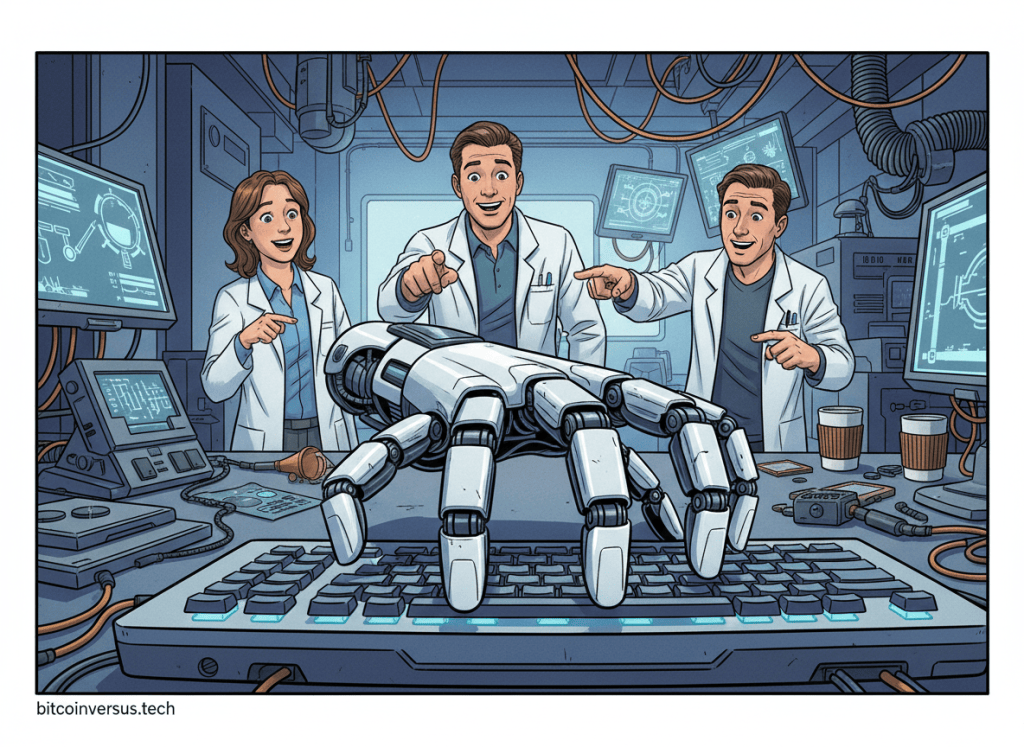
If your robot hand ever gets tired of waiting for the rest of the robot, ETH Zurich has apparently solved that problem.
Researchers at ETH Zurich’s Soft Robotics Lab taught a five-finger anthropomorphic robotic hand to use those same fingers as legs. The result can crawl untethered, steer, recover after falling over, press keyboard keys and push objects—without an arm carrying it to the job first.
The team’s research paper, “Fingers as Legs,” was submitted September 15. Designboom independently documented the demonstrations, including the hand crossing indoor and outdoor surfaces and using a keyboard. Researcher Amirhossein Kazemipour summed up the concept particularly well when he introduced the project on X: normally an arm takes the hand to the work; this one gets there itself.
Yes, the fingers are the legs
The joke-looking part is also the engineering problem. A normal robotic hand is designed to manipulate objects after a larger robot positions it. Here, every finger has two jobs: support and move the 818-gram machine, then stop being a leg long enough to interact with the environment.
The five fingers are not identical, so the researchers could not simply treat the machine as a tiny five-legged walking robot. They trained locomotion policies with reinforcement learning in a simulator calibrated from measurements of the physical hardware.
It falls down. Then the hand gets itself back up.
The hand was tested on 14 indoor and outdoor surfaces, including carpet, tile, metal grating, asphalt, grass, gravel and stone. When researchers deliberately placed it on its side, it recovered to an upright position in 21 of 25 trials.
That ability matters because a mobile manipulator that needs a human to rescue it every time it tips over is not especially autonomous. The researchers packed the battery, sensing and computation onboard so the prototype can operate without a tether.
Then they let it near a keyboard
This is where the research becomes unusually entertaining. While supporting its own weight, the hand pressed keyboard arrow keys without vision and correctly hit 29 of 32 targets. The team then used those inputs to complete moves in the puzzle game Sokoban.
So, yes: researchers have now built a hand that can walk itself over to a keyboard and start pressing buttons. Fortunately, its current ambitions appear limited to warehouse-style manipulation research and puzzle games.
The work complements the broader push toward dexterous end effectors. BitcoinVersus.Tech recently covered Honda and Redwire pairing a dexterous hand with a space robotic arm, where the hand stays attached and the arm supplies mobility.
Why make a hand that can leave?
There is a practical idea underneath the visual comedy. A larger robot could place the hand near a confined opening, narrow workspace or control panel that the full machine cannot enter. The hand could detach, crawl to the target, manipulate an object or control, and return.
Other teams are attacking dexterity from different directions. Sharpa is combining tactile sensing, dexterous hands and haptic teleoperation, while Boston Dynamics redesigned Atlas around four-finger, 13-degree-of-freedom hands. ETH Zurich’s approach asks a stranger question: what if the hand did not need the robot to move around at all?
That question produced something genuinely useful—and a machine that looks like it has somewhere important to be.
BitcoinVersus.Tech
Advertisement
Editor’s Note:
We volunteer daily to ensure the credibility of the information on this platform is Verifiably True. If you would like to support our research initiatives, please donate here: 3C9o19EH5HSiwEPyCTmEKzxhNCbo2X6TTb
BitcoinVersus.tech is not a financial advisor. This media platform reports on financial subjects purely for informational purposes.


Leave a Reply