Bitcoin miners moving into artificial intelligence may sound like a retreat. Bob Burnett sees a possible upside: less competition for the operators that keep mining, alongside a renewed argument over who actually builds Bitcoin’s blocks.
In Onramp’s September 28 interview, the Barefoot Mining CEO and OCEAN executive chairman argues that the public miners’ AI pivot could be a healthy correction. He also expects global hashrate to remain flat or decline for as long as two years. That is his forecast, not an established outcome.
An AI lease changes the business
Independent Reuters Breakingviews analysis published September 23 describes the same infrastructure shift from a different angle: power access is becoming the durable asset. It distinguishes operators leasing powered facilities from those investing in the GPUs and services needed to sell AI computing themselves. Those models carry different capital requirements and equipment risks.
BitcoinVersus.Tech has already documented HIVE winding down Swedish mining while expanding BUZZ HPC and Hyperscale Data switching off its Michigan miners for an AI deployment. Burnett’s interview adds a different question: what does that migration leave behind for Bitcoin?
Less hashrate is not automatically better
Burnett’s argument separates large public operators from smaller miners and favors off-grid energy. His thesis is that an AI alternative can relieve financial pressure on public companies while opening opportunities for miners that remain focused on Bitcoin.
The tradeoff deserves attention. Bitcoin’s difficulty adjustment can ease competition after hashrate leaves, but lower difficulty does not guarantee profitability. Revenue, electricity costs, machine efficiency and downtime still determine whether a particular operation can continue. A miner leaving also removes hashing work from the network; an industry shakeout should not be treated as an automatic security improvement.
Who chooses the transactions?
Burnett’s other concern is block construction. He argues that concentrating template creation in a small number of pools matters independently of how many companies own the machines.
A block template is the candidate block an ASIC works on. Choosing its transactions and ordering is a different job from repeatedly hashing the candidate header. Many geographically dispersed machines can therefore work on templates chosen by comparatively few coordinators.
OCEAN’s DATUM approach lets participating miners construct templates locally while coordinating shared rewards through the pool. Its earlier DATUM explanation shared on X provides background for the interview’s discussion; the post below is from January 7, not a new product announcement.
That makes this discussion relevant to the 256 Foundation’s push for an open mining stack. Hardware access, software access and control over mining work are separate parts of an operator’s independence.
The next test is operational
The practical question is whether miners that stay can combine sustainable power economics with more independent block construction. Watch actual hashrate, completed AI deployments and the use of locally built templates. An interview offers a thesis; those operating results will show how well it holds up.
BitcoinVersus.Tech
Advertisement
Editor’s Note
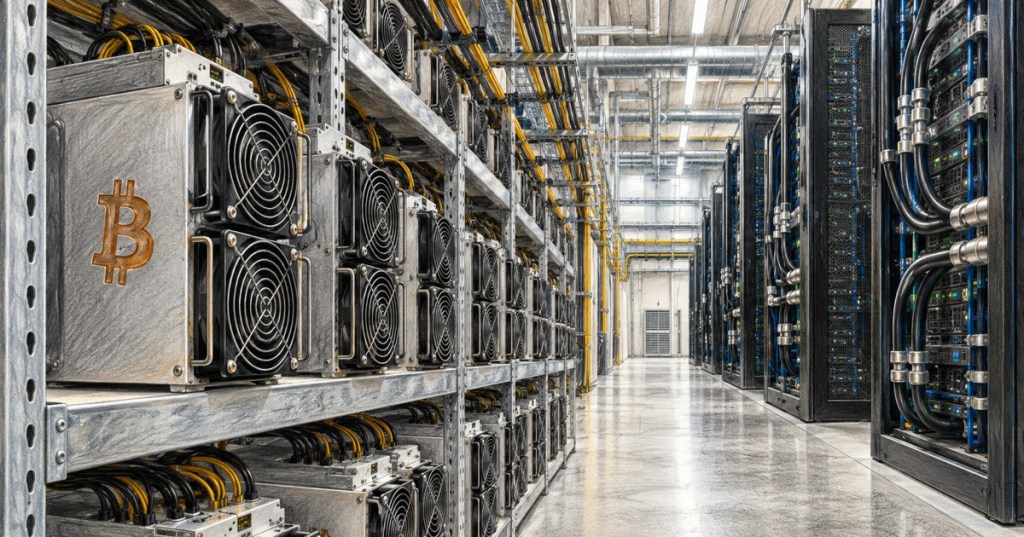
We volunteer daily to ensure the credibility of the information on this platform is Verifiably True. This report distinguishes Burnett’s forecasts from observed company actions. The featured cover is an original AI-generated editorial illustration, not a photograph of a real facility.
If you would like to support our research initiatives, please donate Bitcoin to: 3C9o19EH5HSiwEPyCTmEKzxhNCbo2X6TTb.
BitcoinVersus.tech is not a financial advisor. This media platform reports on financial subjects purely for informational purposes.


Leave a Reply