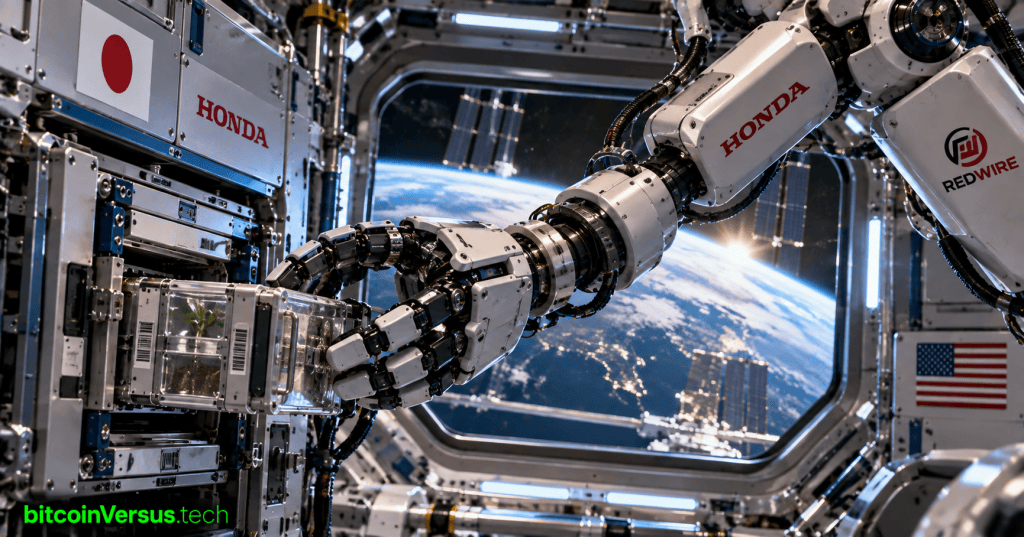
Honda and Redwire are exploring a robotic research system for future commercial space stations that combines Honda’s multi-fingered robotic hand with Redwire’s STAARK robotic arm and experiment-locker technology.
The companies’ Oct. 1 announcement describes a concept intended to automate portions of experiment handling, sample transfer and other routine laboratory work in orbit. The idea is to give smaller commercial-station crews more time for science and mission-critical work.
The proposed system joins a dexterous end effector, a space-rated robotic arm and standardized experiment hardware into one automated research workflow.
Honda brings the hand, Redwire brings the arm
Honda’s contribution is a multi-fingered hand designed for human-like dexterity in laboratory tasks. Redwire contributes STAARK, its robotic-arm platform, along with experiment-locker technology already aimed at orbital research and manufacturing.
The dexterity challenge is familiar on Earth. BitcoinVersus.tech recently examined how Boston Dynamics gave Atlas four-finger hands with 13 degrees of freedom, while space adds constraints around crew time, microgravity, reliability and remote operation.
Redwire’s official announcement emphasizes that future commercial stations may operate with smaller crews. The company’s public post says automation could take over portions of routine experiment handling.
The target is routine laboratory work in orbit
The companies are not presenting a finished flight system. They are exploring how the combined hardware could automate experiment setup, sample movement and related laboratory operations that currently consume astronaut time.
That makes manipulation quality central to the project. BitcoinVersus.tech covered Sharpa’s tactile dexterous hand and haptic-glove system, another example of robotics moving beyond simple open-close grippers toward controlled contact with varied objects.
Honda describes its hand as capable of precise laboratory tasks with human-like dexterity. The company says integrating it with STAARK could automate parts of the research workflow rather than merely reposition equipment.
Commercial stations make crew-time economics more important
Commercial low-Earth-orbit stations are expected to support research while operating under different staffing and economics than the International Space Station. Independent reporting from SpaceNews notes that Honda plans to use the International Astronautical Congress in Antalya, Türkiye, to connect with commercial-station developers and prospective partners.
Automation can therefore be valuable even when a robot does not replace a crew member. Moving repetitive sample and experiment tasks away from astronauts can make scarce human time available for work that still requires judgment, troubleshooting or direct scientific involvement.
Space hardware also has to survive a deployment environment far removed from a factory floor. BitcoinVersus.tech’s coverage of NASA’s two-engine CubeSat ground testing illustrates how extensive validation precedes even comparatively compact orbital systems.
For Honda and Redwire, the next meaningful milestone will be turning the integrated concept into hardware that can demonstrate repeatable laboratory manipulation under space-relevant conditions.
A robotics partnership, not a finished space product
The announcement is explicitly exploratory. Honda and Redwire have not announced a flight date, customer station, launch provider or commercial price for the combined system.
What is concrete is the division of labor: Honda brings dexterous manipulation, Redwire brings the larger robotic arm and experiment infrastructure, and both companies are testing whether those pieces can become a useful automation layer for future orbital laboratories.
If the concept advances, its value will come from reliably completing real research steps—not from simply putting another robotic arm in orbit.
BitcoinVersus.Tech
Advertisement
BitcoinVersus.Tech Editor’s Note:
We volunteer daily to ensure the credibility of the information on this platform is Verifiably True. If you would like to support to help further secure the integrity of our research initiatives, please donate here: 3C9o19EH5HSiwEPyCTmEKzxhNCbo2X6TTb
BitcoinVersus.tech is not a financial advisor. This media platform reports on financial subjects purely for informational purposes.


Leave a Reply