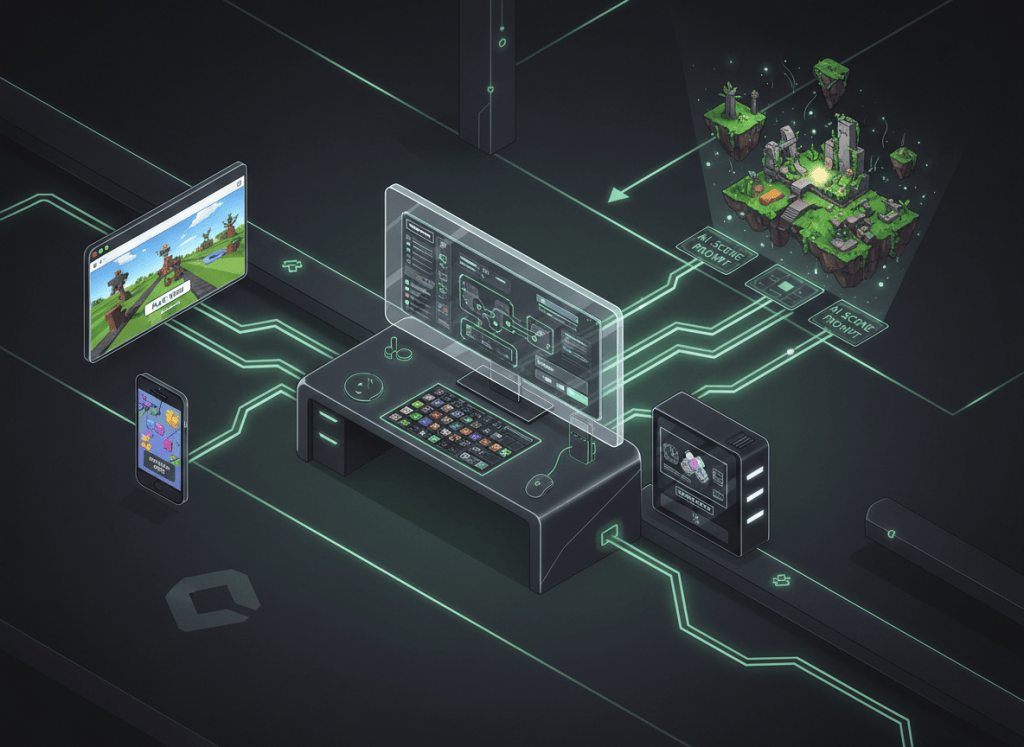
Roblox is trying to turn itself from a destination app into something closer to a distributed game platform: one engine that can launch through a browser, work offline, ship as a standalone app and increasingly build scenes with AI.
At RDC 2026, Roblox outlined a technical roadmap that stretches well beyond the platform’s traditional 3D multiplayer identity. The company says creators will be able to launch experiences directly in Chrome, add offline solo play, publish standalone apps and build more 2D games using new camera, sprite and UI capabilities.
Roblox summarized the broader RDC roadmap in an official X post covering what is next for players and creators.
Browser play turns a Roblox link into a launch surface
By the end of 2026, Roblox says players will be able to open supported games directly in Chrome from an experience page without first installing or launching the Roblox app. More browsers are planned later.
That sounds like a distribution feature, but it is also an engine problem. The same game needs to boot through a browser while preserving identity, multiplayer services, safety systems, assets and performance expectations that were previously wrapped inside the native Roblox client.
GamesBeat’s RDC briefing described Roblox’s approach as one integrated engine and platform underneath multiple launch points, rather than asking creators to rebuild separate versions for each destination.
Offline play forces a cloud-first platform to think locally
Roblox has historically been defined by persistent online services. The company now plans to let creators support offline solo play alongside live multiplayer modes, with early access coming before a broader mid-2027 rollout.
That creates a different technical model. A game that normally expects network access has to decide which systems can run locally, which data can be cached safely, how progress synchronizes later and what happens when cloud-only features are unavailable.
The architectural shift is important because it expands the kinds of Roblox games developers can build. A short puzzle game, campaign or single-player simulation no longer has to behave like a permanently connected multiplayer service.
Roblox is finally taking 2D seriously
RDC 2026 also included engine features aimed at genres that historically fit Roblox poorly. The roadmap adds an orthographic camera, direct sprite-sheet import, animated image containers and new UI effects such as blur, text shadows and improved gradients.
Those additions matter because a game engine designed around 3D character worlds does not automatically make a good 2D engine. Pixel art, puzzle games, card games and interface-heavy experiences need different camera behavior, rendering assumptions and asset workflows.
That broader creator direction connects to BitcoinVersus.tech’s recent look at AI coding agents entering the PC modding workflow. Both trends reduce the amount of engine-specific friction between an idea and a playable result.
Scene Generator pushes prompts deeper into the engine
Roblox says its upcoming Scene Generator will turn a text prompt plus a reference image into a functional scene that creators can refine in Studio. That is a different target from generating a static image: the result has to become an editable game-space layout inside an engine.
That puts Roblox in the same larger movement BitcoinVersus.tech examined with Meta’s natural-language game creation tools. The important shift is from AI producing media to AI producing structures that remain interactive and editable.
Roblox Reality points toward hybrid rendering
One of the more experimental RDC announcements is Roblox Reality, which the company says combines the Roblox Engine and multiplayer cloud infrastructure with a video world model to target real-time photorealistic output. Early access is planned for 2027.
That approach suggests Roblox is experimenting with a future where conventional simulation and generative visual systems run together rather than replacing one another.
Standalone apps may be the biggest distribution change
Roblox also plans to let creators distribute selected experiences as standalone apps across mobile, PC and consoles while keeping Roblox technology and services underneath. If that works as described, the same experience could exist inside Roblox and as its own application without splitting into two separate products.
That is closer to a game-engine-as-platform model than the old idea of Roblox as a single app full of user-generated experiences. Identity, multiplayer, safety, communication and economy stay connected while the front door changes.
The engineering challenge is similar to what BitcoinVersus.tech highlighted in SWE-Game’s executable benchmark: the real test is not whether a feature looks convincing in a demo, but whether it survives actual runtime conditions across different environments.
Roblox is becoming less like one app and more like an operating layer for games
The common thread across browser play, offline mode, standalone apps, 2D tooling and AI scene generation is portability. Roblox wants creators to build once, then reach more devices, launch surfaces and game genres without rebuilding the underlying services every time.
If the roadmap lands, a Roblox experience could begin as a prompt-assisted prototype, become a 2D or 3D game in Studio, run offline when necessary, open from a browser link and eventually ship as its own app—all while remaining connected to the same platform backend.
That is a much bigger ambition than adding another feature to Roblox Studio. It is an attempt to stretch the Roblox engine into a general distribution and creation layer for games.
BitcoinVersus.Tech
Advertisement
Editor’s Note
We volunteer daily to ensure the credibility of the information on this platform is Verifiably True. If you would like to support to help further secure the integrity of our research initiatives, please donate here: 3C9o19EH5HSiwEPyCTmEKzxhNCbo2X6TTb
BitcoinVersus.tech is not a financial advisor. This media platform reports on financial subjects purely for informational purposes.


Leave a Reply