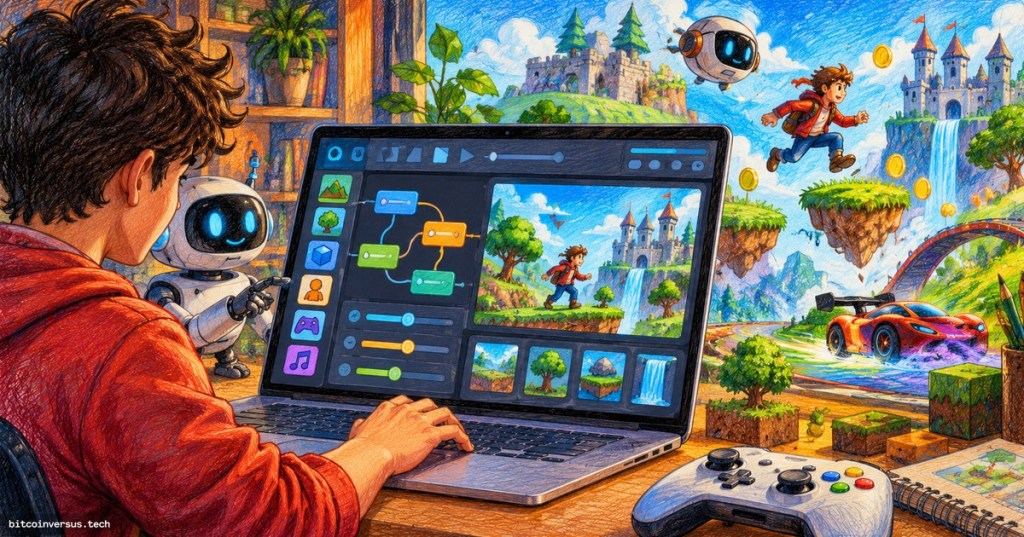
Google has launched a new experimental gaming platform called Playground that can turn plain-language prompts into playable browser games without requiring the creator to write code.
The idea is simple: describe the game you want, test what the AI builds, then keep changing the mechanics through conversation. Google says users can start from a blank canvas or starter prompt, then ask Playground to change the physics, rewrite rules, customize characters or overhaul the environment without opening a traditional code editor.
Playground Is Basically Vibe Coding for Games
Google describes Playground as a conversational game creator. Instead of manually scripting every interaction, a user can type instructions such as changing movement, adding a mechanic or adjusting how the world behaves. The system can create 2D or 3D experiences, while TechCrunch reports that creators can also choose between single-player and multiplayer formats and upload visual references that the system can adapt into game assets.
That puts Playground in the same broader movement as AI-assisted game development systems such as Genex, but the target audience is different. Genex coordinates developer tools and coding agents around an existing project. Playground is aimed at people who may have a game idea but little or no programming experience.
You Can Keep Editing After the Game Exists
The most important part may be iteration. Google’s Playground help center says creators can reopen a draft or published game and continue modifying gameplay logic, graphics and rules through conversational instructions. Edits remain private until the creator republishes the project.
That is a much more useful workflow than a one-shot “make me a game” demo. Game development is iterative by nature: movement feels wrong, levels need rebalancing, enemies need different behavior, and art direction changes after people actually play the build.
Playground Is Also a Distribution Platform
Once a game works, it can stay private, be shared through a link or be published to Playground’s Explore gallery. Google says browser-based games can be played on both phones and computers, with player ratings and activity helping surface projects in the gallery.
Select genres can support multiplayer and leaderboards, while a Google Play Games profile can provide a handle and creator-following features. That makes Playground more than an AI tool. Google is trying to combine creation, hosting, discovery and play inside the same ecosystem.
That Puts Google Closer to Roblox
The obvious comparison is Roblox, which has spent years combining game creation, social discovery and a huge player network. The difference is that Playground is trying to make the first step dramatically easier: instead of learning a game engine before building, a creator can begin with ordinary language.
Google is not alone here. Roblox has been adding AI-assisted creation tools of its own, and traditional game-engine companies are increasingly exposing parts of their engines to coding agents and natural-language workflows. BitcoinVersus.Tech recently covered Unity’s 30+ first-party engine skills for Grok Build, another example of game-development tooling moving toward agent-driven workflows.
Unity Spark Is the More Serious Second Step
Google’s larger plan includes Unity Spark, a new browser-based AI game-making environment that is still in testing. Google and Unity say Spark will add professional-level mechanics, higher-fidelity 3D capabilities and access to the Unity runtime while preserving the easier prompt-first workflow.
Google and Unity’s joint announcement frames the two products as a ladder: start with a simple prompt inside Playground, then move into more advanced interactive work through Unity Spark when a project needs deeper control.
Unity CEO Matt Bromberg has also pushed back on the idea that Spark is supposed to generate a finished game with one command. In Unity’s launch essay, he describes the goal as helping people build, refine and share games rather than simply cloning an existing idea. Spark also connects to the Unity Asset Store, which gives creators access to artist-created assets instead of relying entirely on generated art.
The Catch: This Is Still an Experiment
Playground is not yet a replacement for a full professional game-development stack. It launches as a Google Labs experiment for users 18 and older in the United States, and AI game creation is rolling out gradually. Playing the public catalog is free, while game generation uses a weekly token system with higher limits tied to Google One AI plans.
There are also unanswered questions about generated-game quality, originality, moderation and how far prompt-based tools can go before creators need direct control over code, assets, networking, optimization and platform-specific publishing. Those are exactly the areas where traditional engines still matter.
Game Creation Just Got a Much Lower Floor
The important shift is not that coding suddenly becomes useless. It is that the minimum technical skill required to create a playable idea keeps falling. A person who once needed to learn programming, scene graphs, physics systems and asset pipelines before showing a prototype may now be able to get the first version running through conversation.
That could create a flood of small experimental games, but it could also change how experienced developers prototype. If the first ten versions of a mechanic can be generated and tested quickly, developers can spend more time deciding what is actually fun—and less time building disposable scaffolding around the idea.
BitcoinVersus.Tech
Editor’s Note
BitcoinVersus.Tech independently covers gaming, artificial intelligence, game-development tools, semiconductors and the computing infrastructure behind them.
If you would like to support our research and technical publishing, donations are welcome: 3C9o19EH5HSiwEPyCTmEKzxhNCbo2X6TTb
BitcoinVersus.Tech is not a financial advisor. This media platform reports on financial and technology subjects purely for informational purposes.


Leave a Reply