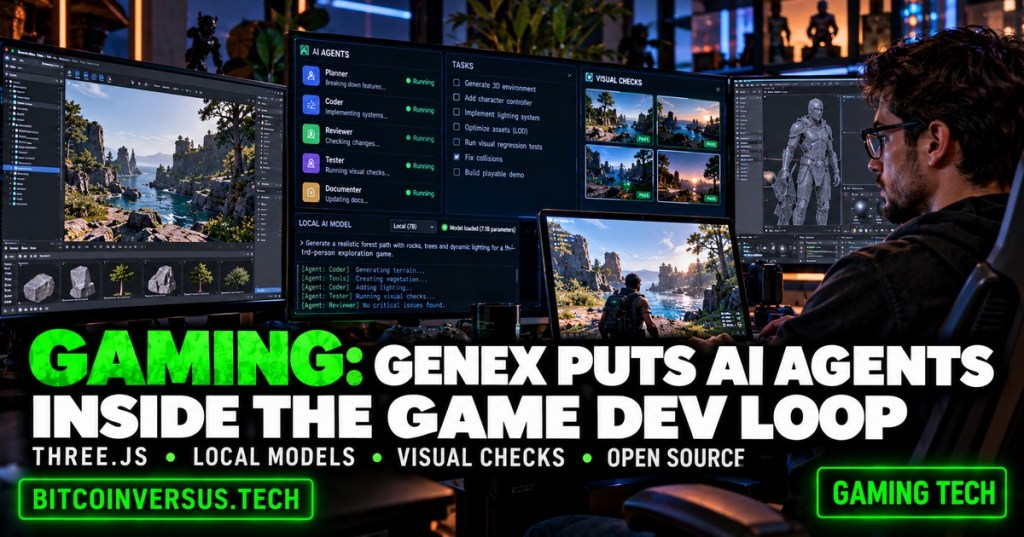
Game development is becoming another proving ground for agentic software. Genex has released an open-source desktop app that coordinates AI coding agents, local models, asset tools, build checks, visual inspection and playtesting around an ordinary game project instead of trying to replace the game engine itself.
The October 5 release currently targets Three.js browser games on macOS and Linux, with Windows listed as coming soon. According to the official Genex Desktop page, developers can connect Claude Code, Codex or local AI models, assign different models to planning, building and judging, then keep the resulting source files in a normal project they control.
Genex Is a Harness, Not a New Game Engine
The distinction matters. Genex is not attempting to replace rendering, physics or gameplay frameworks. Its current projects remain ordinary Three.js codebases that can run in a web browser and export as static bundles. The desktop app sits above that project as an orchestration layer for the AI workers and tools modifying it.
That approach resembles the broader move toward agent-aware development environments. BitcoinVersus recently covered Unity exposing more than 30 first-party engine skills to Grok Build, where an AI system is given structured knowledge about how the engine actually works rather than being asked to blindly edit a project.
Multiple Agents Can Plan, Build, and Judge the Same Game
Genex separates jobs that are often collapsed into one chatbot session. One model can plan a feature, another can implement it, and another can inspect the result. The interface also exposes task state so a developer can see which worker is planning, coding, reviewing or testing instead of treating AI activity as one opaque prompt-and-response loop.
That separation is important because AI-generated code still needs independent verification. BitcoinVersus covered the same problem from another angle in GitHub’s ReviewBench benchmark for AI code reviewers: generating code and reliably detecting defects in code are different tasks.
Visual Checks Are Part of the Build Loop
Games are especially difficult for coding agents because a build can compile successfully and still be visibly wrong. A character can float above the ground, a collision box can block the wrong area, lighting can fail, or a camera can point somewhere useless while every source file remains syntactically valid.
Genex addresses that by adding visual judges and game-specific checks to the workflow. Its product page shows agents taking screenshots of the running game, comparing results, and checking whether requested changes are actually visible. That is closer to how a human developer validates a game than simply asking whether the compiler returned an error.
Runtime evidence matters in traditional engines too. BitcoinVersus previously covered a Godot input bug that could push games below 1 FPS, a reminder that code can look reasonable while real execution exposes a very different problem.
Local Models Can Work Beside Cloud Models
Genex does not require every task to run through a hosted model. The app supports local-model workflows alongside Claude Code and Codex, allowing developers to choose different compute for different jobs. Its documentation says local models can run through tools such as Ollama or Bonsai, while cloud agents keep their own authentication instead of handing Genex a separate API key.
This model-per-task architecture could become useful as game projects grow. Expensive reasoning can be reserved for architecture or difficult debugging, while smaller local models handle repetitive edits, lightweight checks or project-specific tasks.
Asset Tools Plug Into the Same Workspace
Game development involves much more than source code. Genex exposes plugin connections for Blender, 3D model generation, textures, images, animation, sound, music and voice. That means an agent can potentially request an asset, place it into the project, run the game and inspect the result without forcing the developer to manually bridge every application.
The public Genex desktop repository is MIT-licensed and written primarily in TypeScript. Genex also says Unity and Unreal Engine connections are on its roadmap, but the current release is focused on Three.js browser projects.
The Harness Can Experiment on Itself
One of the more unusual features is an experimental self-improvement loop. Genex stores tools, skills and prompts in a Git repository, snapshots the state before changes, evaluates candidate changes, and can roll back a version that fails to start. The feature is experimental and stays disabled until the developer turns it on.
That creates a useful separation between “AI changed something” and “the new version survived an actual check.” For agentic game development, the second statement is far more valuable.
Why This Matters for Game Development
The interesting part of Genex is not whether an AI can generate another small browser game. AI models have already demonstrated that. The harder problem is building a repeatable engineering loop where agents can plan, edit, run, inspect, reject bad changes and leave behind a project that a human developer can still understand.
If tools like Genex mature, the game-development IDE may begin to look less like one editor with an autocomplete box and more like a small software studio: multiple specialized agents, shared project state, automated tests, visual evidence and a human developer deciding what is actually good enough to ship.
BitcoinVersus.Tech
Advertisement
Editor’s Note
Genex is an early open-source development tool. Features and platform support can change quickly as the project develops.
We volunteer daily to ensure the credibility of the information on this platform is Verifiably True. If you would like to support to help further secure the integrity of our research initiatives, please donate here: 3C9o19EH5HSiwEPyCTmEKzxhNCbo2X6TTb
BitcoinVersus.tech is not a financial advisor. This media platform reports on financial subjects purely for informational purposes.


Leave a Reply