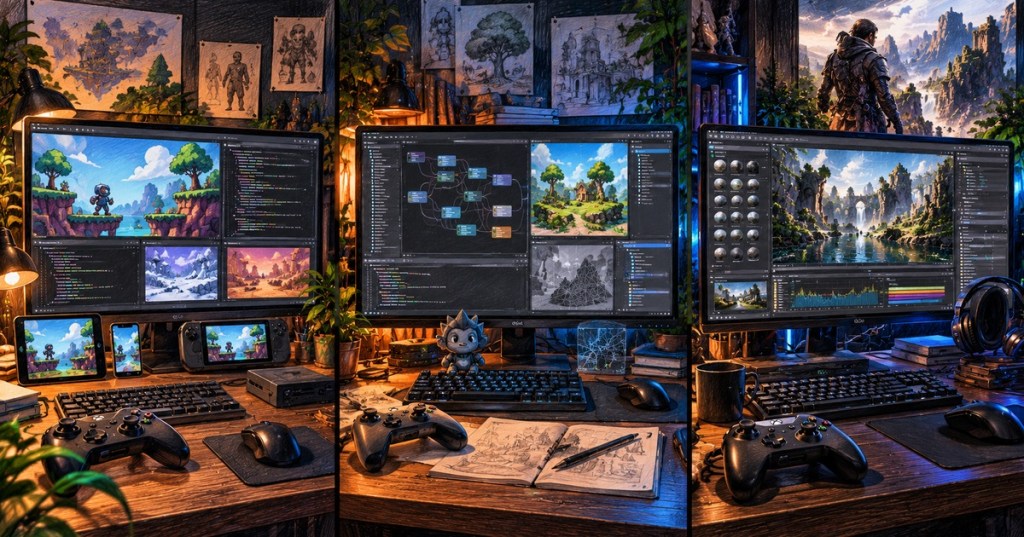
Defold’s new Xbox support changes the game-engine comparison for small studios. As of October 2026, developers choosing between Defold 1.14.0, Godot 4.7.2, and Unity 6.5 are no longer comparing one lightweight engine, one open-source engine, and one commercial engine with completely different platform reach. All three can now reach major consoles—but the cost, licensing model, language stack, and path to shipping are still very different.
The important point is that there is no universal winner. The right engine depends on whether a team values a lean runtime, full source freedom, commercial tooling, C# familiarity, or the simplest console path. That makes this less like a benchmark and more like an engineering tradeoff.
| Category | Defold 1.14.0 | Godot 4.7.2 | Unity 6.5 |
|---|---|---|---|
| License | Free, source-available Defold License | Free and open source, MIT | Proprietary commercial engine |
| Main scripting | Lua 5.1 / LuaJIT | GDScript, C#, C++ via GDExtension | C# |
| Console path | Xbox, PlayStation and Switch resources for approved developers; Defold says its console support is free | Console middleware/ports through approved providers such as W4 Games and porting houses | Console publishing included with Unity Pro after platform-holder approval |
| Desktop/mobile/web | Windows, macOS, Linux, iOS, Android and HTML5 | Windows, macOS, Linux, iOS, Android and web; Godot 4 C# currently cannot export to web | Web, desktop and mobile included in Personal |
| Current paid threshold | No engine subscription or royalty | No engine subscription or royalty | Personal is free; Pro is required for businesses above $200K in funding or annual revenue and for console publishing |
| Best fit | Lean cross-platform games, mobile/web, 2D-heavy projects and small teams | Teams prioritizing FOSS control, engine modification and flexible scripting | Teams already invested in C#, commercial tooling and Unity’s production ecosystem |
Defold: the lightweight option just became more serious
Defold 1.14.0 added official Microsoft Xbox development support for approved developers. The Defold Foundation says the Xbox resources are provided free of charge, joining its existing PlayStation and Nintendo Switch support. That is significant because console access was one of the clearest gaps separating smaller engines from commercial competitors. Defold’s official release also adds cubemap render targets, Metal by default on macOS, support for up to 1,048,576 game objects per collection, and lower editor CPU usage. Defold’s Xbox announcement explains that developers still need approval from Microsoft before receiving the console-specific resources.
Its programming model remains deliberately compact. Game logic is primarily written in Lua, with LuaJIT used where the target platform permits it. That can make Defold attractive to small teams that want a relatively simple runtime and one shared project across web, mobile, desktop and consoles. The tradeoff is that teams wanting a large C# codebase or deeper built-in high-end 3D workflows may find Godot or Unity more natural.
Godot: the strongest ownership story
Godot’s biggest differentiator is still its license. The engine is distributed under the permissive MIT license, so developers can inspect, modify and redistribute the engine while keeping their own games under separate licenses. Godot officially supports GDScript, C#, and C++ through GDExtension, giving teams more language flexibility than either Defold or Unity. The current stable branch is 4.7.2.
Console development is possible, but the route is different. The Godot Foundation does not distribute closed console SDK code itself; instead, approved developers can use middleware and porting providers. Godot’s current console support page lists W4 Games middleware for Nintendo Switch, Xbox Series X|S and PlayStation 5 along with multiple porting companies. That adds another relationship to the pipeline, but preserves Godot’s open-source model.
For developers who care most about being able to own and modify the engine beneath their game, Godot has the cleanest answer. That same flexibility is why projects that need custom simulation systems, unusual rendering paths, or long-term independence from a vendor often find it attractive. Our earlier look at the code behind major RPGs showed how much engine architecture can shape the final game.
Unity: the commercial production path
Unity remains the most conventional commercial choice of the three. Unity Personal is free for gaming and entertainment projects within its eligibility limits, while Unity Pro is currently listed at $210 per month per seat. Unity says Pro is required for businesses with more than $200,000 in annual revenue or funding, and Pro includes publishing for Xbox, PlayStation and Nintendo consoles. Unity’s current plan page lists those terms directly.
The core coding language is C#, which is a major advantage for studios already invested in the .NET ecosystem. Unity 6.5 also continues to expand 2D tooling, graphics, shaders, editor APIs, mobile performance and its path toward CoreCLR. The tradeoff is obvious: the strongest commercial tooling and console workflow comes with a proprietary engine and a paid tier once a studio crosses the threshold or needs console publishing.
Which one should a small team choose?
Choose Defold when the priority is a compact cross-platform project, especially for 2D, mobile, web or a small codebase that may later expand to consoles. Its new Xbox support removes a major platform disadvantage.
Choose Godot when engine ownership, open-source control, GDScript/C#/C++ flexibility, and the ability to modify the underlying technology matter more than having one commercial vendor manage the console path.
Choose Unity when the team already knows C#, expects to use commercial middleware and Asset Store tooling, or values a mature paid console-development workflow more than an open engine license.
The broader trend is that engine choice is becoming less about whether a tool can ship to a platform and more about how much complexity, licensing cost and technical control a studio wants to carry. That same shift is visible in our coverage of Epic’s UEFN and Verse training push and AI-assisted game-development loops.
BitcoinVersus.Tech Editor’s Note:
We volunteer daily to ensure the credibility of the information on this platform is Verifiably True. If you would like to support to help further secure the integrity of our research initiatives, please donate using the QR code provided

For best QR-code scanning results, please scan this donation code from a desktop or larger screen. Mobile screens may prevent camera recognition.


Leave a Reply