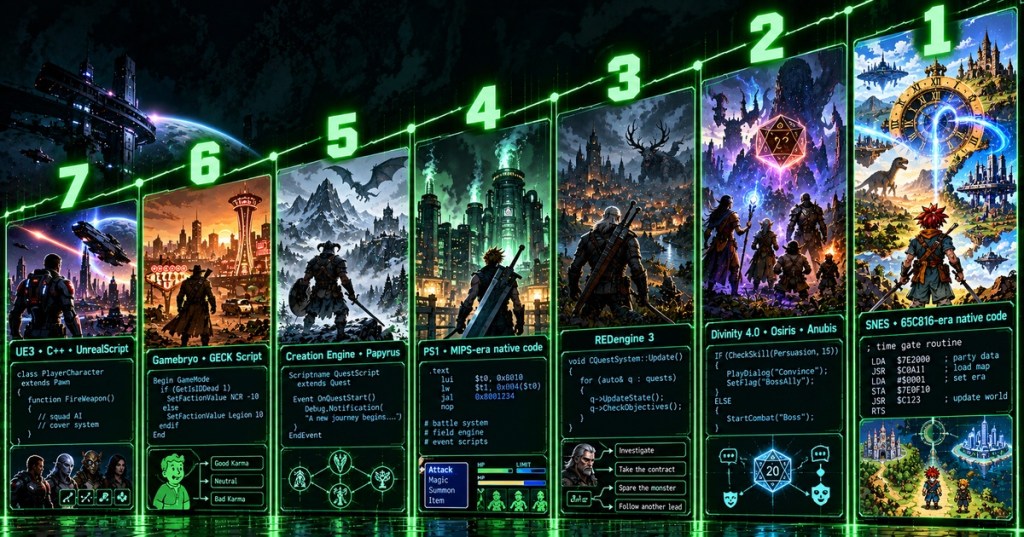
The best role-playing games do more than tell a good story. They give players systems worth mastering, choices worth arguing about, worlds worth revisiting and characters that survive long after the hardware they were built for becomes obsolete.
This BitcoinVersus.Tech countdown weighs role-playing depth, writing, systems, influence, replayability and long-term impact. It is an editorial ranking, informed by long-running community consensus such as ResetEra’s RPG essentials vote and multi-publication aggregation from Acclaimed Video Games. The coding notes distinguish public engine/scripting information from closed proprietary internals instead of pretending every game has a single known programming language.
The technology behind these games also shows how much RPG development has changed—from SNES-native code and PlayStation-era binaries to modern proprietary engines with dedicated story languages. BitcoinVersus has recently covered procedural game-world generation, modern C# game-development tooling, and low-level engine performance problems.
7. Mass Effect 2
Mass Effect 2 is BioWare at its most focused. The loyalty missions turn party-building into the heart of the game, the Suicide Mission converts dozens of earlier choices into consequences, and Commander Shepard remains one of gaming’s strongest examples of a player-shaped protagonist. It is less mechanically open than some games above it, but few RPGs have ever controlled pacing and character payoff this well.
Code stack: Unreal Engine 3, with the engine’s native C++ foundation and UnrealScript-era gameplay architecture. BioWare’s exact production source remains proprietary.
The Mass Effect 2 cinematic trailer captures the game’s squad-driven structure and galaxy-scale stakes.
6. Fallout: New Vegas
New Vegas is one of the purest examples of role-playing through consequences. Factions remember what you do, quests can be solved in radically different ways, character builds unlock different conversations, and the Mojave rarely forces one moral answer. Its rough edges are real, but its systemic freedom still embarrasses more polished RPGs.
Code stack: Gamebryo-era engine technology plus Bethesda’s GECK content pipeline and Fallout/New Vegas scripting system. The GECK documentation exposes the script layer used for quests, dialogue and world logic; the full native game source is not public.
The original New Vegas teaser established the Mojave setting, NCR imagery and ruined Las Vegas atmosphere.
5. The Elder Scrolls V: Skyrim
Skyrim is not the deepest Elder Scrolls game, but it may be the most enduring. Its genius is accessibility: walk toward a mountain, enter a cave, join a guild, learn a shout, abandon the main quest for 40 hours and somehow the world still feels coherent. Its modding life has extended that design for more than a decade.
Code stack: Bethesda’s Creation Engine with Papyrus as the Creation Kit scripting language. Bethesda’s native engine code is proprietary, so “Skyrim was written entirely in C++” would overstate what is publicly documented.
Bethesda’s original Skyrim trailer remains one of the clearest snapshots of the game’s exploration-first RPG identity.
4. Final Fantasy VII
Final Fantasy VII helped redefine what a console RPG could look and feel like. Midgar, Materia, Cloud, Aerith and Sephiroth became global gaming vocabulary. Its combination of cinematic presentation, turn-based systems and an emotionally direct story helped move JRPGs into the mainstream outside Japan.
Code stack: The original PlayStation source has never been officially released. Modern matching-decompilation projects reconstruct its PS1 executable from MIPS-era binaries, giving researchers a clearer view of the game’s low-level architecture without pretending the reconstructed source is Square’s original codebase.
Square Enix’s modern launch trailer for the original Final Fantasy VII shows why its characters, battles and Midgar imagery remain instantly recognizable.
3. The Witcher 3: Wild Hunt
The Witcher 3 proved an enormous open world could still support authored storytelling at a high level. Side quests routinely have the narrative weight of other games’ main quests, decisions return hours later, and Geralt is defined enough to be memorable without preventing the player from shaping how he handles the world.
Code stack: CD PROJEKT RED’s REDengine 3 with native C++ systems and WitcherScript for a large amount of gameplay logic. CDPR’s current REDkit documentation explicitly shows WitcherScript importing native classes defined in C++.
The Witcher 3 Remastered trailer revisits the same world and systems that made the 2015 RPG a genre benchmark.
2. Baldur’s Gate 3
Baldur’s Gate 3 is the modern standard for reactive role-playing. Combat encourages experimentation, dialogue checks can redirect entire quest lines, companions have unusually deep arcs, and the game often reacts to ideas that feel like they should be impossible. It translated tabletop-style freedom into a blockbuster-scale videogame without sanding away the weirdness.
Code stack: Larian’s proprietary Divinity 4.0 engine. Its public scripting layer includes the event-driven Osiris language and Anubis behavior scripting; Larian explicitly identifies Osiris as an in-house scripting language. The native engine implementation itself remains closed.
Larian’s launch trailer shows the party-based scale and cinematic presentation built on the Divinity 4.0 engine.
Baldur’s Gate 3’s official social feed reflects the unusually strong character-driven community that grew around Larian’s RPG.
1. Chrono Trigger
Chrono Trigger gets the top spot because almost nothing in it feels wasted. The pacing is tight, the battle system still feels readable, time travel changes locations instead of merely changing scenery, New Game Plus helped popularize repeat-play structures, and its multiple endings reward experimentation without bloating the adventure. More than 30 years later, it remains remarkably easy to recommend.
Code stack: The original 1995 game was built for the Super Famicom/SNES hardware generation, whose CPU was the 65C816. Square has not published Chrono Trigger’s original source code, so the responsible description is SNES-native 65C816-era machine code and assembly-oriented development—not a fabricated claim that a modern high-level language drove the original game.
Square Enix’s Chrono Trigger launch trailer showcases the time-travel structure, party combat and art that still define the classic.
Honorable mentions include Baldur’s Gate II, Elden Ring, Persona 5 Royal, Disco Elysium, Final Fantasy VI, Dragon Age: Origins and Diablo II. Any serious all-time RPG ranking has to leave something painful outside the top seven.
BitcoinVersus.Tech Editor’s Note:
We volunteer daily to ensure the credibility of the information on this platform is Verifiably True. If you would like to support to help further secure the integrity of our research initiatives, please donate using the QR code provided

For best QR-code scanning results, please scan this donation code from a desktop or larger screen. Mobile screens may prevent camera recognition.
BitcoinVersus.tech is not a financial advisor. This media platform reports on financial subjects purely for informational purposes.


Leave a Reply