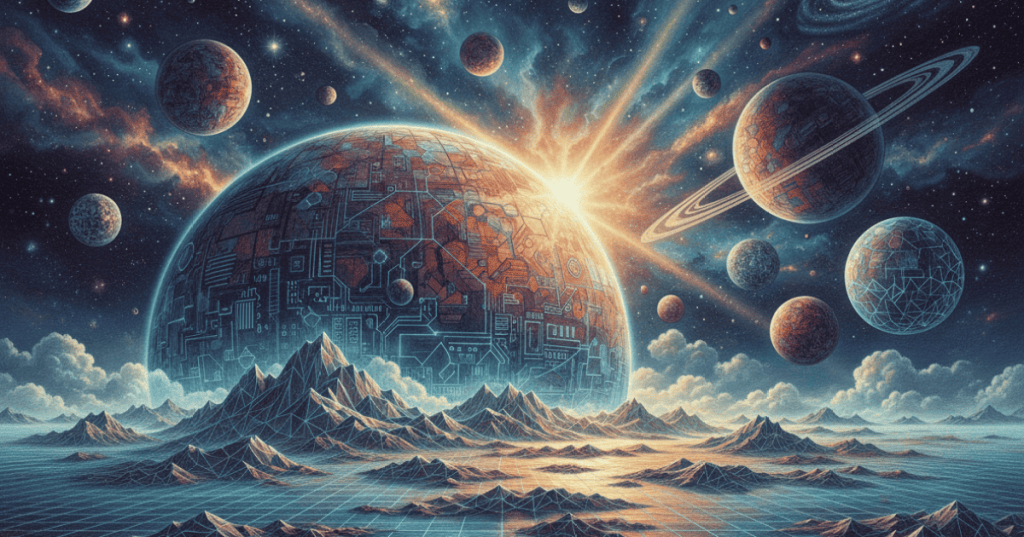
No Man’s Sky does not contain 18 quintillion hand-built planets. It contains a set of mathematical rules capable of generating them.
That distinction is the secret behind one of gaming’s most famous technical achievements. Hello Games built a universe so large that, at a rate of one discovered planet every second, exploring every possible world would take roughly 585 billion years.
The universe is generated, not stored
The core idea is procedural generation. Instead of shipping a separate handcrafted asset package for every mountain, valley, animal, tree and planet, the game uses algorithms to produce variations from rules and numerical inputs.
In Hello Games founder Sean Murray’s GDC 2017 session, he described the challenge as building realistic and alien terrain through mathematics while giving a very small development team the ability to create and test an environment of extraordinary scale.
The result is not literally an infinite universe. Hello Games chose a 64-bit system capable of addressing 264 possibilities: 18,446,744,073,709,551,616 potential planets. An official PlayStation technical explainer from Murray put the number into perspective: even discovering one planet every second would take about 585 billion years.
A seed becomes a world
Procedural generation works because a relatively compact numerical input can be passed through the same deterministic rules again and again. The rules decide what terrain forms, how features are distributed and how visual components are combined. A different input produces a different result without an artist manually sculpting every square kilometer.
That is why procedural systems can create apparent scale far beyond the amount of data a traditional handcrafted game would need to store. The software describes how to build the world instead of storing every possible world in advance.
The difficult part is not randomness — it is believable variation
Pure randomness would be easy and mostly useless. A believable game universe needs constraints. Mountains should read as mountains. Creatures need coherent skeletons and animation. Plants need forms that look intentional. Colors, climate and terrain still need to feel as though they belong together.
Hello Games therefore had to design systems that could produce surprises while staying inside a visual and gameplay language. The algorithm is not replacing design. The algorithm is executing a design space created by programmers and artists.
The same procedural foundation keeps evolving
No Man’s Sky is useful to study because Hello Games did not freeze its procedural systems at launch. The studio has repeatedly revised terrain, water, atmospherics, biomes and creatures while preserving the idea that a compact set of rules can generate enormous amounts of explorable variation. The engine has become a living laboratory for how procedural content can be refreshed without replacing the entire universe by hand.
That long-term evolution is visible in Murray’s Worlds Part I announcement, which highlighted a universe refresh alongside new creatures, varied skies, dynamic waves, new biomes and upgraded atmospheric systems. Those features show why procedural generation is more than a launch-day trick: when the underlying rules improve, the same enormous possibility space can produce noticeably richer worlds.
No Man’s Sky is also a lesson in game-engine architecture
This is why No Man’s Sky remains relevant to modern game development. Its universe is a demonstration of what happens when the engine itself becomes a content-generation system rather than only a renderer for assets created elsewhere.
That idea is resurfacing in a different form as studios add automation and AI tooling to engines. Capcom is rebuilding RE Engine around AI-assisted development workflows, showing how proprietary engines can evolve into broader production systems.
Unity is moving in a similar direction through agent-accessible tooling. BitcoinVersus.Tech recently covered how Unity exposed 31 game-development skills to Codex for tasks involving C#, physics and command-line workflows.
The broader question is no longer only whether software can render a large world. It is whether code can help generate, test and continuously reason about that world. That is the same frontier being measured by projects such as SWE-Game, which tests whether coding agents can build playable games rather than simply output source code.
Procedural generation turns storage into possibility
No Man’s Sky demonstrates a powerful programming principle: a small set of rules can describe a space vastly larger than the code and assets used to define it.
The game does not need developers to visit every planet first. It needs rules capable of producing a planet when one is required, along with enough constraints to make that result feel like part of the same universe.
That is why its scale still feels almost absurd a decade later. The breakthrough was never simply “make more planets.” It was learning how to turn mathematics into a universe.
BitcoinVersus.Tech
Advertisement
Editor’s Note
We volunteer daily to ensure the credibility of the information on this platform is Verifiably True. If you would like to support to help further secure the integrity of our research initiatives, please donate here: 3C9o19EH5HSiwEPyCTmEKzxhNCbo2X6TTb
BitcoinVersus.tech is not a financial advisor. This media platform reports on financial subjects purely for informational purposes.


Leave a Reply