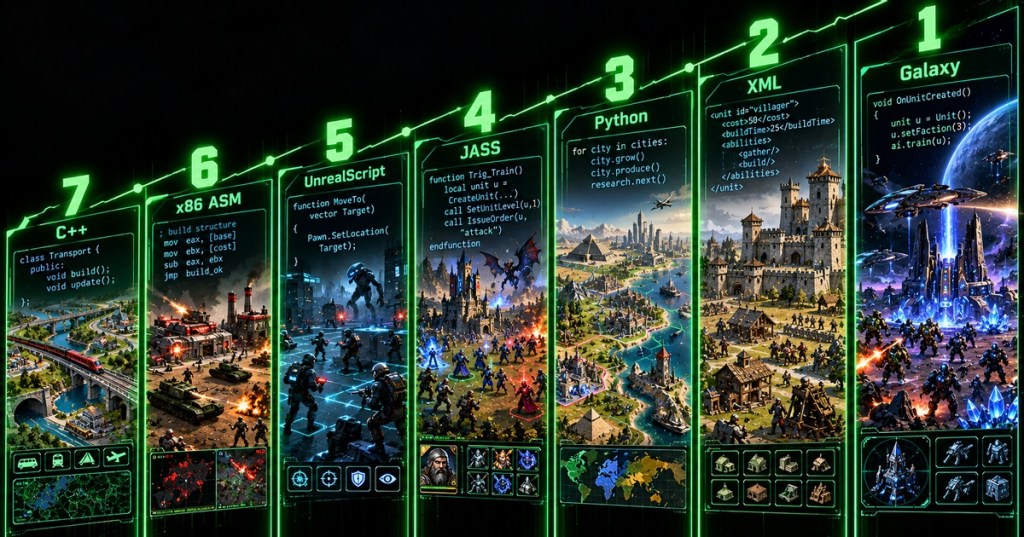
Some strategy games are remembered because they sold millions. Others are remembered because they changed how players think. The very best did both — and underneath every memorable tech tree, fog-of-war system, tactical map and AI opponent was a software stack making it possible.
This is BitcoinVersus.Tech’s editorial Top 7 strategy-game countdown. The ranking weighs influence, replayability, design depth, longevity and how much each game changed its corner of the genre. The code notes are deliberately conservative: where original source code is public, we name the language directly; where the engine remains proprietary, we separate the documented scripting/modding layer from what cannot be independently verified.
That distinction matters. Modern game development often mixes a native engine with scripting, data files and tools — the same layered approach seen in newer Unity workflows, Godot engine work and procedural systems such as those behind No Man’s Sky.
7. OpenTTD
Code stack: C++. OpenTTD is the easiest game on this list to inspect because its source is public. The official OpenTTD repository is overwhelmingly C++, and the project openly documents how to obtain, compile and contribute to the source.
Why it belongs here: OpenTTD turns transport into strategy. Rail signaling, station throughput, vehicle replacement, industry chains, town growth and network congestion gradually become one giant optimization problem. Its open-source life has also allowed the game to keep improving for decades instead of becoming frozen in time.
OpenTTD’s official press material uses this gameplay video to show the transport networks, industries and large-scale simulation that make the project distinctive.
6. Command & Conquer: Red Alert
Code stack: C++. This one is unusually verifiable because Electronic Arts released the original Red Alert source. Files such as MAP.CPP and BUILDING.CPP expose the actual Westwood-era code behind map logic, buildings and AI systems.
Red Alert helped define the readable, fast RTS formula: asymmetric factions, memorable units, harvest-and-build economies and constant pressure to balance production against expansion. Even now, its interface and pacing feel like a blueprint for much of the genre that followed.
Electronic Arts’ Remastered Collection reveal shows why Red Alert’s base-building and battlefield language remains instantly recognizable decades later.
5. XCOM 2
Code stack: Unreal Engine 3 native C++ plus UnrealScript. Firaxis built XCOM 2 on a heavily modified Unreal Engine 3 branch. Its public development kit exposes UnrealScript source, while technical work around the SDK documents Firaxis-specific native UE3 types compiled into the engine’s C++ layer.
XCOM 2 is strategy through consequences. Every mission mixes positional tactics, percentages, destructible cover and permanent soldier loss with a strategic layer where research, engineering and global resistance management compete for scarce time. Few games are better at turning one bad decision into a story you remember years later.
2K’s official XCOM 2 launch trailer shows the mixture of squad tactics, base progression and asymmetric resistance warfare that earns it the #5 spot.
4. Warcraft III
Documented scripting language: JASS. Core engine source: proprietary. Blizzard never released Warcraft III’s complete original engine source, so claiming one definitive native language would overstate what is public. What is documented is its map/game scripting layer: JASS, Blizzard’s native Warcraft III scripting language, powers triggers and custom-map logic.
Warcraft III changed RTS design by shrinking armies and making individual units matter more. Heroes, inventories, leveling, neutral creeps and powerful spells pushed the genre toward RPG mechanics and helped create the design space that eventually produced MOBAs.
Blizzard’s Warcraft III: Reforged reveal revisits the four-faction RTS structure and World Editor ecosystem built on top of the Warcraft III design.
3. Sid Meier’s Civilization IV
Code stack: C++ core and AI, Python scripting, XML data. Civilization IV is one of the clearest examples of a deliberately layered strategy-game architecture. Firaxis exposed the low-level game and AI code through a C++ GameCore DLL SDK, while Python handled high-level scripting and XML stored large amounts of game data. 2K still describes XML, Python and the SDK as official customization tools.
Civ IV earns #3 because almost every turn creates a meaningful tradeoff. Expansion, technology, diplomacy, religion, civics and military planning all collide on one map. It also became one of the great modding platforms in strategy history precisely because so much of that logic was exposed.
The official Civilization IV: Beyond the Sword launch trailer shows the expansion of the same systems-driven framework that made Civ IV such an enduring 4X platform.
2. Age of Empires II
Code stack: Visual C++ plus hand-written x86 assembly in the rendering core. Former Ensemble programmer Matt Pritchard has explained that Age of Empires and Age of Kings contained roughly 13,000 lines of 32-bit x86 assembly in their drawing core, compiled alongside Visual C++ code. That low-level optimization helped the game push large sprite armies at higher resolutions than many competitors of the period.
Age II may be the cleanest RTS ever made. Villager economy, four resources, technological ages, counters, walls, siege and dozens of civilizations create complexity without destroying readability. More than two decades later, the competitive game still produces new build orders and matchup theory.
Xbox’s Definitive Edition console trailer shows how the core Age II design remains viable across modern hardware and input methods.
1. StarCraft II
Publicly documented stack: proprietary native engine, Galaxy scripting, XML-style game data, and Blizzard-supported C++ APIs. Blizzard has not published StarCraft II’s complete retail engine source, so we should not pretend the entire game is one public language. What is verifiable is the surrounding technical ecosystem: Blizzard publishes a C++ StarCraft II client API, while StarCraft II map/game logic uses the C-like Galaxy scripting language and structured game-data/layout files.
StarCraft II takes #1 because it is the rare strategy game that works simultaneously as a cinematic campaign, a deep multiplayer ladder and an esports instrument. Terran, Protoss and Zerg are not cosmetic variations; their economies, production, movement and combat logic fundamentally differ, yet the game remains readable at professional speed.
Blizzard’s Legacy of the Void launch trailer represents the final form of StarCraft II’s three-race strategy framework and campaign trilogy.
StarCraft’s official account has long highlighted the franchise’s visual and competitive legacy across both Brood War and the modern era.
What the Code Tells Us
The most interesting pattern is that there is no single “strategy-game language.” OpenTTD and Red Alert show how far C++ can carry an entire simulation. Age of Empires II demonstrates why developers once dropped into assembly for raw rendering speed. Civilization IV exposed C++, Python and XML as separate layers. XCOM 2 leaned on Unreal’s native-plus-script architecture. Warcraft III and StarCraft II show how proprietary engines can still become enormous creative platforms through dedicated scripting languages.
The code changed, but the design problem stayed the same: simulate a world quickly enough that the player can make meaningful decisions inside it.
BitcoinVersus.Tech Editor’s Note:
We volunteer daily to ensure the credibility of the information on this platform is Verifiably True. If you would like to support to help further secure the integrity of our research initiatives, please donate using the QR code provided

For best QR-code scanning results, please scan this donation code from a desktop or larger screen. Mobile screens may prevent camera recognition.
BitcoinVersus.tech is not a financial advisor. This media platform reports on financial subjects purely for informational purposes.


Leave a Reply