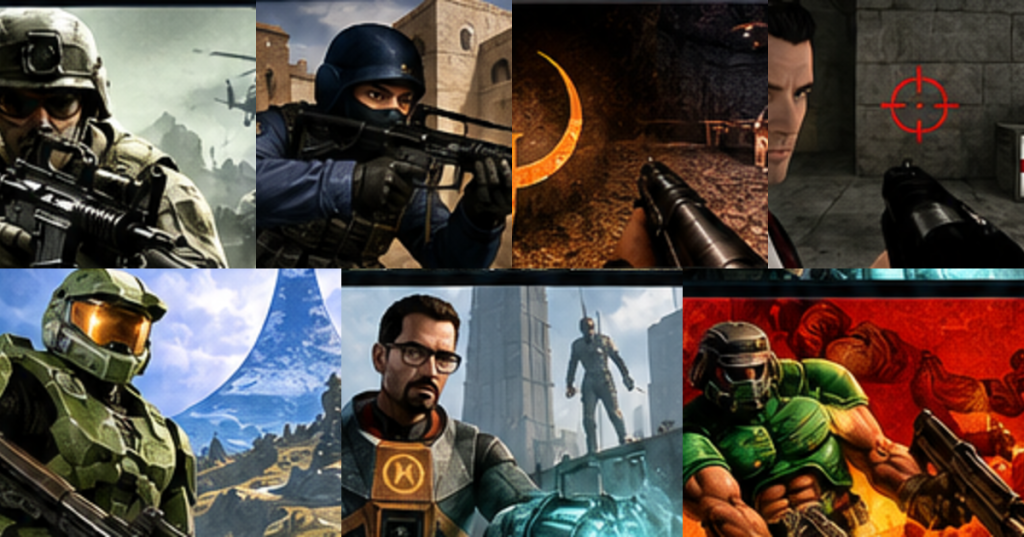
The greatest first-person shooters did more than sell copies. They changed how games render worlds, move data across networks, simulate physics and structure competitive play. This countdown weighs gameplay, influence and technical impact. For more engine history, see our Top 7 Strategy Games of All Time — and the Code Behind Them.
7. Call of Duty 4: Modern Warfare — 2007
Engine: IW 3.0
Code: Proprietary native codebase, descended from Infinity Ward technology that traces back to id Tech 3.
Modern Warfare reset expectations for the military FPS. Its 60-FPS-oriented gunplay, aim-down-sights combat, scripted campaign pacing, perks and persistent multiplayer progression became a template copied across the industry. IW 3.0 also pushed dynamic lighting, HDR effects, shadows and depth of field. The engine remained proprietary, but its ancestry can be followed through Infinity Ward’s engine history.
6. Counter-Strike 1.6 — 2003
Engine: GoldSrc
Code: C++, C and assembly.
Counter-Strike proved that an FPS could become a sport through systems rather than spectacle. Recoil, round economy, map geometry, objective design and client-server networking produced a competitive loop that survived for decades. Valve’s technical documentation identifies GoldSrc as a C++, C and assembly engine descended from heavily modified Quake technology. That mod-first lineage remains one of gaming’s best examples of an engine becoming a platform.
5. Quake — 1996
Engine: Quake Engine
Code: C, performance-critical assembly and QuakeC for game logic.
Quake is arguably the most important programmer’s FPS ever released. id Software’s official Quake source release exposes the C engine, assembly optimizations and the architecture that drove true polygonal 3D environments, BSP traversal, QuakeWorld networking and a separate QuakeC gameplay layer. Its descendants helped shape GoldSrc, Source and the technology behind early Call of Duty. Modern open-source engines continue the same spirit; BitcoinVersus recently covered Crown Engine’s open-source game-programming toolchain.
4. GoldenEye 007 — 1997
Engine: Rare’s proprietary Nintendo 64 technology
Code: Predominantly C, with N64/RSP assembly and low-level platform code.
GoldenEye helped prove the FPS could thrive on consoles. Mission objectives, stealth, location-based reactions and four-player split-screen gave it a design identity separate from PC shooters. The ongoing GoldenEye 007 decompilation exposes a large C source tree plus RSP and assembly components, while director Martin Hollis’ GDC postmortem documents how the project evolved from a Virtua Cop-style concept into a landmark console FPS.
3. Halo: Combat Evolved — 2001
Engine: Blam!
Code: C and C++.
Halo solved the console-FPS control problem while building combat as a sandbox. Bungie’s Blam! engine combined vehicles, projectiles, AI, physics, scripting and large combat spaces. The Reclaimers Library’s Halo 1 engine documentation describes C/C++ code alongside portal occlusion, radiosity, AI/pathfinding, dynamic physics, shaders and scripting. The result was combat that could produce unscripted interactions instead of functioning only as a shooting gallery.
2. Half-Life 2 — 2004
Engine: Source
Code: Predominantly C++ game code.
Half-Life 2 made physics part of level design rather than a background effect. The Gravity Gun, rigid-body interactions, vehicles, facial animation and entity I/O transformed environmental objects into gameplay systems. Valve documents Half-Life 2 as a C++ Source-engine title, and Valve’s public Source SDK exposes substantial portions of its game-code architecture. Source later powered Counter-Strike: Source, Team Fortress 2, Portal and other major Valve releases.
1. DOOM — 1993
Engine: Doom Engine
Code: Primarily C.
DOOM gets No. 1 because nearly every game above exists in an industry it helped create. BSP-based world traversal, sectors, sprites, WAD files, multiplayer deathmatch, modding and demo recording turned the FPS into both a genre and a technical ecosystem. id Software later released the DOOM source code, letting generations of programmers study and port it. The engine remains so portable that developers still find absurd new hardware to run it on, including the conference badge we covered this month.
The engineering family tree: DOOM → Quake → GoldSrc → Source, with Quake III-era technology also feeding the early Infinity Ward lineage. GoldenEye and Halo represent a parallel console branch that solved controls, sandbox combat and multiplayer for living-room hardware.
BitcoinVersus.Tech Editor’s Note:
We volunteer daily to ensure the credibility of the information on this platform is Verifiably True. If you would like to support to help further secure the integrity of our research initiatives, please donate using the QR code provided

For best QR-code scanning results, please scan this donation code from a desktop or larger screen. Mobile screens may prevent camera recognition.


Leave a Reply