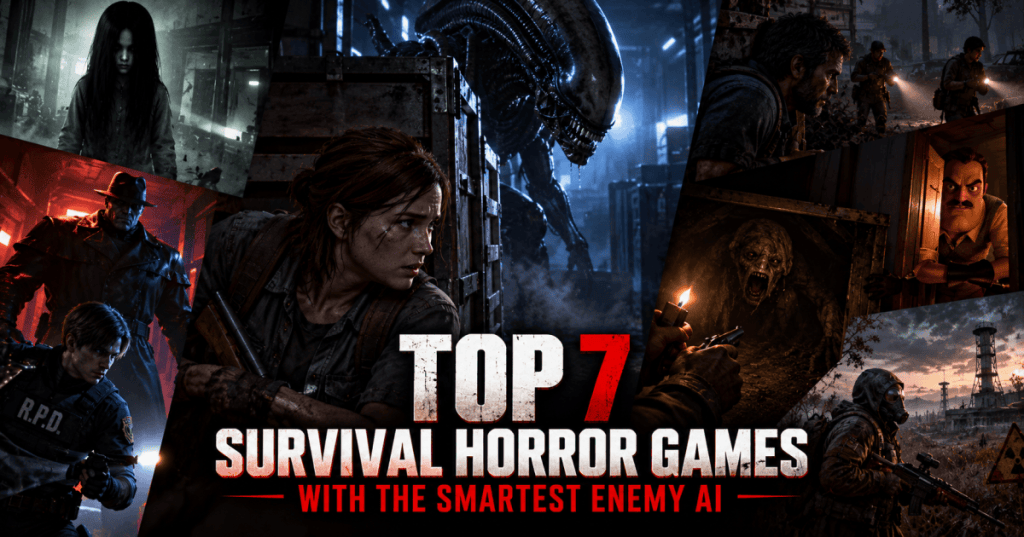
Some game enemies feel intelligent because they learn your habits. Others use coordinated tactics, sound cues, patrol systems or clever scripting. This Top 7 Games With the Smartest Enemy AI ranking compares the player-facing behavior of adversaries in horror, stealth and survival games—not the size of a machine-learning model. Rankings are editorial judgments, and a scripted opponent can still create excellent gameplay.
Our Top 7 Horror Video Games ranking measured fear and influence. Here the focus is detection, searching, pursuit, cooperation, unpredictability and interaction with the environment. Some titles also appear in our stealth-games countdown.
7. S.T.A.L.K.E.R.: Shadow of Chernobyl (2007)
Best for a simulated world. The A-Life concept allows stalkers and creatures to participate in a world beyond a single staged firefight. Factions, mutant threats, patrols and changing encounters make the Zone feel active. The original game’s ambitious simulation is not proof that every NPC reasons independently, but it helped make persistent world behavior a major design goal. GSC Game World documents the series and its Zone setting.
Watch the S.T.A.L.K.E.R.: Shadow of Chernobyl video below for a visual reference to the game and its enemy encounters. The video is illustrative; it does not independently verify the game’s underlying AI code.
For this ranking, the key distinction is between behavior that feels responsive to players and the specific rules or planning systems developers implement.
6. Hello Neighbor (2017)
Best for behavior-driven traps. The Neighbor is designed to respond to how players approach the house, including likely entry routes and obstacles. The game’s promotional emphasis on adaptive behavior should not be mistaken for a general-purpose learning AI: much of the challenge comes from authored detection, patrol and trap systems. Its standout idea is making the player’s own habits part of the encounter. Official game site.
Watch the Hello Neighbor video below for a visual reference to the game and its enemy encounters. The video is illustrative; it does not independently verify the game’s underlying AI code.
For this ranking, the key distinction is between behavior that feels responsive to players and the specific rules or planning systems developers implement.
5. Amnesia: The Bunker (2023)
Best for reactive pressure. A stalking monster reacts to noise, movement and player decisions while resources such as generator fuel change the risk of exploring. The encounter system creates emergent suspense without needing a human-like intelligence. The bunker is frightening precisely because players must infer what their actions may attract. Developer Frictional Games is known for systemic horror design.
Watch the Amnesia: The Bunker video below for a visual reference to the game and its enemy encounters. The video is illustrative; it does not independently verify the game’s underlying AI code.
For this ranking, the key distinction is between behavior that feels responsive to players and the specific rules or planning systems developers implement.
4. Resident Evil 2 (2019 Remake)
Best for persistent pursuit. Mr. X searches parts of the police station, follows audible disturbances and interrupts carefully planned routes. His presence encourages players to think about doors, noise, ammunition and escape paths. There are designed constraints on his behavior, but the combination of roaming pursuit and limited player information is highly effective. See Capcom’s Resident Evil 2 page.
Watch the Resident Evil 2 video below for a visual reference to the game and its enemy encounters. The video is illustrative; it does not independently verify the game’s underlying AI code.
For this ranking, the key distinction is between behavior that feels responsive to players and the specific rules or planning systems developers implement.
3. The Last of Us Part II (2020)
Best for believable squad reactions. Human enemies search, communicate, call out fallen companions and respond to movement through grass, buildings and cover. Their animations and voice performances strengthen the illusion of teamwork. Much of that realism is the product of carefully authored behaviors and encounter design, not a claim that the enemies possess human reasoning. Naughty Dog develops the series.
Watch the The Last of Us Part II video below for a visual reference to the game and its enemy encounters. The video is illustrative; it does not independently verify the game’s underlying AI code.
For this ranking, the key distinction is between behavior that feels responsive to players and the specific rules or planning systems developers implement.
2. F.E.A.R. (2005)
Best for tactical coordination. F.E.A.R.’s soldiers flank, seek cover, throw grenades and communicate their intentions in ways that make firefights feel like contests against a team. Its widely discussed goal-oriented action planning (GOAP) helped select tactical actions dynamically. The system was built from explicit goals and actions, not modern generative AI. The game’s enduring lesson is that readable tactics can feel more intelligent than complicated but opaque systems. GDC Vault’s technical presentation discusses planning approaches in game AI.
Watch the F.E.A.R. video below for a visual reference to the game and its enemy encounters. The video is illustrative; it does not independently verify the game’s underlying AI code.
For this ranking, the key distinction is between behavior that feels responsive to players and the specific rules or planning systems developers implement.
1. Alien: Isolation (2014)
Best overall for unpredictable hunting. Creative Assembly’s alien combines sensory detection, stalking and search behaviors with a higher-level system that helps maintain tension. Players must weigh motion-tracker readings, hiding spots and environmental sound. The result is a predator that seems to anticipate you without needing an unconstrained neural network. Its reputation comes from sustained, legible pressure: players can learn its cues, but rarely feel entirely safe. SEGA’s official game page provides game context.
Watch the Alien: Isolation video below for a visual reference to the game and its enemy encounters. The video is illustrative; it does not independently verify the game’s underlying AI code.
For this ranking, the key distinction is between behavior that feels responsive to players and the specific rules or planning systems developers implement.
What Smart Enemy AI Actually Means
These systems generally combine perception (vision and sound), state (searching, attacking or retreating), decision logic (goals, behavior trees or planners), and navigation (finding routes through a level). Developers also tune encounter pacing and use animation and dialogue to communicate decisions. A game can be outstanding at one of these without containing machine learning. Our FPS game-engine ranking explores another side of technical game design.
Verdict: Alien: Isolation takes first for relentless, systemic pursuit; F.E.A.R. remains a classic for tactical coordination. The ranking evaluates observable gameplay rather than claiming access to proprietary source code or benchmarked AI models.
BitcoinVersus.Tech Editor’s Note: We volunteer daily to ensure the credibility of the information on this platform is Verifiably True. If you would like to support to help further secure the integrity of our research initiatives, please donate using the QR code provided

For best QR-code scanning results, please scan this donation code from a desktop or larger screen. Mobile screens may prevent camera recognition.


Leave a Reply