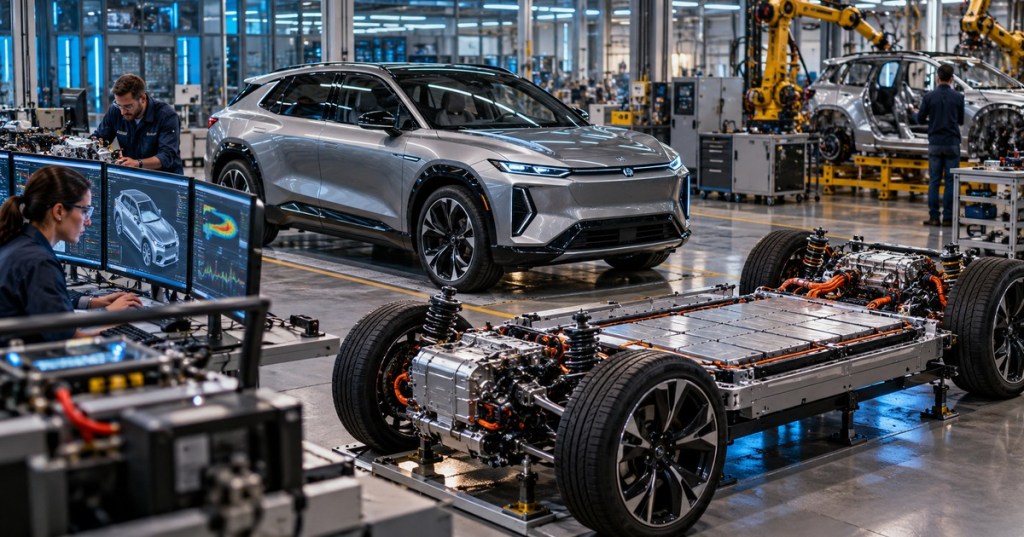
General Motors outlined its fourth-generation electric-vehicle platform on October 21, 2026, at GM Forward in New York. The automaker says redesigned batteries, motors, aerodynamics and computing could deliver roughly 20% more driving range per kilowatt-hour than today’s EVs. The platform remains under development; that efficiency gain is GM’s early engineering projection, not a published production-vehicle test.
Key Takeaways
- GM projects approximately 20% more range per kWh from the combined vehicle design.
- Its LMR battery chemistry targets 33% greater energy density than LFP at comparable cost.
- The new drive unit targets 40% fewer parts; vehicle architecture targets 30% less wiring.
- No confirmed fourth-generation vehicle launch date or consumer price was announced.
More Range From the Same Electricity
In GM’s primary technical announcement, the 20% estimate applies to the whole vehicle, combining lithium-manganese-rich (LMR) prismatic cells with lighter propulsion hardware and lower aerodynamic drag. It is not a claim that the battery alone becomes 20% more efficient. Our regenerative-braking explainer describes another way EVs recover energy already spent moving.

GM says it evaluated more than 300,000 virtual cell designs before constructing a physical prototype. LMR cells are planned for its Ultium Cells venture with LG Energy Solution in Spring Hill, Tennessee. Their promised 33% density advantage is relative to lithium-iron-phosphate chemistry, not every battery currently on sale. For another emerging approach, see our report on ProLogium and Rimac battery testing.
MotorTrend interviews GM engineers about LMR batteries and vehicle computers (2025; battery segment at 15:20). Background to GM’s 2026 announcement. Watch on YouTube.
Beyond chemistry, GM estimates its new drive units can use 40% fewer components, while the next electrical architecture cuts wiring by about 30% and offers up to 40 times more computing power. These are GM comparisons with its present systems, not an industry-wide benchmark. Our EV powertrain comparison provides context for today’s propulsion designs.
A Projected Platform, Not a Shipping EV
The company’s GM Forward overview also describes centralized computing, software updates and AI-assisted engineering. GM expects some underlying compute technology to debut in the 2028 Cadillac Escalade IQ, but did not provide a firm release date, model list or price for fourth-generation EVs. Battery economics, vehicle durability and actual range will require validation on production vehicles.
October 21 Reddit discussion of GM’s targets; opinions are not test results.
The community discussion asks how smaller batteries can coexist with greater range. GM credits improved battery chemistry, lighter components and lower drag. Until production testing, the gains remain projections.
BitcoinVersus.Tech Editor’s Note: We volunteer daily to ensure the credibility of the information on this platform is Verifiably True. If you would like to support to help further secure the integrity of our research initiatives, please donate using the QR code provided

For best QR-code scanning results, please scan this donation code from a desktop or larger screen. Mobile screens may prevent camera recognition.


Leave a Reply