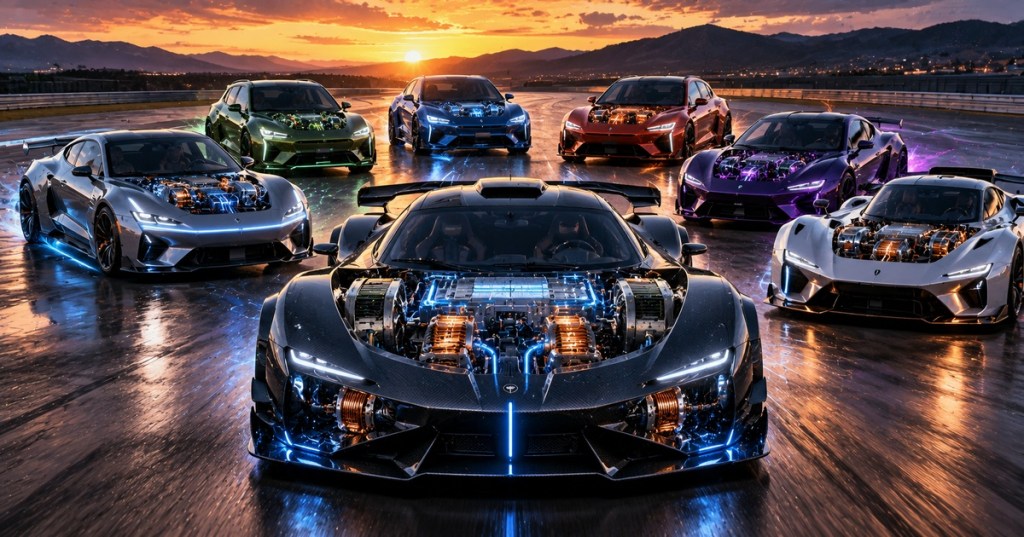
Electric performance has moved far beyond the old idea that EVs are quick only because they make instant torque. The strongest production electric cars now generate well over 1 megawatt of propulsion power, and the most extreme example is approaching 3,000 horsepower.
This countdown ranks production road-going battery EVs by total peak electric powertrain output, not by the rating of a single motor. That distinction matters because many manufacturers publish only combined system power. Announced concepts and cars that have not entered production are excluded. For the underlying power comparisons, we cross-checked current 2026 figures against EVspecs’ production-EV power database and manufacturer specifications.
| Rank | EV | Peak output | Motors |
|---|---|---|---|
| #7 | Xiaomi SU7 Ultra | 1,138 kW / about 1,526 hp | 3 |
| #6 | Rimac Nevera | 1,408 kW / about 1,887 hp | 4 |
| #5 | Pininfarina Battista | about 1,417 kW / 1,900 hp | 4 |
| #4 | Aspark Owl | 1,480 kW / 1,984 hp | 4 |
| #3 | Lotus Evija | 1,500 kW / 2,011 hp | 4 |
| #2 | Rimac Nevera R | 1,571 kW / 2,107 hp | 4 |
| #1 | Yangwang U9 Xtreme | 2,220 kW / about 2,977 hp | 4 |
#7 — Xiaomi SU7 Ultra
The SU7 Ultra is the outlier in this list because it is a four-door sedan rather than a seven-figure hypercar. Its three-motor system combines two high-output V8s motors with a V6s unit for roughly 1,138 kW, or about 1,526 mechanical horsepower. That makes Xiaomi’s production sedan powerful enough to sit beside machines built almost entirely around maximum performance. BitcoinVersus.Tech has also covered Xiaomi’s expanding performance-car presence.
#6 — Rimac Nevera
The original Nevera remains one of the defining electric hypercars. Four independent motors provide roughly 1,408 kW, with each wheel receiving its own drive unit and torque-vectoring control. The architecture matters as much as the headline number: Rimac built the battery, inverters, motors and control software as one tightly integrated propulsion system. That engineering base is still evolving, including new battery work covered in Rimac’s next-generation EV battery testing.
#5 — Pininfarina Battista
The Battista uses four electric motors and a Rimac-derived electrical architecture, but it is tuned as a luxury hyper GT. Its marketed output is 1,900 hp with more than 2,300 Nm of torque. The important point is that nearly two thousand horsepower no longer requires a giant combustion engine, multi-speed gearbox and mechanical all-wheel-drive system. Software can meter torque independently at all four corners.
#4 — Aspark Owl
Japan’s Aspark Owl remains one of the most extreme low-volume EVs ever put into production. Its four motors combine for roughly 1,480 kW, or 1,984 hp. The Owl is also a useful reminder that enormous motor output does not automatically translate into everyday usability: packaging, thermal control, battery discharge capability, tires and software all have to survive the same load.
#3 — Lotus Evija
Lotus targets 1,500 kW from four motors in the Evija, equivalent to roughly 2,011 hp. With one motor assigned to each wheel, the car can use independent torque control rather than a conventional differential. The result shows why four-motor layouts dominate the top of this ranking: they allow manufacturers to combine huge total power with very fine control over how that power reaches the road.
#2 — Rimac Nevera R
The Nevera R raises Rimac’s four-motor system to 2,107 hp. It is not simply the standard car with more boost. Rimac paired the higher-output drivetrain with a new 108 kWh battery, revised torque-vectoring software, more downforce, new brakes and a sharper chassis. That is the recurring theme at this power level: once the motors become powerful enough, the challenge shifts to batteries, tires, cooling and control.
#1 — Yangwang U9 Xtreme
The Yangwang U9 Xtreme sits in another category entirely. Its four motors are rated at 555 kW each, producing a combined 2,220 kW—about 2,977 mechanical horsepower, or just over 3,000 metric horsepower. The car also moves from an 800-volt architecture to a 1,200-volt platform, helping feed four motors that can spin to 30,000 rpm. BYD says the limited-production U9 Xtreme reached 496.22 km/h and became the first production EV in its class to lap the Nürburgring Nordschleife in under seven minutes. BYD’s technical release confirms the 1,200V system, four 30,000-rpm motors and more than 3,000 PS of combined output.
For comparison, BitcoinVersus.Tech’s recent ranking of the most powerful combustion engines shows how differently the two technologies reach extreme output. Combustion engines add cylinders, boost, fuel flow and mechanical complexity. EVs add motor count, inverter capacity, battery discharge power and cooling. The limiting component is increasingly not the motor itself but the system around it.
Bottom line: the most powerful EV in production today is no longer merely competing with combustion hypercars. The Yangwang U9 Xtreme has pushed electric propulsion beyond 2 megawatts, and the gap between ordinary performance EVs and the top of the market is now measured in entire megawatts.
BitcoinVersus.Tech Editor’s Note:
We volunteer daily to ensure the credibility of the information on this platform is Verifiably True. If you would like to support to help further secure the integrity of our research initiatives, please donate using the QR code provided

For best QR-code scanning results, please scan this donation code from a desktop or larger screen. Mobile screens may prevent camera recognition.
BitcoinVersus.tech is not a financial advisor. This media platform reports on financial subjects purely for informational purposes.


Leave a Reply