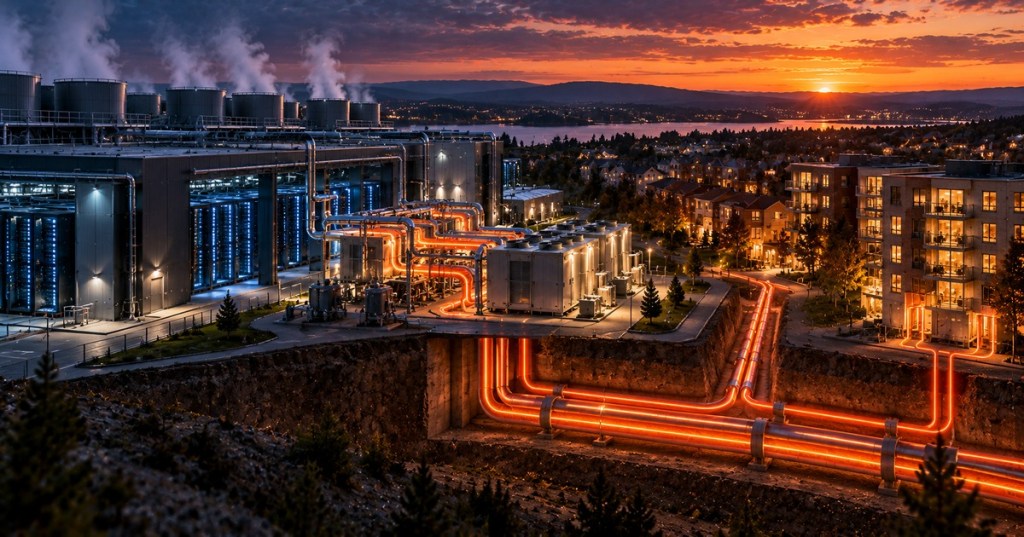
Yes—data-center waste heat can warm homes. In the right location, it is not even speculative. Cities in Northern Europe are already connecting data centers to district-heating systems so the heat produced by servers can be moved into homes, offices, and public buildings instead of simply being dumped outdoors.
The catch is that heat reuse only works when several pieces line up at the same time: the data center has to be near a heat customer, the temperature has to be useful or boosted with heat pumps, the district-heating network has to exist, and the economics have to beat simply rejecting the heat into the air or water.
The Short Verdict
| Question | Verdict |
|---|---|
| Do servers create enough heat to matter? | Yes. |
| Can that heat warm homes? | Yes. |
| Can every data center do it economically? | Nah. |
| Is waste-heat reuse likely to grow? | Yes. Especially where district heating already exists. |
Almost All Server Electricity Eventually Becomes Heat
A server does useful computation, but the electrical energy it consumes does not disappear. Processors, memory, storage, networking hardware, power supplies, and voltage regulators eventually release most of that energy as heat into the surrounding cooling system.
That means a large computing campus is also a large heat source. A facility drawing 100 MW can be rejecting heat on roughly the same order of magnitude, although the amount that is actually recoverable depends on cooling design, temperature, losses, auxiliary equipment, and how the heat is collected.
Bitcoin miners have already demonstrated the same basic physics at smaller scales. BitcoinVersus.Tech previously covered Canaan miners supplying heat for 2,800 Nordic homes. Data centers can use the same idea with CPUs, GPUs, AI accelerators, and liquid-cooling loops.
Finland Is Already Doing It
The City of Espoo says a Microsoft-Fortum data-center project is expected to cover about 40% of Espoo’s district-heating demand by recycling server heat into the municipal heating network. The project is designed to replace part of the heat that would otherwise come from fossil-fuel generation.
Espoo’s own project description makes the important point: the heat is valuable because the data center is being integrated with an existing district-heating system. The local network already has insulated pipes, heat customers, and infrastructure for moving thermal energy around the city.
The Heat Usually Needs An Upgrade
One of the biggest engineering issues is temperature. Server cooling water may leave a data center warm, but not always hot enough to feed directly into a district-heating network.
A heat pump can raise that temperature. Instead of creating heat from scratch, the heat pump uses electricity to move and concentrate existing thermal energy so it becomes useful for buildings. Higher-temperature liquid cooling can make this easier because it captures server heat in water rather than mixing it into huge volumes of warm air.
Liquid Cooling Makes Waste Heat More Valuable
Air cooling is good at keeping servers alive, but it often produces low-grade heat spread across large airflow volumes. Direct-to-chip liquid cooling and immersion cooling can capture heat in a denser, more controllable form.
That matters as AI racks become hotter. More concentrated thermal loads create a cooling problem inside the data center, but they also create an opportunity: if the heat is captured efficiently, the same cooling loop can become the first stage of an external heating system.
Distance Can Kill The Economics
Waste heat is not like electricity. Electricity can move long distances over transmission lines with manageable losses. Low-temperature heat is much harder and more expensive to move.
If a data center is far from homes, greenhouses, factories, hospitals, or an existing district-heating network, the cost of pipes, pumping, insulation, heat exchangers, and heat pumps may outweigh the value of the recovered energy.
This is why site planning matters. The same logic appears in BitcoinVersus.Tech’s recent off-grid data-center analysis: once power, cooling, storage, and local infrastructure are treated as one system, location becomes part of the engineering design rather than just a real-estate decision.
Europe Is Starting To Treat Waste Heat As An Energy Resource
The European Commission said in September 2026 that reusing around half of Europe’s total data-center waste heat could correspond to the heating demand of roughly four million households. Its new data-center efficiency framework specifically considers waste-heat reuse as part of how facilities interact with the wider energy system.
The Commission’s current data-center efficiency initiative shows how the issue is changing. Waste heat is increasingly being viewed not only as a cooling by-product, but as something that can be measured, reused, and potentially integrated into city-scale energy planning.
BitcoinVersus.Tech recently covered Europe’s move toward data-center energy and water labels. Heat reuse fits naturally into that trend because a facility that recovers useful thermal energy can deliver more total value from the same electricity input.
Does Reusing Heat Make The Data Center More Efficient?
It depends on what “efficient” means. Recovering waste heat does not necessarily make the servers use less electricity. A GPU still needs roughly the same electrical power to perform the same computation.
What changes is the usefulness of the energy after computation. Instead of paying to remove heat and then separately burning fuel or using electricity to warm nearby buildings, one energy flow can perform two jobs: computation first and heating second.
What About Summer?
Seasonality is another limitation. Homes need far more space heating in winter than summer, while data centers produce heat all year.
That mismatch means a heat-reuse project may need several customers with different demand profiles. Domestic hot water, swimming pools, industrial processes, greenhouses, absorption cooling, and thermal storage can all help use heat when residential heating demand falls.
So: Data-Center Heat For Homes, Or Nah?
Scientifically valid? Yes. Already working? Yes. Universal solution? Nah.
The physics are almost embarrassingly straightforward: data centers consume electricity, computers turn most of that electricity into heat, and that heat can be moved somewhere useful.
The hard part is infrastructure. The best projects will be the ones where data centers, heat pumps, liquid cooling, district-heating networks, and nearby customers are planned together from the beginning.
So this one is more yes than nah. The question is not whether server heat can warm homes. It can. The question is whether a particular data center is located and designed well enough to make the recovered heat worth using.
BitcoinVersus.Tech
Advertisement
Editor’s Note
We volunteer daily to ensure the credibility of the information on this platform is Verifiably True.
If you would like to support our research and publishing work, please donate here: 3C9o19EH5HSiwEPyCTmEKzxhNCbo2X6TTb
BitcoinVersus.tech is not a financial advisor. This media platform reports on financial and technology subjects purely for informational purposes.


Leave a Reply